What does the number of naloxone deployments reveal about Hamilton Township?
Nineteen.
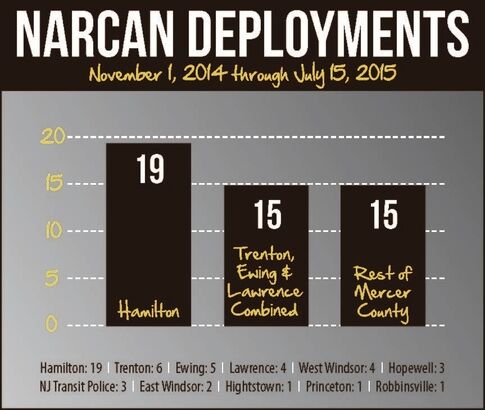
That’s the number of times Hamilton Township Police deployed an opioid antagonist called naloxone between Nov. 1, 2014 and July 15 of this year, according to the Mercer County Prosecutor’s Office. It’s also more than three times the amount Trenton police has used naloxone in the same time period, and as much as the police forces of Ewing, Lawrence, West Windsor, Hopewell, East Windsor, Princeton and Robbinsville combined.
It means that 19 times in eight and a half months, Hamilton Police officers responded to a call where they have had to assemble a naloxone kit—a vial of antidote, a syringe and an atomizer—and dispense it up the nostrils of an unresponsive person. Also known by the brand name Narcan, naloxone works only on someone who has overdosed on opioids—substances like heroin, morphine and Vicodin. Every second counts when attempting to combat an overdose with naloxone, a life-saving action akin to a using a defibrillator on a stopped heart.
HPD officers spent last summer training how and when to use naloxone, and they put their training to use as soon as the Mercer County Prosecutor’s Office launched its program Nov. 1, 2014. Countywide, there were four naloxone deployments in the first two weeks of the program. Lawrence Township had the first. The other three were in Hamilton: Nov. 7, to a 23-year-old male; Nov. 13, to a 22-year-old female; and Nov. 15, to a 24-year-old male.
Clearly, Hamilton Township has proven the $19,000 spent by the prosecutor’s office on 600 naloxone kits was a wise investment. But why has Hamilton used naloxone so much more than any other municipality in Mercer County?
Hamilton Mayor Kelly Yaede said people are using naloxone more in Hamilton because they know more about the program. Activists like Kevin Meara and Paul Ressler say the naloxone numbers prove an opioid epidemic is ravaging Hamilton. The only thing they agree on is that police have acted valiantly.
Yaede credits the high number to an aggressive campaign by the municipal government and HPD to raise awareness about naloxone on social media and in the community. Hamilton Police Capt. James Stevens also cited Yaede and Police Chief James Collins’ outreach efforts for creating awareness of what naloxone is and what police will do on an overdose call. Police have been sure to emphasize that all calls about drug overdoses will be anonymous, and that officers will only respond to aid in the care of the affected person. This is not unique to Hamilton; it’s the same procedure statewide.
HPD officers spend, on average, 80 minutes on a call involving a heroin overdose before being redeployed. Yaede said word of the police division’s work has helped people develop a level of trust with the police.
“In Hamilton Township, we are saving more lives,” Yaede said. “Hamilton Police are in the business of saving lives, and that’s what they will continue to do.”
Meara doesn’t dispute naloxone has saved lives. But he said those rescued are only a small percentage of those suffering from opioid addiction.
“It’s peeling back the skin on the onion,” said Meara, a township councilman. “You may have guessed there was a problem, or thought there was a problem. The Narcan statistics show there is a problem in Hamilton Township.”
Meara founded City of Angels, an addiction services nonprofit, in 2009 after his son KC died of an overdose. In his time with City of Angels, he has seen firsthand the scope of the opioid abuse problem in New Jersey. In Mercer County, heroin overdose deaths have increased 29 percent since 2011. In 2014, Mercer County had 6.2 deaths per 100,000 people, nearly three times the national rate, according to a July report by nj.com.
Meara said 15 young adults associated with City of Angels have died from overdoses or drug-related causes this summer. He attended nine funerals from May to July. Not all those people were from Hamilton, but many were, he said.
“It’s been devastating,” Meara said. “One is too many.”
Ressler also lost his son to a drug overdose. Corey Ressler died in 2010 at 22, after years of battling addiction. Following Corey’s death, Ressler started campaigning for a statewide Good Samaritan law and naloxone program. Both of those have become reality.
Ressler has made overdose prevention his career, starting The Overdose Prevention Agency Corporation last November. He has spent every day since training people how to use naloxone, and will give a free naloxone kit and training to anyone who asks.
As part of TOPAC, Ressler tracks naloxone deployments. He said the numbers reflect only the people lucky enough to get help in time.
“There are 19 deployments since November,” Ressler said. “That’s only reversals, and doesn’t count people who die on the scene. It doesn’t count people who die in the hospital. And it certainly doesn’t count Hamilton residents who died outside of Hamilton, like my son and seven of his friends—Steinert High School kids. Eight of them have passed away already. My son should be 27; he’s been dead five years.
“If [the mayor] doesn’t think 19 deployments is a problem, she needs to be removed from office, because kids are dying in this town. She doesn’t want any part of this issue. Young people are dying left and right.”
Yaede insists the deployment numbers reveal nothing about the severity of the opioid problem in Hamilton. Since Hamilton is the largest municipality in Mercer County, it’s only natural for the township’s Narcan deployment numbers to be elevated, she said. (Based on the county prosecutor’s numbers, though, Hamilton would still have the highest deployment rate in Mercer County when adjusted for population.) Yaede pointed to U.S. Attorney General Eric Holder’s assessment in 2014 that heroin overdoses were an “urgent public health crisis” as proof opioid abuse was a nationwide issue, not a Hamilton issue.
Township officials also cited a nj.com report from August that showed Hamilton had one of the state’s lowest rates of admission to treatment facilities for heroin abuse. The data showed nine Hamilton residents sought treatment for heroin addiction in 2014, a rate of 0.1 per 1,000 residents. Ewing Township had a rate of 1.83, by comparison. Trenton’s rate was 2.17.
This report may not paint a full picture, either. The data only includes patients who were admitted to facilities in-state, and relies upon the patients to report the correct municipality of residence. Anyone seeking treatment out of state was not included.
Meara said treatment beds in New Jersey are hard to come by, so those who can afford it often go out of state for treatment. There is a two-to-four week wait for admission to an in-state treatment center, and stays are being shortened due to the demand for beds. Beds in New Jersey are more scarce now than when he started City of Angels in 2009, he said.
And, of the people who receive treatment for addiction, only 2 to 5 percent will stay in recovery. The others relapse.
Meara feels the municipal government has done little to fight to addiction in the community.
“In Hamilton Township, there’s nothing being done about it,” he said. “Yet, we have press conferences about enterovirus and ebola and hepatitis. If you take the heroin and prescription drug overdoses in Hamilton, we have more than the ebola and enterovirus deaths nationally. I bet we spent more on administrative hours for hepatitis at one restaurant than we do on this heroin epidemic. Why there’s no response? I can’t answer it.”
Yaede said the township is acting. She has appointed township health and recreation department director Marty Flynn to a “next steps” committee formed by county prosecutor Angelo Onofri. The Hamilton Police will unveil a new prescription drop-off box at police station starting in September, an important step since prescription drugs often are a gateway to cheaper alternatives like heroin. HPD also has tasked its officers involved with the LEAD program and who serve as in-school resource officers with educating students about the dangers of street drugs.
But Meara said the township’s measures do nothing to help those already suffering from addiction, the people who have needed the naloxone deployments. He said the Hamilton Police should form a narcotics unit and establish standard operating procedure when dealing with a drug-related call that gets the patient into addiction treatment as soon as possible. The optimal scenario would be for the township to face the issue head-on. Instead, he said town leadership tries to ignore the issue.
“Some feel that mentioning there’s a problem will make people not want to come into the town and the school district,” Meara said. “But the head-in-the-sand attitude only makes the problem worse.”
There’s one thing everyone agrees on—the police have done well.
“There’s every possibility that those 19 could have been in the death column,” Meara said. “[Narcan is] doing what it’s designed to do.”
“Saving a human life, I don’t know if there’s any better reward than that,” Stevens said.
,

