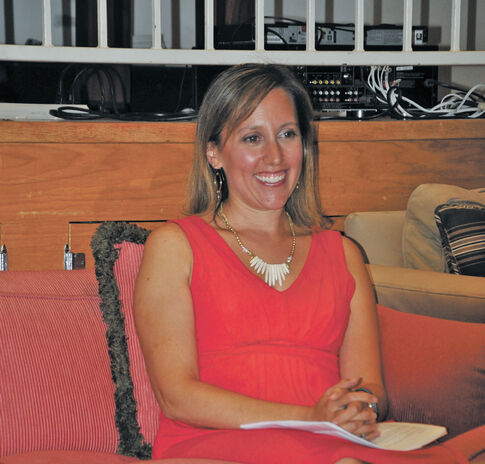
Rabbi Roni Handler has been hired by Temple Micah to succeed Rabbi Vicki Tuckman who died from cancer in April.
By Michele Alperin
Temple Micah has just hired its fourth part-time rabbi, Roni Handler, after experiencing the tragic loss of Rabbi Vicki Tuckman to cancer on April 7.
Although Tuckman was at Temple Micah, which meets at the Presbyterian Church of Lawrenceville for only two-and-a-half years, she created very strong personal relationships with her congregants, who are still wrestling with her loss.
“Rabbi Vicki was the most unique person I’ve ever known—she was warm, outgoing, incredibly smart, and funny,” said Larry Leder, the current board president. “When you interacted with her, it was like you were the only person in the congregation or the only person in the room.”
Leder said Tuckman also gently prodded her congregants to become better human beings: “She challenged you, questioned you, questioned your beliefs and attitudes. You couldn’t be in a comfort zone with her—she was always probing. You couldn’t just move along and repeat what you did yesterday.”
Bob Pollack of Lawrenceville, who was president of Temple Micah for 20 years, said of Tuckman, “Everyone who knew her felt they had a special relationship with her. She listened intently, never rushed anyone off; had time for everyone and everything.”
Barbara Weiner of Lawrenceville was drawn to Temple Micah by the free High Holiday services, but she stayed because she was fascinated by Tuckman. “I thought she was very inspirational; and I liked the way she conducted the service—it was comfortable, spiritual, and all seemed very real.”
Robin Williams of Lawrenceville recalls Tuckman as “a magnetic, charismatic person; even if you didn’t know her well, everyone thought she had an immediate personal connection with them.”
When Tuckman died, Williams adds, “it was like losing a family member because of the type of person she was.”
Because the community is still mourning Tuckman’s loss, the transition to having a new rabbi is complicated. For this reason Handler sees her role as first “grasping the community I am stepping into and the hole left by her passing.” Then comes “the holy work of a rabbi—for all of us to recognize what are those moments we are holding on to and how to lift them up.”
One path that allows people deal with their grief but at the same time move forward is through ritual. This is a natural for Handler, who first learned about the power of ritual during an internship at Mayyim Chayyim, a community Jewish ritual bath in Boston, while she was working on her master’s degree in Jewish communal service at Brandeis University. Since 2007 Handler has also served as editor of ritualwell.org, which makes available traditional and contemporary ceremonies.
During a women’s Rosh Hodesh group started by Tuckman that celebrates the new Hebrew month, Tuckman crafted an experience using Jewish themes and poetry that allowed the women to both express their sadness at losing Tuckman as well as their excitement about working with Handler.
Although Handler is facing a grieving congregation, it is one that grew much stronger under Tuckman in which doubled in size the religious school and put in place an adult education program.
“One of her legacies is that we have a much stronger community. She brought a resurgence of energy and enthusiasm into Temple Micah,” said Adrienne Rubin, cantorial soloist at the synagogue for 18 years.
When Tuckman was diagnosed with a cancer recurrence in January 2014 and had to step away from her rabbinical duties, everyone helped out—including Rubin; the Presbyterian Church of Lawrenceville, led by the Rev.Jeffrey A. Vamos; and the Temple Micah community. “The congregation sent a tremendous amount of love and good energy to her and by doing that they sent it to each other too,” Rubin said.
Looking forward, Rubin said the congregation is lucky to have found a rabbi as aware and emotionally prepared as Handler. “It is not a typical transition to a new rabbi; this was a congregation for which the rug was pulled out from underneath where they were standing,” Rubin said. “She is a relatively newer rabbi but she is so well grounded; and she also understands that this is our transition.”
From the congregation’s perspective, Pollack said, “It’s a new beginning. That’s the nature of life—it goes in cycles. People are looking for a way to move beyond.”
A member of the search committee, Weiner sees Handler as “very mature and capable” and said “she handles herself amazingly well.”
Also part of the search committee, Mary Kuller, the synagogue’s immediate past president, remembers when Handler walked into the interview. “She was like a breath of fresh air—all the gray clouds that had been hanging over us from when we learned about Vicki’s illness recurring lifted,” she said. “Roni was the medicine we needed; I was sold on her in the first 5 minutes of the interview.”
Although Handler has been an active Jew since she we as child in northeast Philadelphia, her first inkling that she wanted to study Judaism more deeply came at age 16 when she went on the March of the Living, a program that brings students from all over the world to Poland to study the history of the Holocaust and the roots of prejudice, intolerance, and hate.
Learning of the sense of hope that Judaism inspired even under the most difficult circumstances imaginable, she said she wanted “to keep those traditions alive and to connect with them because so many people died for them.”
A semester in Israel at Ben Gurion University, which exposed Handler to people who had so many different and equally passionate visions of what it meant to be a Jew, pressed her to explore Jewish identity even further.
Handler graduated from George Washington University with a degree in international affairs and a concentration on the Middle East. After getting her master’s degree at Brandeis University, she investigated liberal rabbinical seminaries and when she visited the Reconstructionist Rabbinical College in Philadelphia, she said, “there was something about the community here that felt really right. It was the people and the approach that I witnessed sitting in on classes—there didn’t seem to be an expectation that everyone coming out would look the same way and do the same thing.”
In addition to her work at Ritualwell, which Handler said gets 170,000 unique visitors a year, she is part of the team that engages with Reconstructionist affiliates and individuals and she also helps with recruitment to the Reconstructionist Rabbinical College.
One thing that has particularly impressed Handler at Temple Micah is how participatory the congregation is. “They take a lot of pride in that,” she said. “They want a part-time rabbi and also to do it themselves, whether it is organizing educational programs and communal gatherings or taking out the trash and setting up chairs.”
Temple Micah has been in Lawrenceville for 46 years. Leder, a Temple Micah member for 22 years, said he was drawn there for many reasons: its eclectic approach; the diversity of the congregants; warmth; humor; a sense of welcoming; and its openness to interfaith marriage.
The congregation was founded in 1969 by “a bunch of liberal Jews,” who needed something a little different from traditional congregation, said Pollack. Before Tuckman, Rabbi Albert Ginsburgh and Rabbi Ellen Greenspan each served as Temple Micah’s part-time rabbi for 20 years.
Temple Micah’s has called Lawrenceville home many years, its one-year trial having extended to a 46-year stay. In 1969 Reverend H. Dana Fearon of the Presbyterian Church of Lawrenceville, approached by Temple Micah leader Harry Kihn, thought members of his church, founded in 1698 as Maidenhead Church on a land grant, would benefit from exposure to another religion and to people with different cultural backgrounds.
Kuller was a little nervous at first about meeting in a church, but she fell in love with the space at the Presbyterian Church. “The main sanctuary is this beautiful, plain white—a typical colonial worship space and very easy to convert to a synagogue.”
For Weiner, Temple Micah is like a long-sought treasure. “I felt like I looked my whole entire life for a spiritual connection and I finally found it.”
A meet and greet for Rabbi Handler, open to existing and prospective members, will be held Sept. 1 (rain date: Sept. 2), from 6 to 8 p.m. at Village Park’s Bergen Street entrance in Lawrenceville. To register, visit meetrabbironi.eventbrite.com.
,

