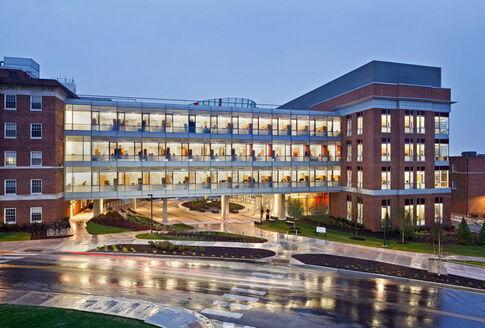
The New Jersey chapter of the American Institute of Architects (AIA-NJ) has presented the Lawrenceville office of HDR with a Merit Award in the Built Open category for its design of the Physical Sciences Complex at the University of Maryland in College Park, MD.
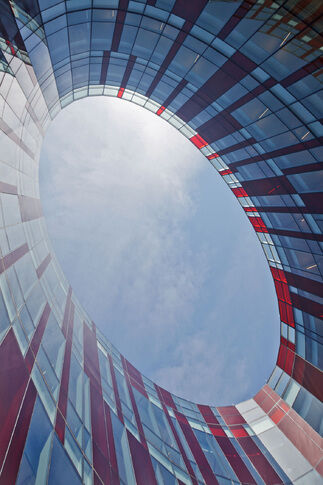
The focal point of the design of the Physical Sciences Complex is an inverted elliptical glass cone that begins in the atrium and extends to an opening in the roof, providing natural lighting.
The New Jersey chapter of the American Institute of Architects (AIA-NJ) has presented the Lawrenceville office of HDR with a Merit Award in the Built Open category for its design of the Physical Sciences Complex at the University of Maryland in College Park, MD.
The new complex will serve the school’s College of Computer, Mathematical and Natural Sciences. Part of the institution’s new campus master plan, the building itself weaves several disciplines together into one environment. One of the largest building projects in the university’s history, the complex’s central location guarantees its status as a new campus landmark.
HDR provided architecture, engineering and design planning services for the 160,246-square-foot complex, which includes three below-ground stories and houses more than sixty laboratories, including those devoted to lasers, nanotechnology and physical sciences. Some space is used in collaboration with federal agencies, including the Joint Quantum Institute, a partnership with the National Institute of Science and Technology; the Joint-Space Science Institute, a partnership with the NASA-Goddard Space Flight Center; and a collaboration between the National Institutes of Health and the University’s Institute for Physical Science and Technology.
The building’s first three levels feature an open atrium, faculty offices, conference facilities and collaborative spaces. In addition, the building includes an accessible roof garden. The focal point of the design is an inverted elliptical glass cone that begins in the atrium and extends to an opening in the roof, providing natural lighting. In addition, floor-to-ceiling central glazed windows allow students and faculty to see into the lobby when walking towards the complex.
The design creates an atmosphere that encourages scientific interaction; both the wide corridors and a spiral staircase between the first and second floors serve to promote conversation. To further encourage creativity, the walls of public areas and corridors feature whiteboard and chalkboard surfaces on which students and researchers can write down ideas.
Sustainable features of the LEED Gold-certified building include a green roof, innovative wastewater technologies, an energy-efficient HVAC distribution system and solar shades that reduce sun exposure.
,