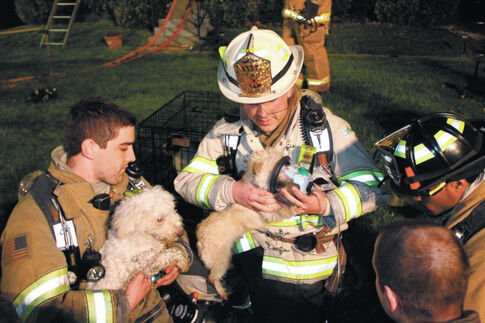
Lawrence Road Volunteer Fire Co. firefighters Chris Laird, Richard Laird, James Brundage, and Wayne Hannon Jr. administer oxygen using a pet mask during a house fire in Hopewell.
By Pat Summers
Hearing of a house fire, you hold your breath, hoping everyone got out safely. But then, your heart sinks when you learn “Two family cats did not survive the fire,” or “The family’s pet dog died in the blaze.”
If those animals were recovered during the fire, what could have made the difference, helping them live instead of die, and saving their families heartache and guilt?
Pet oxygen masks might have saved them.
Relatively new in first responders’ arsenal of lifesaving tools, pet oxygen masks keep firefighters, EMS squads and police from having to improvise — adapting human oxygen masks for pets — when every second counts in reviving an animal suffering from smoke inhalation or any other respiratory emergency.
Pets who live in Lawrence are lucky: the township is one of the leading municipalities in Mercer County in having, and using, pet oxygen masks, according to officials. Each of the three fire companies in town has two kits, each with three different-sized masks, for use in fire trucks. And there’s one kit in each of three ambulances.
The typical human oxygen mask covers only a person’s nose and mouth, with tubing connecting that part to an oxygen tank. An alternative means of delivering oxygen is via nasal cannula, or tubes into the nose. Neither of these configurations works for pets, whose heads come in various sizes and shapes, and who would probably fight the cannula.
Instead, for animals who are conscious and breathing on their own, one of three sizes of pet mask will fit, allowing oxygen to be absorbed through normal breathing while forcing carbon monoxide out. For the pet to get 100 percent oxygen, the whole head should be inside the mask, with its rubber seal around the neck.
For nonresponsive or unconscious pets, the mask is adapted and used with an “ambu (resuscitation) bag” instead of the oxygen tank. If there’s still no pulse, animal CPR performed by two rescuers comes next. Reusable, pet oxygen masks can also deliver life-saving oxygen to other pets, as well as farm animals, and they’re easily cleaned between uses.
Chrissie Vincent, chief of Lawrence EMS, said she remembers an unsecured pet who was riding in the front seat of a car that was in an accident. The dog hit the dashboard and was unconscious on the floor, needing to be stabilized with oxygen before being transported to a vet. Ducklings rescued from storm drains have also benefited from the masks.
Lawrence Township firefighters’ involvement with pet oxygen masks began with a Ewing house fire in September 2011. Responders from Lawrence and Ewing saved a dog in that blaze, and in recognition, pet oxygen masks were donated to companies in both towns in January 2012. For a house fire in April in Hopewell, 22 dogs and puppies were saved — becoming in effect, poster pups for pet oxygen masks — thanks in part to the pet masks Lawrence responders brought with them.
With their value clearly established, pet masks became standard equipment in emergency vehicles, said Jack Oakley, director of Emergency Management for Lawrence Township, because “the pet’s life they save may be your own.” That’s the slogan of Wag’N fur life, LLC (wagn4u.com), whose masks are used.
You can’t miss the pet mask kits — and that’s the idea. They’re easy to spot and grab. A bright orange nylon bag with a drawstring, stamped in black with “WAG’N, oxygen fur life, Pet Oxygen Masks” and a logo, each kit holds small, medium and large masks and oxygen tubing; an orange kennel lead (because dogs rescued in fires are unlikely to be wearing leashes); logo decals saying “pet oxygen masks on board”; and training materials — a 10-minute video and a laminated card with specifics.
Another tool firefighters use to save pets is window decals signaling that pets are inside a stucture that’s on fire. The problem is that sometime the pets are no longer there, and the residents haven’t removed or updated the decal. Searching for non-existent animals during a fire wastes vital time.
Given that there are at least 3,000 licensed cats and dogs in Lawrence as possible beneficiaries of responders’ pet oxygen masks — and that figure doesn’t include rabbits, gerbils and guinea pigs, birds, reptiles and rodents — current pet-alert decals can be invaluable aids. (To obtain a free ASPCA “Animals Inside!” decal and an Animal Poison Control Center magnet, go to aspca.org/form/free-pet-safety-pack.)
With pet food options and formats ever-expanding, pet health care that offers sophisticated surgeries and medical procedures until recently available only to humans and a wide world of “pet welfare” that includes spas, camps and sitters, catios, pet furniture and clothing, it should come as no surprise that now there are pet oxygen masks too.
Pet lovers want their pets to have the best lives possible — and the longest lives too. Pet oxygen masks can help assure that.
“They’re a testimonial to how important pets are,” said township manager Richard S. Krawczun. “They further support our emergency operations when we respond to protect lives and property.”
,

