Stanley Switlik II, far left, runs The Switlik Parachute Company on East State Street on the Trenton-Hamilton border. His daughter, Sarah Switlik, markets it.
The Switlik Parachute Company, headquartered on East State Street on the Trenton-Hamilton border, is now less about parachutes but still about keeping people alive. Most recent the company has been assuring that soldiers encountering problems flying in helicopters over the ocean are able to wear lifejackets buoyant enough to keep them afloat even with burdensome equipment — making, since 2001, 30,000-plus special life vests for armored marines, along with many other kinds of life rafts and survival equipment for the military companies
Civilians benefit too. If you fly on United Airlines, Swissair, Qantas, or Korean Airlines, odds are the inflatable lifejacket stowed under your seat cushion (which doubles as a flotation device in the event of a water landing) was made by Switlik. The company also makes flight suits, life rafts, and survival suits.
But it is Switlik’s innovations during World War II that distinguishes it as a Trenton company to remember during Veterans Day.
Switlik has been in the business of saving lives almost since it was founded in 1920 by Stanley Switlik, a Polish immigrant to Trenton. From the 1920s through the early 1980s, it made parachutes. The company culture reveres its parachute making past, and its logo still incorporates a parachute even though it hasn’t made one since 1981. Switlik made 70 percent of all American parachutes during World War II, which saved the lives of thousands of aviators. The company is still in the family, and is now on the fourth generation of Switlik owners, with Stanley Switlik II running the company and his daughter, Sarah Switlik, working in the marketing department.
Stanley Switlik arrived in Trenton and immediately began a series of business ventures, including a real estate office. In 1920 Switlik borrowed $500 from his brother and bought a failing canvas factory at 241 South Warren Street called the Canvas Leather Specialty Company that made many leather and canvas products including a small line of flying suits, masks, and belts for the nascent aviation market.
Switlik expanded the aviation part of the business and in 1925 decided to team up with his friend Floyd Smith, the inventor of the ripcord, to start making parachutes. Parachutes had been around since the early days of balloon aviation but were not usable from airplanes. The ripcord parachute developed by Smith and Switlik allowed the possibility of jumping from a plane during an emergency.
Switlik quickly became a major supplier of parachutes for the military and for civilians. Amelia Earhart was photographed in 1934 wearing a parachute with “SWITLIK” printed on its straps.
Switlik was responsible for another major innovation in parachute safety — the jump tower. Until the 1930s, parachutes were tested by throwing dummies out of planes. A plane trip was also required in order to learn how to use a parachute. Switlik pioneered the parachute tower, which allowed test dummies and humans to be hoisted by cables to a height of 146 feet and dropped at much less cost than flying an airplane. The first human test of the tower, located in Jackson, was made by 16-year-old Richard Switlik, heir to the family fortune.
Switlik’s heydey came with the arrival of World War II. The company geared up to meet military production goals. Not only did pilots need parachutes, but the Army was organizing entire divisions of soldiers who would parachute into enemy territory — paratroopers. They also needed specialized parachutes for different types of aviators. For example, the B-17 Flying Fortress bomber had a spherical gun turret tucked into its belly where a gunner would crouch in the fetal position. There was no room for a backpack in there, so ball turret gunners needed a compact parachute they could strap to their chests.
Switlik ramped up to the challenge, enlisting the help of other Trenton-area companies to make component parts, and opening secondary locations in Brazil to further increase production. Soon after Pearl Harbor, the company was making 2,500 parachutes per week. Switlik was one of the first recipients of the coveted Army-Navy “E” award for excellence in production. It was also among only a handful of plants in the entire country to earn the award every year America was engaged in the war.
Michael Dilts, CFO and something of an unofficial company historian for Switlik, says the parachute maker had about 800 workers in its factory during the war, and about 3,200 more people in other companies throughout the greater Trenton area were involved in supporting the company’s parachute making efforts.
Switlik contributed to the war effort in other ways besides manufacturing. Stanley Switlik sold his patents to the government for $1, allowing other manufacturers to use his pioneering designs. The Switlik models became the standard parachutes used by the military, Dilts says.
The Navy pilot George H.W. Bush, after being shot down over the Pacific, bailed out with a Switlik parachute.
Switlik was also involved in a top-secret project that was used during the Allied invasion of France in 1944 — the creation of fake paratroopers to confuse German defenders. The PD Paradummy was a four-foot-tall inflatable rubber fake paratrooper equipped with a Switlik parachute, a CO2 inflation bottle, an explosive noisemaker to simulate gunfire, and a block of TNT explosives. The “PD packs” were assembled at the Switlik factory under a veil of secrecy.
In August of 1944, when American troops attacked southern France following the D-Day landings, planes dropped thousands of the PD dummies behind Nazi lines. As each paradummy descended, its noisemaker went off to create the sound of gunfire all over the battlefield. When the dummy landed, the TNT charge would explode, leaving nothing for the Germans to find but a parachute — just like they would if a real paratrooper had landed and then run off. To the garrison below, it seemed like a real paratrooper invasion.
The deception sowed chaos behind the lines and helped divert German troops to respond to the fake attack rather than the real amphibious landings that were taking place at the same time.
During the war, Switlik’s Caterpillar Club gained thousands of members. The Caterpillar Club is an association of people who have parachuted out of an aircraft in an emergency situation. Members get a gold caterpillar-shaped pin and a certificate. Switlik and several other parachute manufacturers maintain caterpillar clubs, and Switlik’s continues to this day even though the company no longer makes parachutes. To apply to the club, potential members must fill out a form and briefly write the story of their escape from death. The East State Street factory houses the records of most of the 14,000 Caterpillar Club members.
Dilts says after the war, Switlik’s operations were scaled back dramatically, but the military still needed many kinds of parachutes during the Cold War era. For example, the most powerful nuclear bombs required parachutes — euphemistically called “special weapons” parachutes — to slow the descent of the bomb to give the bomber time to get away from the blast. Switlik also made parachutes designed to slow aircraft upon landing. Chutes made by Switlik in Trenton brought NASA space capsules safely back to Earth.
Switlik began to switch away from parachutes during the Vietnam War. The widespread use of the helicopter to move troops meant that the days of the mass paratrooper assault were over.
Photos of the Switlik factory in the 1940s show ranks of women in white uniforms seated at sewing machines, stitching miles of cloth together. In some places, the factory looks exactly the same. Dilts says the white dresses worn by the sewing machine operators are the same as they were during the war era. Even the black old-fashioned sewing machines are the same in many cases.
Despite that turbulent era, the company has survived by modernizing its production lines. Many processes that used to be done by hand are now automated by sophisticated machines. One of the newest additions to the factory is a Gerber cutting machine that automatically slices patterns out of material 25 layers thick and punches holes and cuts notches where needed. The machine also arranges shapes on the cloth like a giant jigsaw puzzle so that the bare minimum amount of fabric is wasted. Dilts says wastage is a very important consideration when waterproof Gore-Tex Nomex fabric is $100 a yard.
Part of the plant is devoted to production, and the other half is for testing the equipment to make sure it meets rigorous standards. Many of the flight suits made there are g-suits, which help fighter pilots resist the high gravitational forces (g-forces) of violent maneuvers during aerial combat. Air bladders in the suit automatically inflate during high-speed turns, forcing blood to stay in the pilot’s head, thereby delaying g-induced blackout.
Switlik employs about 115 people on the edge of Trenton long after many manufacturers have abandoned the city for cheaper labor overseas. Dilts says the company has no plans to leave its current location. “We live here and we work here and we want to stay here as long as we can,” he says. “We will do whatever we can to make it a viable living company not only for the owners, but to the employees who work here.”
Switlik Parachute Company Inc., 1325 East State Street, Trenton, switlik.com.
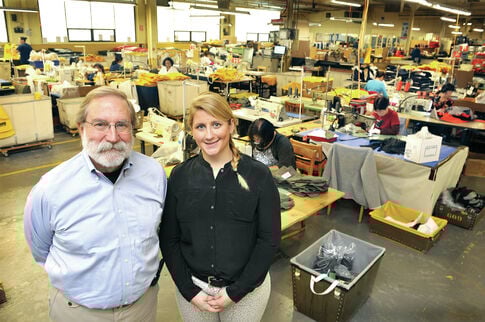
Stanley Switlik II, far left, runs The Switlik Parachute Company on East State Street on the Trenton-Hamilton border. His daughter, Sarah Switlik, markets it.,

