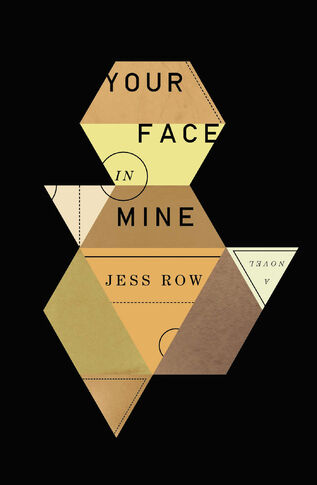
The harsh reality about writing books is that it is rarely a self-sustaining profession. Even many critically acclaimed authors find themselves working full-time jobs in addition to their writing.
Jess Row is one such writer. His novel, Your Face In Mine, published in August, has earned notice from The New York Times, the New Yorker and other publications. But for now at least, he remains a teacher as well as a writer. For the past nine years, he has been mentoring creative writers at The College of New Jersey, in Ewing, where he is a tenured associate professor.
Your Face In Mine is a daring novel that explores what would happen if people had the option of getting “racial reassignment surgery” to alter their race. The story’s narrator, Kelly Thorndike, meets up with an old friend, formerly Martin Lipkin, now Martin Wilkinson, who has undergone the surgery to change himself from white to black. In the novel, Row explores the political and social implications that such a procedure would bring.
This sort of charged idea is not unusual for the Washington native, a graduate of Yale University and the University of Michigan. In his stories he often writes about what happens when members of different cultures or social strata come together.
Many of Row’s stories are set in Asia, where he has traveled extensively. Row spent two years in Hong Kong, teaching English to Chinese students. He is the author of two collections of short stories, The Train to Lo Wu and Nobody Ever Gets Lost, and a recent short story, “The Empties,” was published in the Nov. 3 issue of the New Yorker.
He and his wife, Sonya Posmentier, lived for six years in Princeton, but have recently moved to New York City. They have two children. He will be doing a reading from his novel Feb. 4 at noon in the TCNJ library auditorium.
Ewing Observer: Everything of yours that I have read, including Your Face In Mine and “The Empties,” is socially conscious fiction. Have you always taken this approach or is that something that developed over time?
Jess Row: That’s not the first descriptor I would use, socially conscious. The world of my fiction is a politicized world because that’s my general experience. I think part of what’s happening in America today is we see that every aspect of our lives has become, in some sense, part of some kind of political argument.
A friend of mine was just complaining on Facebook about how a discussion about city planning, a discussion about whether there ought to be sidewalks in a part of town, became a discussion about the politics of pedestrians and cars. When I say that my worldview is a politicized worldview, it’s a reflection of that level of fundamental disagreement and antagonism about the most basic constituents of our lived experience.
EO: Culture clashes are often a theme or an inciting factor in your work. Did your experiences abroad help you establish an ethos as a writer?
JR: When I went to Hong Kong right after college, I had the sort of romantic idea of what being an expatriate writer was like. I didn’t have any concept of what it meant to live overseas or in Asia.
Only after going there did I really have a sense of why I had done that. I had this sense in college that I needed to step outside of what was comfortable for me. It really began with my sense of there being something missing, something unarticulated and lacking in my own upbringing, my own sense of cultural origin.
I was trying to define myself by “othering” myself, by experimenting, by taking on other identities. Once I came to realize that about myself, it became a hallmark of my writing — characters, especially white characters, who can’t quite explain who they are or where they belong.
EO: The popular new podcast, Serial — which like Your Face In Mine is set in Baltimore — has come under fire from some members of minority groups because the reporters and producers are all white, and the people they are covering are mostly of color. When you were writing your novel, did you worry about authenticity, or white privilege?
JR: I worried a lot about it before I started, and in the early stages. Then once the novel was rolling along, I had to put those fears aside, because I was already in so deep. I think part of what I had to accept is that some people were going to dismiss it out of hand, and frankly I’m glad that so many people were able to get over their discomfort.
The book is all about white privilege and whiteness itself, the paradoxes and the gaps and the unarticula
ted assumptions within white identity. It’s also about the very desperate longing some white people have to escape white identity, and their willingness to use radical means to do so.
What I was trying to do in Your Face In Mine was think through what would happen if that desire was taken to its furthest extreme, and also what would happen if this was something that was opened up to anyone.
EO: In your short story “Amritsar,” a white character takes it upon himself to “protect” his Indian neighbor from possible harm after the Sept. 11 attacks, even though the neighbor is a Sikh and not a Muslim. Do you think that we can work toward better mutual understanding?
JR: There’s a huge cultural gulf and gulf of identification between them, but at end of the story they have both learned something about each other, have a sympathetic coming to terms with one another. I think one of things really missing from the American conversation about race is that if you spend enough time here, and have any sense of what American life is like outside your own community, you have to acknowledge that Americans have a kind of family relationship with one another. The differences and historical burdens and liabilities that we have bind us together, even if we’re on opposite sides, oppressor and oppressed.
The fact that we’ve been locked in that relationship — it makes us family, in a way. We don’t want to admit that family can be such a hurtful, dissonant and damaging thing, but everyone’s family is like that.
There has to be some capacity to say this is problematic or this is insulting or this demonstrates a kind of unconscious prejudice, but without dismissing it or saying it’s beyond the pale.
EO: You’ve been teaching at TCNJ for 9 years. How did you come to settle in this area and why have you stayed?
JR: I was teaching at Montclair State for 3 years before TCNJ. Then my wife left her career as high school teacher and went back to get a Ph.D., and she got into Princeton. The next year, the job opened at TCNJ. So it was perfect timing. We were able to live in Princeton, have our kids, and I could commute to a job 20 minutes away.
Really the reason I’m still there is that I love TCNJ. What I like about TCNJ is that it really offers a very high quality education that is accessible to a lot of kids who are perfectly qualified to go to a place like NYU or Oberlin or Sarah Lawrence.
EO: Have you seen students’ writing change over time?
JR: It has changed dramatically. Just even in the past 4 years or so, I’ve noticed a marked turn toward fantasy, and toward writing novels rather than short stories. Nine or ten years ago, it was really unusual to have student in fiction workshop class student writing a novel. Now I have at least half of my students come into the class wanting to write a novel.
I’m not sure exactly what to attribute that change to. I think that certainly that proliferation of popular fantasy literature like Harry Potter and The Hunger Games and Game of Thrones has something to do with it. I think it’s interesting that prose fiction is still something that’s interesting to people in their teens and twenties. These are kids who frankly don’t read a lot of prose fiction. Yet they still want to write it.
EO: Do you find that students are receptive to feedback and edits?
JR: I do. I think one of the great things about teaching at TCNJ is that students don’t come to a writing workshop with a sense of entitlement. The sort of cliché about millennials that they’re all told that they’re brilliant from day one, that they’re self-esteem junkies. TCNJ students don’t fit that description, they never have. Students who choose to go to TCNJ are serious and dedicated and have a kind of earnestness that I think is really wonderful.
EO:Your Face In Mine ends in such a way that one could say the characters’ journeys are really just beginning. Are you finished with these characters, or might you write about them again?
JR: I’m finished with them. It could always be that the book has a second life, as a cable series or something like that, it could go on. In fictional terms, though, I’m done with them.
EO: What’s next for you?
JR: I’m working on a new novel and the collection of stories that “The Empties” is a part of. Right now I’m formalizing a new two-book contract with Ecco, part of HarperCollins. This collection of stories, called Storyknife, is part of that book contract. That collection is more or less finished.
The novel I’m working on is called The New Earth. It’s kind of a big-picture family story, with a lot of characters, a lot of different voices. It’s a big project I’m going to be involved in for a long time.
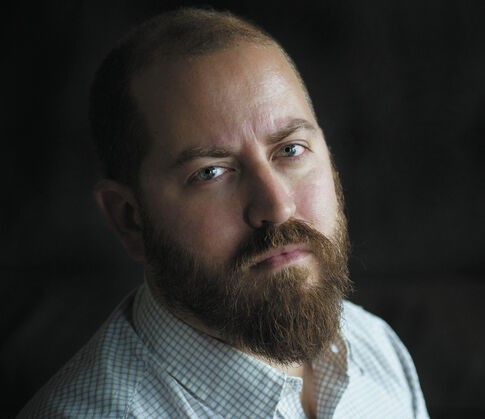
Jess Row,