Town crews use new anti-icing methods in 2015
Last year, the Advance reached out to Robbinsville Department of Public Works director Dino Colarocco to find out how crews deal with winter weather in the township.
We recently checked in with Colarocco to see if anything had changed for 2015. Sure enough, it had, with crews adding a new tool to its anti-ice arsenal.
What follows is the township’s winter weather protocol, broken down into five tips:
When do township crews apply salt to the roadways?
When the township receives a winter storm forecast, Robbinsville Township employees use six dump trucks to apply salt to the roadways. The township’s anti-icing policy includes spreading salt as early as possible to prevent snow and ice from bonding to the pavement and to keep it in a plowable condition.
Robbinsville has approximately 84 miles of roads that are township responsibility. It takes about 3-1/2 to 4 hours to apply rock salt to all of the roads in the township. Route 33, Route 130, Robbinsville-Edinburg Road, Robbinsville-Allentown Road, Church Street, Windsor Road from Main St. in Windsor west and Old York Road are all either state or county responsibility.
This year, Robbinsville Township began using treated rock salt for anti-icing. The salt is treated with magnesium, which melts snow and ice at temperatures as low as minus-20 degrees. It is also a safer and less corrosive alternative than calcium chloride treated salt, Colarocco said.
Brine can be applied well ahead of the onset of forecast frozen precipitation and is significantly less expensive than most other chemicals used for anti-icing. But Colarocco said it remains to be seen whether it is effective on local roads. Brine needs traffic to dissipate the melted snow, or else it becomes diluted and, in colder temperatures, can freeze. The roads would then have to be salted, Colarocco said, creating twice the amount of work DPW does currently.
What about plowing?
When a weather forecast calls for two or more inches of snow, plows are installed on all township trucks and equipment. Once plowable snow accumulates on the pavement, Robbinsville Township employees begin plowing on all primary roads. On the primary roads, crews attempt to keep the roadway clear of snow from curb to curb. Primary roads are maintained in a passable condition throughout the entire storm.
Once the primary roads have been deemed passable and that condition can be sustained with fewer resources—usually when the snowfall ends—the plows are sent into secondary and residential roads. Development streets are also plowed from curb to curb, but driveways will not be cleared.
Currently, there are 18 trucks, one loader, one backhoe and one tractor the township owns and utilizes for plowing. During heavier snow accumulations, township sanitation trucks can be used as plow vehicles. Private contractors may also be used.
Don’t keep your car in the street when it snows — it’s illegal
If possible, remove your vehicle from the street whenever plowable snows are forecast. Not only do vehicles parked along the curbs make it difficult for plows to clear the roads, but township ordinance prohibits parking on any street in Robbinsville whenever enough snow has fallen that it covers the roadway.
The prohibition stands until streets have been plowed to the extent that parking on them would not interfere with the normal flow of traffic. Any unoccupied vehicle in violation of the ordinance can be removed by the police, at the owner’s expense.
Colarocco also recommended removing portable basketball hoops, hockey nets and the like from roadways to avoid being damaged by snow plows.
You can avoid that plowed-in driveway
Township crews do not clear driveway openings, and snow may be deposited in front of driveways by trucks during plowing. Colarocco said residents should clear snow from the area of the roadway adjacent to the curb that is left of their driveway when looking at the street from their property. Most of the snow being carried by the plow will drop off in that area before reaching the driveway, preventing a build-up in front of the driveway.
However, it is sometimes necessary to plow roads more than once, and residents, therefore, may have to open up their driveway more than once.
Property owners are responsible for clearing their sidewalks
Just don’t put the snow in the street.
Township ordinance prohibits shoveling or blowing snow into the roadway. Not only does it defeat the purpose of plowing, Colarocco said, but it can create unsafe conditions for drivers. All shoveled or blown snow should be piled in your yard or in the area between the curb and sidewalk. People found violating the ordinance may be issued a summons or fine.
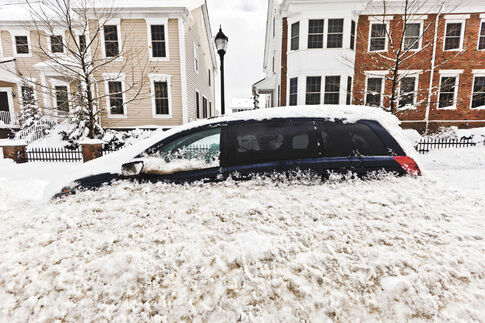
Township code prohibits parking on any street in Robbinsville whenever enough snow has fallen that it covers the roadway. The law is meant to allow crews to clear roadways of snow, but it can also save vehicle owners a headache like the one pictured in Town Center after township crews plowed in a van during a Jan. 27, 2011 storm. (File photo by Suzette J. Lucas.),

