By Gabriela Imreh
The year was 1985. I was a 21-year-old piano student and orchestra performer in the music conservatory in the town of Clouj-Naboca in the Transylvania region of Romania, a Soviet bloc country under the iron rule of communist dictator Nicolae Ceausescu.
On this one particular April afternoon, we were herded into the old recital hall in the conservatory that was once a month used for Communist party meetings.
We all sighed when Professor Ninuca Osanu Pop, the “secretary” (the highest member of the party in the conservatory, also the dean) waddled to the front of the room, carrying enormous volumes of communist nonsense.
Huddled together in a couple of rows towards the back of the room, we extracted the books from our bags that we had smuggled in to help pass time during the meeting. These things would go on for hours and hours, and nobody paid attention to us anyway.
But this time I was not reading. The pages in front of me were a blur — words jumping around. I was totally overwhelmed.
It was Thursday, and the Sunday before, just about at midnight, in a town eight hours away called Ploiesti, I had secretly married an American man — in the bedroom of an Orthodox priest, a family friend, with curtains tightly closed, and Mother as the only witness. Despite the potential repercussions, we had decided to marry before he had to leave the country.
By Wednesday, my new husband, Dan Spalding, left Romania. His already-extended visa expired, and he had to return to the United States.
Sitting there in the meeting room, it all seemed like a dream, a fairy tale, so close and yet so hard to believe.
Our story started when Dan, 5,000 miles away from his own home in the U.S., was conducting in Romania, studying under the wing of the celebrated chief conductor of the Bucharest Philharmonic, Mircea Cristescu.
Several months before, I had played the “Emperor” (piano concerto) under Cristescu’s direction on a televised series featuring the complete Beethoven concerti. After our concert, he mentioned that later in the year he was coming through Cluj and would be accompanied by a young American conductor.
I didn’t gave it another thought until Cristescu was in town and called to ask if I could come to his concert that night and meet “the American” afterward.
I dreaded it. I didn’t speak English and was in no mood to meet any man. Plus I found it to be a bit presumptuous of him to assume that I would just jump to give guided tours to his prodigy, American or not. To be the designated “girl” of the day. Regardless, though, it was hard to say no the maestro.
I remember little about the concert that night. My thoughts were lost in worries about school, my mother, and other life problems. My piano teacher had defected to Germany at the beginning of the academic year, and I was getting through my last year at the conservatory on my own. I didn’t know where I would be “posted” when I finished my studies, and my mother was ill.
After the concert, I slowly made my way backstage. Hordes of people were going both ways — musicians leaving, dressed in big, heavy winter coats over their black gowns or tails, carrying beat up instrument cases, while members of the public were elbowing their way through to the opposite side in order to congratulate the conductor or soloist in the green room.
I looked up and there was a very handsome, tall man, with the bluest eyes, a tentative smile on his face. I remember thinking that this must be “him.” Even though he was wearing a very customary brown sheep skin coat and indigo wool scarf — something that could be worn by any Romanian, there was something quietly strong, an unknown quality about Dan, that set him apart immediately.
After the concert, Maestro Cristescu, Dan and I made our way to our apartment for a nightcap. My mother had only two kinds of days anymore, bad and really bad. That day had been really bad. My father was out of town for a few days on business, and she was in terrible pain. This late night visit was the last thing she needed. But again, there was no saying no to the maestro.
Fortunately, she enjoyed Cristescu. He was good to me, always cheerful, and gallant toward her. He was also full of gossip from the music world, telling stories of his career. She was an avid music lover, an astute observer, had a phenomenal memory for music and was able to hold long and intense conversations with Cristescu.
I spent most of the time during the visit helping out my mom, while my brother, pretty fluent in English, entertained the “American,” happy to practice his language skills and to talk to a foreigner. I guess it was a relief for Dan too; it must have gotten pretty old to manage with the few words in Romanian he picked up. I got a few glances of him in transit — he was laughing, relaxed, showing a wide, sincere smile, but that was about it for the two of us.
The next day the maestro made a call to our apartment and asked if I could see Dan again. I was surprised. I thought the night before was the end of it all. I made an excuse and declined.
One more day passed. I was practicing, when Cristescu, in the now-well-rehearsed-role of “ambassador” called again — something about Dan being invited to a party given by an American Fulbright scholar and needing a companion to help him navigate the complicated, treacherous myriad of streets of Cluj.
I said “yes” hesitantly, and they both showed up late afternoon to pick me up. I was still practicing, when they came into my room and Cristescu asked me to play something for them. Since they just caught me in the middle of the Chromatic Fantasy and Fugue by Bach, I decided to give it a run. It was chance to steal a few minutes away from the rest of the evening and be in my comfort zone, playing piano rather than accompanying a man to a party.
After that, Dan and I left for the party. The walk through the cold, quiet, winter-gray streets was punctuated mostly by monosyllables; attempts of anything resembling conversation were crushed by our lack of a common language. It was dark when we arrived.
Sometime during the party, after introductions were made and Dan had had a chance to speak with his compatriots, we ended up facing each other again. He was handsome and tried very hard to make a connection, to find a way to communicate. He heard me speaking Hungarian to someone and asked me about it.
I told him I was half Hungarian — a common occurrence in Transylvania. He responded that he was part American Indian. I looked at him more attentively and laughed; there were no such things as blue-eyed Indians! I read enough James Fenimore Cooper novels as a child to know that.
“That is the Swedish side,” he said.
And with that small exchange the ice was broken. Probably for the first time I really looked into those deeply blue eyes, at the smooth, slightly olive shade high cheeks, the dark hair that had the half-filled promise of waves.
He was older than I was by more than 10 years, almost 32. But that felt natural, comfortable to me. I never had the slightest interest in boys or men my own age. To me they were bland, immature. There was this sense of calm, of serenity, of a quiet strength about him. If I had to describe it in one word, it would be nobility.
I didn’t need words to be warmed by his subtle but charming sensitivity, thoughtfulness. The rest of the night flew away, filled with half sentences, a lot of sign language, a cacophony of languages, but we felt awakened and at ease with each other.
When he invited me to lunch next day, to accompany Cristescu and him to a folk singer’s house, I accepted immediately.
The next day was a whirlwind. Dan had his dress rehearsal in the morning, and then we accompanied Cristescu to the folk singer’s house for lunch. There was really loud conversation around us, amplified by multiple refills of plum brandy that Cristescu and his friend seemed to enjoy greatly and loud folk music on the record player. And yet we seemed oblivious to most of the racket around us, deeply immersed in our small and newly discovered universe.
That evening, Dan conducted his debut with the Cluj-Napoca Philharmonic. I was nervous for him. It was a big deal to stand in front of that expertly-trained and opinionated orchestra, and his program was very ambitious. My heart was racing. My hands were ice cold. Watching him conduct, I realized that thousands of hours of talking wouldn’t have been able to bring me closer into his world, to understanding him. It was like a totally straight, uncensored voyage into his soul. One that was able to reach its deepest, most secretive parts.
This probably makes more sense if you are a musician. We tend to communicate with music as our first language, but there was also perfect harmony between what I had learned about him in the last three days and the music that was washing over me. For the first time, I felt the powerful sensuality of this man. It might have been the choice of music too: Samuel Barber’s Second Essay for Orchestra, “La Mer” by Debussy. Dan’s hands skillfully, masterfully blending colors with emotions in seamless gestures.
On the way to our home, chaperoned by Cristescu, of course, there was a visible contrast from the same scene three nights before. We were animated, suspended in the excitement of Dan’s success, savoring the moment. This time we couldn’t be separated for any amount of time. Our time together time was running out fast, only hours left before he had to continue with the tour. The countdown already started.
Around 5 a.m. in the morning Dan left. We promised each other to meet for the last time in front of his hotel in the morning, before he left for Bucharest.
In the freezing cold we stood in front of the “Hotel Continental,” next to a towering concrete kiosk covered in posters, including Dan’s from the night before. We each took a picture of the other and said goodbye. I felt brave. I didn’t cry, didn’t look back. But with every moment from then on it felt like a large part of me left me, didn’t belong to me anymore, that there was huge canyon opened somewhere inside me that would never be filled again.
On the train to Bucharest, Dan and Cristescu were set up for a very long journey. Soon after the train took off, Dan managed to surprise the old maestro (who thought he has seen it all before) by stating simply, in English, “I will marry that girl.”
***
We were apart for three weeks, when Dan, who was still touring, called and said that he had something very important to talk about and wanted to see me again. When we did meet, he asked me to marry him. I agreed.
Dan was supposed to leave Romania, but we just couldn’t be apart. I knew that Romanian orchestras were hard up for money, and if there was a foreign conductor they could charge more money. The orchestra hired him and his visa was extended so he could conduct the two concerts that we had left.
After the concert in my hometown, we got married — without waiting for the state to approve.
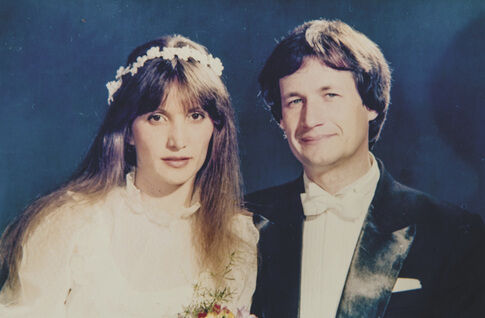
It was a simple affair. Everything was prepared in advance. The bedroom shades were drawn and a little round table was set up as a makeshift altar with candles, ribbons, honey, lady fingers, and crowns. We were having a Russian Orthodox wedding, something that neither of us knew much about.
We went through the long ceremony, which included both of us wearing crowns. I glanced at Dan and had to hold back a giggle because I thought he looked pretty silly.
We were then fed lady fingers dipped in honey and circled the table while carrying heavy gigantic candles tied with silk ribbon. There was chanting, and a generous amounts of incense was dispensed in all directions, infusing the air with sweet smoke.
I wondered what Dan made of it all. It was strange enough even to the committed atheist I was, but it must have been quite the adventure to an American who didn’t understand a word of what was going on.
He did know when he had to say “Da” (yes in Romanian), maybe prompted by a little nudge from me and the priest’s bushy eyebrows raised over questioning eyes. The rings were slipped on our fingers and then we were married — very very much, deeply, truly married.
Next day we put in our official marriage application in Bucharest and showed up back in town in time for a nationally-televised concert. My wedding band was tucked in the neckline of my black lace concert dress, on a delicate gold chain. Dan openly wore his, and I wonder if some of the younger, unattached women in the orchestra noticed the sudden change.
Three days later Dan was on the Orient Express starting on his journey back to the United States, and I was left behind — my heart broken, yet beating frantically, paralyzed by fear over what would happen next.
By then I had learned a lot about the chances of the state giving me permission to marry an American and allow me to leave Romania: they were slim to nil.
The people in charge of these decisions were the worst of the worst in the Securitate (the Communist Riomanian Secret Police). Word was that Ceausescu himself personally approved and signed the small handful of approval letters that went through every year.
“They” would try everything to make the process an impossible minefield — asking for mountains of paperwork and making sure that the process was drawn out to a point where most love affairs would be tested beyond their limits.
If word got out, I was facing the very likely possibility that I would never see Dan again, not to mention the persecution, the harm it could cause my family: probably jail, maybe one of us disappearing in the middle of the night, never to be heard from again.
Back that Thursday at the conservatory, like in a trance, I suddenly noticed people get up, move. I realized that someone had called my name. I looked around and saw the equivalent of an American HR person saying something about needing me to sign a paper in her office. I tried to make an excuse and put it off, but she said it would take only a minute.
So I headed that way, the world still a blur around. I knocked, opened the door and stepped in the office. A strange man I have never seen before was standing a few feet away facing toward me. I apologized, said I must have gotten the wrong door, and started to turn when he reached behind me, locked the door and said slowly, quietly. “I heard you wanted to leave Romania.”
After that, my participation in concerts was stopped. My recordings were taken. I was stigmatized. If people were seen with me they would be next on the “list.”
It was three long months of this before Dan came back. While he was in the United States, he contacted every politician he could think of, and it eventually paid off. With the help of U.S. legislators, I was put on a number of human rights lists, and somehow I got on the list that then-U.S. Secretary of State George Schultz brought to Romania. The two countries were negotiating a trade agreement and discussing the United State’s most favored nation list. Three weeks after Schultz left, I was told that I was approved to leave.
Years later I performed in a project at Jacob’s Pillow Dance Festival (in the Berkshires of Massachusetts). Dan came. While he was there he went to the Tanglewood Music Festival and saw Schultz and his wife. Dan went over, shook his hand, thanked him, and told him he made a difference. He and his wife were in tears. They were so touched. They had never heard the end of the story.
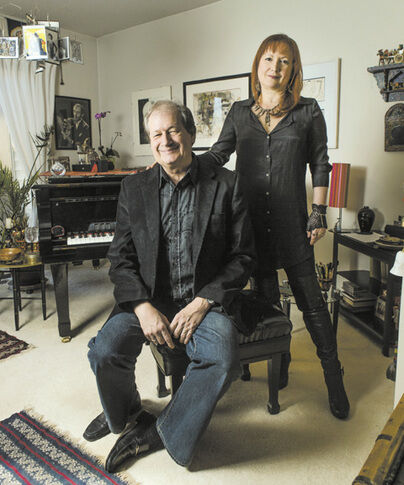
Editors note: In 1986, Gabriela Imreh and Daniel Spalding began their life in the United States in Texas, where Spalding became an assistant conductor with the Houston Symphony Orchestra. In 1988 he was offered the position of orchestra conductor at Trenton State College (now the College of New Jersey) and moved to Ewing. Currently, the couple live in West Trenton in a development off Route 29.
Five years later, Dan started the Philadelphia Virtuosi Chamber Orchestra and has led it for more than 20 years. He also appears as a guest conductor in Europe and the United States.
Imreh became a United States citizen in 1994 and has performed as a soloist with the Hong Kong Philharmonic, National Russian Philharmonic, Vancouver Symphony, Copenhagen’s Tivoli Festival Orchestra, London Mozart Players, and numerous others.
She is featured in three audio recordings, including the Naxos recording of Howard Hanson’s “Variations on a Theme of Youth” with the Philadelphia Virtuosi Chamber Orchestra. She also teaches and writes.
In October, 2013 — after the Trenton Symphony Orchestra ran into financial problems — Spalding joined area musicians to create the New Jersey Capital City Philharmonic Orchestra and maintain the capital’s longstanding New Year’s Eve concert. That night, Spalding conducted and Imreh performed together in Trenton. The piece was appropriately titled: the “Spellbound” Concerto.
Today, while working as a guest pianist, recording and teaching, Imreh has also begun chronicling their story on paper. The above article is an edited version of her work in progress.
Meanwhile, on Valentines Day, Spalding will conduct the N.J. Capital Philharmonic Orchestra in the program, “Valentine’s Day with Maureen McGovern,” at Patriots Theater at the War Memorial Building on February 14, 8 p.m.,Tickets are $25 to $65. For more information, call 609-218-5011 or go to capitalphilharmonic.org.
,