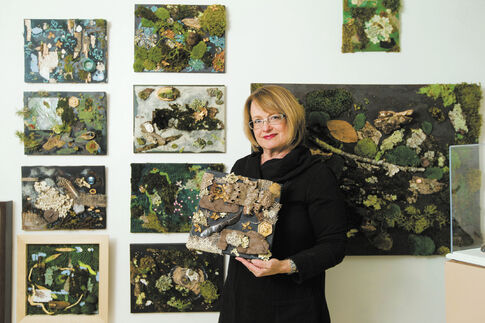
Works by Ewing artist Joy Kreves, pictured above, will be featured in A Space on Main gallery in Cranbury during the month of April. (Photo by Suzette J. Lucas.)
Stop for a moment and think about connectedness. Every living thing is somehow connected to each other, and every seemingly dead thing has its own story.
For Ewing-based artist Joy Kreves, this is the essence. For Kreves, nature is life, life is beauty and art is that which reminds us of our transience and our permanence.
An exhibition of Kreves work titled “Homage & Requiem” will be at A Space On Main gallery in Cranbury from April 3 to 26. An opening reception is set for April 4, from 6 to 8 p.m. “The mixed media collages and assemblages in my show honor the role of the environment in human health, by featuring the solace of preserved mosses and gilded honeybees,” Kreves said of the exhibition.
Author and longtime friend Linda Egenes, Kreves’ college roommate at Illinois State University, refers to Kreves’ ability to mix natural and found objects with ceramics, charcoal, and watercolor as “a visual feast.” But more than that, Egenes said, Kreves manages to concretely knit a sweeping, intangible concept like connectedness in a way that sparks deeper thought.
In Kreves’ world, “nature and man together weave a primordial tapestry,” said Egenes. This gives us hope for an intelligent relationship with our environment, while at the same time, Kreves’ work sounds the alarm “to protect the beauty we have not yet destroyed.”
Kreves certainly doesn’t deny that she’s going for that kind of reaction.
“It seems that the more we learn about ourselves, the earth, the universe, the more we learn that everything is totally tied together,” she said. “The world is so much more alive than I thought it was when I was growing up.”
Talk to Kreves about her art for a few minutes and you will notice something unusual—she hardly talks about her actual art. She talks instead about this concept of life, of vivacity, of connection. She talks about what she sees and feels about our pale blue dot.
But then, that is her art, isn’t it? The message takes precedence over the materials or the process.
And Kreves certainly isn’t the type of person to self-aggrandize. You get the sense that Kreves sees herself as the medium, a channel through which the universe’s interwoven elements pass; it is her job to point them out. But you never get the sense that she feels bigger than she really is.
Kreves, the daughter of a Unitarian minister who was a deep, abstract thinker, grew up in Illinois. Her father was always her biggest supporter, she said, and that remains so to this day. His ability to think philosophically meshed with her mother’s love of nature. Her mother was a more earth-bound smart, Kreves said. A kindergarten teacher and excellent gardener, she was “very, very literal.”
Still, her mother’s love of the natural world blended nicely with her father’s broad thinking, and the foundation of Kreves’ art career was forged. As a younger lady she could never make up her mind whether she wanted to make a career of art or music. By the time she got to college, she stopped seriously playing the violin and concentrated on an art career. She earned her bachelor’s and master’s in art from ISU and promptly moved to New York.
While still in her 20s, Kreves had her first inkling of what was to come in terms of perspective. She was taking a course in botanical illustration and was instructed to disassemble a red tulip so that she could see and illustrate its inner workings.
“I didn’t want to rip it apart,” she said. And as if the flower knew Kreves would not hurt her, “one of its petals folded down—not wilted—and gave me a perfect view of the inside of the flower.”
Part of Kreves felt silly, wondering if the tulip had heard her and decided to help. But she nevertheless had the feeling that maybe it understood her energy.
“The other part of me felt as if the flower wanted to cooperate,” she said.
This was the ’70s, when there was serious scientific study into whether plants could and did react to human interaction. That science in particular was debunked decades ago, but the essence of it never left Kreves, that idea that somehow life knows life, and positive knows positive.
And by the way, new science, serious enough to be reported in mainstream press outlets like Public Radio International and The New Yorker, is starting to reexamine the concept that some plants really do seem to have some level of intelligence, including recognition of individual people and actual memory. So perhaps Kreves is not silly. Maybe she’s just connected.
Connected or not, Kreves worked for years at a mind-numbing graphic design job at a medical publication in New York City “in a little office with no windows,” where a bunch of guys smoked cigars all day. Before the end of the ’80s, she had had enough. She met her husband, a biology professor at Rider University, and decided to open an art studio in Frenchtown. This, said Carol Cruickshanks, executive director of New Hope Arts, was “way ahead of the more recent developments in that town.”
Kreves has shown much of her work through New Hope Arts, and Cruickshanks says she has witnessed Kreves hone her sculptural pieces “to include environmental themes and statements about nature.” Last February, Kreves presented her daughter’s work at the gallery. Kreves’ daughter, Ivia Sky Yavelow, graduated last May from Bard College as a sculpture major. Like her mom, Yavelow has been exhibiting regularly in this area.
Kreves has applied to show in New Hope Arts’ Sculpture 2015 Exhibition, which will be mounted at the gallery in April, Cruickshanks said.
Kreves and her family eventually moved to Ewing because the drive between Rider and Frenchtown was getting a bit much, she said. They now live in the Mountainview area of town, where she finds inspiration and materials everywhere.
One of Kreves’ favorite materials is lichen, a fuzzy green moss most of us pay little attention to. For Kreves, that’s motivation enough to use it. Art, she said, makes the viewer conscious.
“I had shown some friends, who are from similar areas to mine, some work. They said ‘Wow, where did you get these lichens?’” she said. “It’s there. You just don’t see it because you’re not conscious of it.”
And yes, those friends suddenly noticed all the beautiful lichens where they live.
Whether it’s leaves or lichens or ceramic pieces, the point Kreves wants to make is less an illustration and mo re a display of attitude. Beauty and form are, in a way, secondary concerns for her. What matters is that people look at her work and see more of their world before they walk away. Not everyone will get it, but enough will, and that suits her fine.
“I don’t care if everything looks nice so much as it has meaning,” she said.
,

