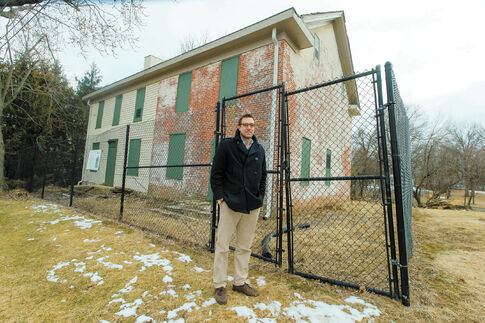
George Leader, anthropology professor at The College of New Jersey, is conducting an archeological dig at the historic William Green Farmhouse on the college campus. (Photo by Suzette J. Lucas.)
If beauty is in the eye of the beholder, then the William Green House, located on The College of New Jersey’s campus, is a clear illustration of that saying.
To the casual observer, the house might seem like a dilapidated brick structure that stands in stark contrast to the 20th and 21st-century buildings that cover most of campus.
To the Friends of the William Green Farmhouse, the house is a local historical treasure, worthy of preservation and restoration.
And to TCNJ anthropology professor George Leader, the house is a unique educational opportunity for his students. This semester Leader is teaching an archeological field methods class that will culminate in a dig at the William Green House.
“I always wanted to do a field methods course. It’s not often that you have a site on campus that you can use within the course,” Leader said.
In order to prepare for the dig, which is scheduled to begin mid-April or May, Leader’s students are studying the theory of how to approach an archeological dig and how to curate and analyze materials. The dig will give the students a chance to put into action what they have been studying all semester. He and his students have been designing research questions, studying maps of the site and discussing the best places to dig in order to answer those questions.
The William Green House is listed on the New Jersey and National Registers of historic places. In addition to being architecturally significant, it was the home of many prominent local citizens.
The oldest standing section of the house was built circa 1717 to 1730. That section is a two and a half story brick house featuring Flemish bond brickwork, which is brick laid in a pattern that resembles a checkerboard. The next section was added to the house circa 1750 to 1790 and added four rooms and a stair hall to accommodate the growing family. The most recent section of the house was added circa 1830 and essentially doubled its size.
The first William Green to live in the house was one of the earliest settlers in Ewing. He came to the area from Newtown, New York around 1700 and was a judge in what was then Hunterdon County. He had 11 children, many of whom became prominent farmers and citizen in the area. Green and many of his descendents are buried in the cemetery at First Presbyterian Church of Ewing. After Green died, the house was inherited by his third son, also named William.
Among the first William’s most notable descendents were his grandsons Enoch and William Green. Enoch was the valedictorian of the Princeton University class of 1760 and served as a chaplain during the Revolutionary Army. William, who inherited his house from his father, the second William, was a member of the Hunterdon militia and reached the rank of ensign. One member of the family (also named William, so it is difficult to discern if it was the house’s owner or one of his cousins) served as a scout for George Washington at the Battle of Trenton.
Leader’s area of specialty is human evolution so most of his archeological experience is working at prehistoric sites South Africa, not at sites dating to colonial America. Nevertheless, he excited to be working on local history.
“I think it’s really important for the students. It’s one thing to excite students to read books and another to actually get out there and pull history out of the ground themselves,” he said.
Leader came up with the idea for digging at the William Green House when he stumbled upon a box of artifacts from digs conducted by retired TCNJ professor Carolyn Metz in the early ’90s. Those artifacts range from the 1700s to the modern day and include ceramics, animal bones from what is believed to be the smokehouse area and pieces of clay pipe from the mid-1800s, along with beer bottle caps that are clearly of a more recent provenance.
“I wanted to take these artifacts and make everybody aware of the significant history that the farmhouse has had,” he said.
His goal is to publish and present the result of Metz’s digs to pique the interest of the archeological community and later to publish the results of the dig that class will be conducting. Leader expects that the artifacts from that dig will be similar to those already found. His greatest hope for the dig is that it will produce some evidence to corroborate written records that some of George Washington’s troops were billeted at the William Green House during the Revolutionary War.
“We haven’t yet found official military documentation, but if we could find evidence of something that relates to military presence that would be fantastic, whether it’s a button, insignia—something of that nature.”
The house continued to be owned by members of the Green family until July 1960 when it was sold to TCNJ. The college used the house for many years, but it stopped placing tenants there in the ’70s, and the house began to fall into disrepair. Throughout the ’70s, ’80s and ’90s, various local civic groups supported efforts to restore the William Green House. One of the most active was Violet Cox, a former Ewing councilwoman who was a member of the Ewing Historic Preservation Commission and won a New Jersey Historic Preservation Award in 1999.
In 2000 Anne McArthur and Bill O’Neal founded the Friends of the William Green Farmhouse, a non-profit with the sole mission of working with TCNJ to restore the house.
McArthur, president of the Friends, retired from her position as head of audiovision at the Talking Books and Braille Center at the New Jersey State Library in 2010, having spent most of her career as a college librarian. She was not originally from the area and moved to Ewing from New Orleans in 1978. Nonetheless, she is a strong advocate of preserving Ewing’s history.
“I fell in love with the Green House when I saw it on campus. It is a living reminder of history. Not many buildings of that age in the area have survived, especially not many domestic buildings associated with the Revolutionary War,” she said.
McArthur explained that her interest in history dates back to her childhood when her father “would drag us around to cemeteries and battlefields.” She said that she was the only one of six children to inherit her father’s passion for history.
O’Neal, vice president of the Friends, has a more personal connection to the William Green House. His wife Lauren’s great-grandfather Amos was the last Green to be born and raised in the house. O’Neal was born and raised in Ewing and currently lives in Lawrence. He is an English teacher at Trenton High School West. He became known to those involved in saving the William Green House because he had a website detailing Green family history.
“It interested me because of our children,” he said, explaining that because his parents didn’t come from the area, it was difficult for him to trace his own family history, but it was easy to track down Lauren’s. “They all went to the same church I went to at the time. All the documents were around.”
The Friends and TCNJ have been negotiating about the future of the William Green House for many years.
The most important achievement that the Friends has had so far was in 2007, when the organization put up $100,000 to stabilize the house so that no further deterioration would occur.
McArthur said that although there is some disagreement among the Friends about the function of the house if and when it is restored, all members want it to be “a viable” and integral part of campus life.
She explained that members of the Frien ds are anxious for the restoration of the house to begin because the project gets more expensive every year that it gets pushed back. In 1976, it was estimated that the restoration project would have cost $213,810. By 2001, the estimated cost for restoration had risen to $1,215,685. The current estimated price tag to fully restore the house is $2.6 million.
O’Neal said that he believes that the ideal use for the house would be as an interpretive center, but he admits that the idea isn’t justifiable financially.
One of the most popular ideas proposed by the college was make the William Green House into an alumni house. For awhile it seemed like the idea might come to fruition as the college contacted construction services and drew up loose plans. However the college ultimately decided that it was not an appropriate use for the house.
Other ideas that have been floated over the years include turning the house into a coffee shop or a museum and event facility for TCNJ sports teams, allowing a non-profit to use the house as an office and moving the house off campus to the grounds of the Benjamin Temple House. Meanwhile, the future of the William Green House remains undecided.
O’Neal explained that the Green family is rather pessimistic about college’s intentions.
“The attitude of the family has always been, ‘They kicked us off the property. They will never do anything, it’s not going to happen,” he said.
Despite their struggles with TCNJ, members of the Friends are excited to see what Leader’s dig produces.
“We’re hoping that it will enrich our understanding of a well-off farmer’s house and how life was for those people, everyday people, over this long period of time. It’s really an extraordinary opportunity,” said McArthur.
She added that you never know what you might find underground, noting that when crews were digging the parking lot for the 7-Eleven at Pennington Road and Ewingville Road they found a Hessian boot.
MacArthur also expressed hopes that the dig will generate enthusiasm for their cause, but O’Neal remains pessimistic.
“I think the dig is a great idea, but I don’t think it will in any way effect what they decide to do with the house,” he said.
,

