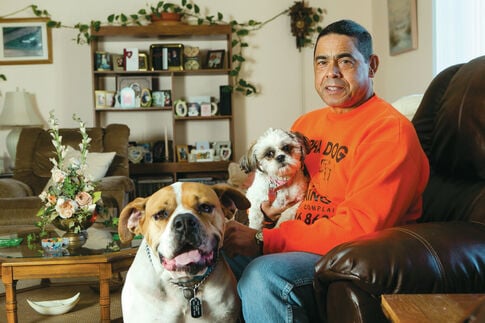
Robbinsville resident Tom Wallace sits with his dogs Kojak and Izzy. Wallace trains dogs using only reenforcement methods found in nature. (Photo by Suzette J. Lucas.)
Tom Wallace knows dogs.
The 60-year-old Robbinsville resident grew up in Germany, then Newark and later Middlesex County with retired military and police German Shepherds. At school, he often eschewed his teachers’ assigned reading material, replacing it with books about man’s best friend.
He had dogs all of his life, and they were just a hobby—until he decided to leave his distribution management job in order to start his own business, Alpha Dog Training, 25 years ago. Wallace teaches behavioral obedience training, addressing any behavioral issues, from aggression to house civilization.
The uncertainty of corporate life and the transitions that came with it were not keeping Wallace fulfilled, he said.
“It was a matter of, ‘This is not the way to go, let me investigate what I enjoy doing, see if I could find a way to make a living,’” he said. “You know what they say, if you do something you like, you never work a day in your life.’ That’s pretty much how I feel now.”
Before he started his business, Wallace sought out an apprenticeship and ended up with Fred Fink, the Ewing-based owner of Analytic Dog Training. He helped Fink teach group classes in Lawrenceville. The pair gelled, and Fink determined that Wallace was ready to go off on his own.
He said the most valuable piece of advice Fink gave him was “If you work, it works.”
“If you’re serious about your commitment and your objectives with your dogs, you’re going to achieve that with me,” he said. “If you’re not, a lot of people want to go to Heaven, but they don’t want to pray. Keep it natural, keep it simple, pay attention to each individual situation and case and scenario. You’re always going to learn something from every dog and every owner. It alleviates the boredom of the job.”
And he has had his share of memorable customers.
One that stands out was an elderly woman from Princeton who owned a pit bull puppy. Wallace had the dog so well-trained by the time it was six months old that the client was able to walk him up and down busy Nassau Street leash-free. Wallace said she and her husband were eventually accepted into a gated community, due in part to how well-behaved the dog was.
“I would have to say that highlights one of my favorite clients, my best scenarios,” he said. “I break out her picture, and I go, ‘Look at this white-haired, older woman. She has a pit bull, and the dog is trained.”
Wallace also enjoys working with children and their pets.
“I’ve had many children with off-lease trained dogs,” he said. “That always is a special joy, to see a child having control of a dog.”
He trains his own dogs, as well. His wife, Pat, had a fear of dogs when they met, brought on by a bite when she was a child. The way Wallace worked with the animals, though, was enough to convince Pat that she could live with them.
Now, she’s hooked.
“He’s an excellent trainer,” she said. “We ourselves have always had dogs. I’ve seen what he has done with ours. I never would have had this many if it weren’t for having him around. They’re members of our family.”
He also specializes in families in general. He aids in breed selection by analyzing factors like home environment and the number of people in the residence.
But he also cautions potential dog owners to think before they adopt or purchase. Introducing a puppy or older dog to a family can be more difficult to handle than owners realize, which sometimes leads to taking it back to a shelter or even abandonment.
“Everybody’s family wants a dog,” he said. “It winds up being the burden of the responsibility, often of the parents who don’t have enough time, so the dog ends up not getting what it’s supposed to.”
That’s where Wallace can help.
He never uses treats, clickers or bribes—his training is based strictly on verbal commands, hand signals and pats. He avoids anything in his training that can’t occur naturally.
“I adhere to mother nature’s plan: establish leadership, maintain leadership,” he said. “It’s all good. I don’t use any inhumane methods. I always tell my clients that if it doesn’t happen dog-to-dog, it doesn’t happen with me and your dog and it shouldn’t happen with you and your dog.”
Which is why Wallace said owners should avoid in-store training classes. Aside from their food-motivated methods, they also expose the dog to more stimulation that it needs, making it difficult for the pet to focus and learn.
“Training the dog in a department store is like teaching your child at Great Adventure,” he said. “You’re flooding the animal’s senses.”
The younger the dog is, he added, the smaller its attention span.
Despite this, it’s important to start training the dog at a young age. Even waiting six months could make training more difficult, as the dog is larger and more developed.
All Wallace wants to do is create an anxiety-free environment for dogs and their human counterparts.
“You got a dog, it’s supposed to be a joy in your life,” he said. “It’s not supposed to be another source of stress. We have enough stress, and your dogs can sense that stress, and it will impact them behaviorally, as well.”
And he hopes to keep that up as long as possible.
“I guess I feel it’s my contribution to mankind and animals to get them on the right page together so they can coexist peacefully together,” he said. “Helping people understand, ‘This is how the dog thinks.’ It can only think like a dog, so you need to get on board with that if you want a good relationship with that animal, if you want that animal to be socially adept. People feel that their dog is a family member. Would you deny a family member proper education?”
,

