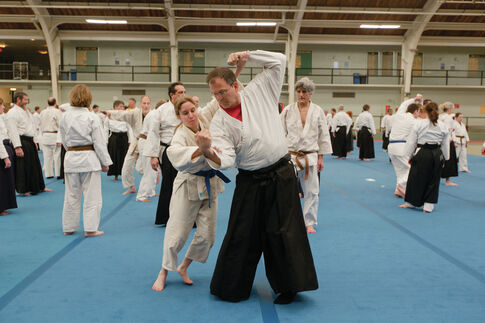
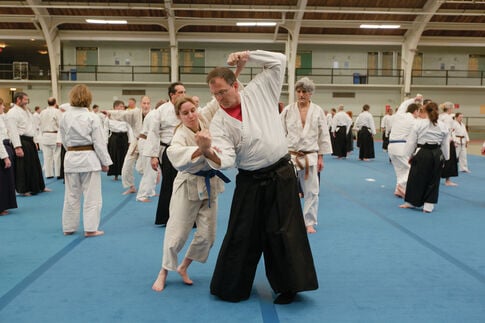
Bryan Gibbons, of Lawrence, practices at the annual Aikido Camp at the Lawrenceville School March 2, 2015. (Photo by Suzette J. Lucas.)
Every year practitioners of Kokikai Aikido come from all over the world to attend an annual winter camp at Lawrenceville School.
Kokikai is a style of Aikido, a Japanese martial art focused on mind-body coordination and defensive tactics.
“We don’t practice punching and kicking, but practice how to defend ourselves against punching and kicking,” said Dan McDougall, the senior aikido instructor at the Princeton YWCA, the dojo that hosts the winter camp.
Aikido is not a competitive sport. Instead, training takes place between cooperative pairs who switch off being attacker and defender.
“In aikido we don’t talk about beating others,” McDougall said. “We talk about beating ourselves. It’s about personal progress. I look better today than I did six months ago, one year ago or three years ago.”
He explained that all this makes aikido a very supportive practice. He pointed out that the small practice groups on the mat were made up of students of different belt levels.
“They all practice in harmony,” he said. “It’s the responsibility of the senior person to work to the level of the more junior person.”
The Kokikai style was founded by Shuji Maruyama. Originally from Japan, Maruyama lived in the United States for many years before returning to Japan in the early 1980s.
“His students didn’t know what life was going to be like with sensei back in Japan,” McDougall said. “Having winter camp was a good reason to bring him back to the states.”
At first the camp was a small gathering and was held at the Princeton Y and Princeton University. As the camp attracted more attendees, it outgrew those spaces and has been held at Lawrenceville School ever since.
“It’s an ideal location,” McDougall said. “There’s beautiful lighting, plenty of space and privacy.”
This year marked the 32nd year of winter camp, which took place on March 6, 7 and 8. Every camp includes five two-hour lessons—one on Friday night and two each on Saturday and Sunday. The lessons begin with a physical warm up and mind-body coordination exercises and move on to practicing technique. All the lessons are taught by Maruyama.
“We just want to take advantage of him as much as possible,” McDougall said. “I’ve known him for over 30 years and he gets better every time I see him. I know I’m getting better every time—he gets exponentially better.”
In addition to being an opportunity to take lessons from Maruyama, winter camp is also a chance for Kokikai practitioners to socialize.
“In the early years, when it was small, members of the Princeton dojo put up visitors in their homes,” McDougall said.
These days there are to many attendees for that to be feasible, but they still like to spend time together. There is a tradition for participants to go to dinner together at Amalfi’s on the Friday night of winter camp and to have a party at the Palmer Inn on Route 1, where many of the participants stay on Saturday night.
McDougall resides in Hopewell and is a sales manager at KNF, a scientific equipment company. He first became interested in aikido after he saw a demonstration on television. What interested him about the martial art was how the defender took advantage of the attacker’s momentary off balance state and used it to his advantage.
At the time, McDougall was living in rural Pennsylvania and could not find anywhere to practice aikido; however, within a few months of moving to the Princeton area in 1981, he discovered the dojo at the Princeton Y and decided to try it out.
“When I started I had no intention to make a commitment because of my personal history—I never seemed to stick to anything. Now it’s been 33 years and I’m still doing it,” he said.
Those attending this year’s winter camp came from as near as Mercer County and as far as Israel. One of the locals who attended was Bryan Gibbons of Lawrence. Gibbons has been a career firefighter for Lawrence Township since 1997. He was also an active volunteer firefighter and EMT at the Lawrenceville Fire Company for 11 years beginning in 1995.
Gibbons, 47, has been practicing aikido since 2005; however, he has been interested in practicing since he was in eighth grade, when on a class trip to the library, he found the book Aikido and the Dynamic Sphere, which at the time was the primer book on aikido.
“I read it from cover to cover,” Gibbons said. “I was enthralled by the idea of defending oneself without intent of hurting the attacker. Growing up in school if I ever got into a fight I knew how to defend myself, but I was afraid of hurting the person, so I would hold back.”
He started training at the Princeton YWCA and has been teaching aikido at The College of New Jersey for five years.
He explained that Kokikai is the style of aikido that resonates with him the most because of its guiding philosophy of using minimum effort for maximum effect.
Another local attendee of this year’s winter camp was Jeremy Whaley. Whaley was born and raised in Ewing and is a freshman at The College of New Jersey. He started practicing aikido last semester, but he has been practicing taekwondo for 11 years.
“I wanted a different experience,” he said on why he decided to take up aikido. “Taekwondo is more about strikes and grabs. Aikido is more about what is going to happen. I’m looking for complementary training.”
Whaley is not unique. There are many martial artists who use aikido to complement the other arts they practice.
“Other martial arts are fighting arts—blocking, kicking, punching, attacks,” Gibbons said. “Aikido is a great adjunct to practitioners focusing on balance, balance-taking, core center and creating opportunity.”
Although still a beginner, Whaley said he was getting a lot out of attending winter camp.
“It’s very good to be in groups with senior students who have a lot more experience than I do,” he said. “They can give greater insight into how techniques are properly done.”
“I’m having fun,” he added. “I’ll be here tomorrow.”
,