When The Nile Project comes to the Matthews Stage at the McCarter Theatre on May 2, don’t leave your seat at intermission: you will miss the brief moment in which Mina Girgis takes the stage.
In a show dominated by exotic musical bliss, Girgis will stand out as the guy who’s not playing anything. He won’t be singing, either. By the time you reach down to check your phone, he could very well have left the stage already.
At minimum, you’ll want to catch a glimpse of this man, for he is the reason you’ll have been enjoying the show so far.
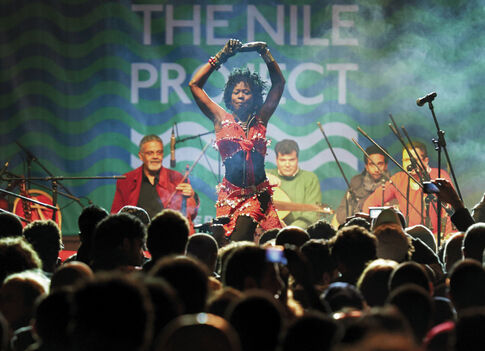
The Nile Project is a unique live music collaboration and environmental awareness project featuring a collective comprised of 12 members from 7 countries in Africa’s Nile Basin region.
Girgis, an Egyptian ethnomusicologist currently based in California, is the president and CEO of The Nile Project, which he founded in 2011 with Ethiopian-American singer Meklit Hadero. At intermission, he will take the stage to give a few minutes worth of context about The Nile Project. And even if you are already a Nile expert, it will be worth sticking around just to hear the information coming from someone as passionate, articulate and well-versed on the topic as Girgis.
When Girgis speaks, his intensive knowledge of ethnomusicology—the study of different countries’ music in conjunction with their sociological and biological factors—shines through.
“Our mission is to inspire and inform and empower people about the Nile Basin, to collaborate on making the Nile more sustainable,” said Girgis.
At 4,258 miles, the Nile River is the longest river in the world, connecting 11 countries with a population of at least 437 million people. The conflict between these countries has everything to do with how much of the Nile’s water is allocated to each country—who gets how much?
Girgis knows what you’re thinking. “Why use music to make a more sustainable ecosystem?” he asked, rhetorically.“Many of the conflicts in the Nile Basin turn out to be less about environmental issues than they are about people problems—the way that these people in all of these different countries are trying to figure out their issues… their cultures are isolated and [the people] are not really seen as part of the same region. So in a way, the only solution to come out of this water conflict is to change the relationship among the people of these different countries.”
And that’s where The Nile Project comes in. “The music is really meant to increase that cultural awareness and to model the kinds of cross-cultural collaborations necessary among people from all of these different countries to transform the water conflict situation,” Girgis said, adding “The music is mainly an inspiration. It’s to inspire people to become more culturally curious about each other, to understand each others’ backgrounds and challenges, and to also inspire these ways of engaging with your neighbors.”
So can music solve all the conflicts of the Nile Basin? Girgis said that the initiative would “fall flat” if that were the sole aspect of The Nile Project, adding that music only comprises about 30 percent of the project’s duties. The other 60 percent goes towards education and lab programs at universities. “We’ve played more than 50 concerts, but we’ve also had more than 35 university residencies over the past four months of this tour,” Girgis said.
Princeton marks the final performance of said tour, which is the collective’s first in the United States. The group is only booked for a single performance at the McCarter Theatre, and Girgis is aware of the limited time he and the group will be spending here.
“Our goal is to really get all of these people who come to the concert to come out curious to learn more, and through that learning, to find a way that they can create their respective Nile Project, to find their own way of having an impact on the sustainability of their ecosystem, whether that’s cultural, social, political, environmental, or otherwise,” Girgis said.
He added that while he and his fellow musicians expect attendees to walk away from the concert inspired, he can’t force them to engage or seek out information on their own after it’s over.
“We certainly hope that some of the people that will come to the concert, whether students or faculty, will become interested in some of these issues,” he said.
Girgis said he hopes that one such faculty member, albeit a former one, will be in attendance. One of the fathers of Nile politics was a professor at Princeton, John Waterbury. He wrote the book “Hydropolitics of the Nile Valley”… So there is a long history of the understanding of the issues of the Nile Basin in Princeton.
“I’m sure there is a receptive community [in Princeton] that would appreciate both the novel approach to The Nile Project as well as all the other programs we’re working on,” he said.
Even though music only covers about a third of The Nile Project, it’s quite the third. Girgis said that the 12 performers (the full collective is 27 members deep) will be representing the rich musical cultures of Egypt, Sudan, Ethiopia, Uganda, Kenya, Rwanda and Burundi.
And while a few of the instruments involved will be recognizable to McCarter’s audience—such as the electric bass and the saxophone—there will also be a more than a few that are likely firsts for them: the kawala, an Egyptian reed flute; the oud, an Egyptian lute, which Girgis notes is “an early predecessor of the guitar”; the inanga, a trough zither; the umuduri, a Burundian bow instrument; and the ikembe, a thumb piano, to name a few.
While The Nile Project showcases a collective of musicians from different African countries, don’t expect this to be run like an amateur talent show at Epcot.
“[The performance] is actually advanced,” Gurgis said. “Most of the songs are collaborative and they mix everything from rhythms to languages to modal systems to the instruments themselves…the music is really, in a way, combining a lot of the traditions and allowing the audience to see all of the possible ways you can combine all of these styles.
Girgis described the flow of the show: “[On] every song the leadership changes and the show is taken in a different direction.” He added that the songs are not categorized by geography, giving a hypothetical example of what he means: “A [given] song might be sung by an Egyptian singer in an Ethiopian scale that was composed by a Ugandan.”
He also said he hopes that people can appreciate the bigger result of this collaboration, beyond mere notes. “What we’re trying to do is really give these musicians the space to express that experience and express the state of collaboration. We’re trying to allow them to be the leaders in the same way that we want the inspired students to be leaders.
“It’s not about the virtuosity of each musician—they’re all extremely virtuosic…when we bring them together, the goal is to combine all of these different musical ideas to make something that’s bigger than the sum of the parts and use that model to inspire similar collaboration in other ways that are not necessarily musical.”
“Virtuoso” is also how Girgis describes Michael Bazibu, a Ugandan multi-instrumentalist who has been with The Nile Project for the last 2 ½ years.
Bazibu, according to Girgis, plays “maybe 20 instruments,” but for this tour, he is traveling a little lighter, playing various percussion—such as the engoma, an Ugandan drum, and the engalabi, a drum that is long and loud—as well as tonal instruments like the adungu (a harp), the etongoli (a plucked instrument), and the amadinda (a marimba-esque instrument from Uganda). On top of this, he sings.
Is he satisfied with his performance? Yes and no. “A true musician cannot be content because any time you play a song, there’s something new that comes in your mind,” Bazibu said. “Our brains are boiling every day and night—again and again, new stuff comes in. I’m satisfied, but not to the maximum because we don’t have the time to work on the new stuff we have.”
But Bazibu is still excited by the music he and his bandmates play, all this time later. “I’m so excited that people are interested in us because most people are used to pop music and different kinds of music… But East African music is not known in the States…When you talk about [African music], most people associate it with West Africa. They never imagine Uganda, Ethiopia, Sudan.”
Though he’s more identifiable on stage as a musician, Babizu feels a lot like a student, thanks to The Nile Project. He looks back fondly, “I’m very pleased and happy with how people think about this project. The goal and ideologies behind it are really amazing…it’s so educative; it’s like a learning center. Especially like with me—as a musician…I didn’t have time [before I knew about The Nile Project] for thinking about other cultures and other people. The workshops we are doing are really collaborative and help to unite Africa.”
In his confident manner, Bazibu tosses off a few lines that could easily be repurposed into a TV ad for The Nile Project: “Expect to see East African music at its best, and also come to see the integration of music of the Nile Basin’s countries. Come and see our newborn kind of music.”
Bazibu pauses for a few seconds, almost as if the accomplishment of creating a new style of music hasn’t quite hit him before. “It’s a new creature and it’s real. It’s Nile music,” he said.
When asked to discuss some of the biggest accomplishments of The Nile Project, Girgis lauds the fact that as a music-influenced collective, they have been able to educate people on the issues of the Nile Bain, which before was, according to Girgis, “only the domain of specialists.”
“The music does a really good job at making this possible and attractive and interesting to people,” he said. “We have musicians from all these countries with striking instruments and musical traditions that really are interesting to combine, which all allow people to become more attentive.
“I think that’s been our biggest impact,” he said. “People are becoming curious about each other and becoming more interested in the Nile as a connecting backbone to this region.”
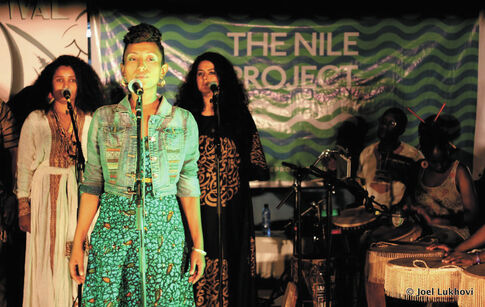
The Nile Project, a collective comprising of 12 members from 7 countries in Africa’s Nile Basin, performs at McCarter Theatre on May 2.,