Dance Legacy: Trenton native George Antheil was known as a composer. But he also influenced dance, and worked with the famous George Balanchine among other choreographers.
Editor’s note: On Sunday, May 9, the New Jersey Capital Philharmonic presents a program that includes the ballet work “Capital of the World” by Trenton-born American composer George Antheil.
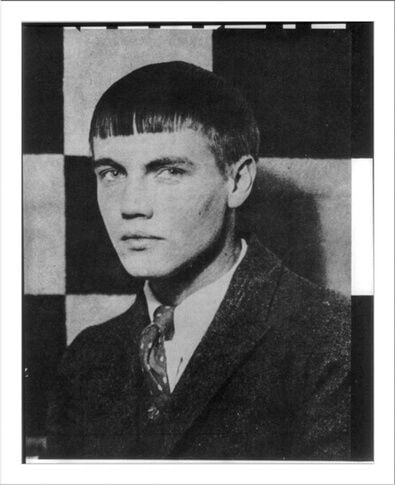
Born in 1900, the son of a shoe salesman, Antheil studied music in Philadelphia and New York. He then found his way to Paris where his avant-garde compositions electrified audiences and put him in a circle that include Gertrude Stein, Pablo Picasso, and Salvador Dali, Antheil worked on an opera with writer James Joyce, becoming the subject of a book on music by poet Ezra Pound, and collaborated with artist Fernand Leger on what has become one of his most notorious works, “Ballet Mecanique” — a concert work that included player pianos, alarm clocks, and an airplane propeller.
Antheil returned to the U.S. in the 1930s and created works that mixed styles and theories for concert halls as well as for film and stage. .
Author Lynn Garafola, a dance historian and critic, teaches dance history at Barnard College. A longer version of the article — based on a lecture at the Cooper Union for the Advancement of Science and Art — first appeared in Ballet Review. A condensed and edited version is reprinted here with permission of the author. As shown in Lynn Garafola’s important article below, dance and his collaboration with major choreographers was also an important — and neglected — part of his legacy
That’s something that NJCPO conductor Daniel Spalding — who recorded a performance of Antheil’s famous “Ballet Mecanique” for Naxos Records — understands and is bringing the composer’s music home.
By Lynn Garafola
George Antheil composed his first music for dancers in the late 1920s. By then he had left France for Germany, where he wrote incidental music for a number of plays and where his first opera, “Transatlantic,” premiered in 1930. In Vienna he did . a commission he later described as his “first music for dance,” as well as sketches for a ballet called “Mediterrane.”
A chance encounter with William Butler Yeats in the summer of 1928 led to “his first ballet opera,” “Fighting the Waves,” actually one of the poet’s “plays for dancers.” Produced by Dublin’s Abbey Theater, it was choreographed by the future matriarch of British ballet, the Irish-born Ninette de Valois. Yeats, she recalled, “had always felt the call of movement in relation to his writings, and he felt the same draw towards music. For him it was the call of the rhythm of the body, and the musicality of words, the search for a fusion in a unified expression of his dance dramas, symbolic in the oneness of the mystery that surrounded his great vision.”
For this strange work, blending Celtic myth with the stillness of Noh (theater), Antheil created a percussive score for orchestra that largely eschewed the use of strings. J.J. Hayes in The Irish Times praised the composer for “grasping the Gaelic spirit underlying the story,” while avoiding the “sensationally striking….The dramatic element was always present and the orchestra made clear at all times what was happening….Mr. Antheil’s music was eloquent in meaning and intensity.”
In 1932, after spending most of the previous decade abroad, Antheil returned to the United States and settled in New York. The country was mired in the Great Depression. Antheil threw himself into American life with the gusto that was one of his most endearing traits. There were concerts in Rochester, his home town of Trenton, and Yaddo, the Saratoga Springs arts colony; committee work with Aaron Copland and Wallingford Riegger; movie scores for Ben Hecht and Charles MacArthur at Paramount’s Astoria studios; a performance of “Ballet Mecanique” at the Museum of Modern Art.
Antheil’s interest in dance intensified with his return to the United States. Early in 1932 he was in touch with (important modern dance choreographer) Doris Humphrey about using her pupils in a “little opera” he expected to complete by the middle of March. The opera never materialized, but in September 1933 Antheil wrote to Humphrey about nothing less than exploring “the possibilities of a ballet here in Trenton”: “The Trenton Civic Orchestra has been organized, and is … pretty good … I have thought of using that (it is at my disposal) and the new Trenton Municipal Theater (which the city wants me to use) and with the help of the Junior League, and a number of interested people, put on a series of American ballets by American composers, with American dancers … a sort of Ballet Russe, so to speak, but with a poorer orchestra … I must admit… .
[T]he ballets could be ordered from the young men, if they are not already written, so that they would not be too ultra difficult… . Princeton, the New Hope Art Colony, and Philadelphia are all nearby. N.Y. is also only 1:07 minutes away. It might be fun. What do you think? There will be no profits unless Mrs. Roebling underwrites more than she has to date, but that shouldn’t stop this first chance at an unlimited orchestra and theater, and enough money for scenery and costumes.”
This project, too, never came off. But within months Antheil had encountered the patron extraordinaire who would make a place for him at the epicenter of New York’s “musical ballet-opera theater” (as he called it) — Lincoln Kirstein.
It was Lisa Parnova, a Russian-born dancer., who brought Antheil to the School of American Ballet in late January 1934. He played a rumba for (choreographer George) Balanchine (so loud that the teacher in the next studio came in to protest), and soon they were talking about a ballet.
Only days before the premiere of (the opera) “Helen Retires,” Antheil received his first commission — a new score for “Les Songes,” or “Dreams,” as the American version was called. It was about a dancer and nightmarish figures. Balanchine had produced the ballet in Europe with music by Milhaud. Now, with Derain’s sets and costumes at hand, the choreographer decided to revive the ballet, but with a new score. A few days later Balanchine demonstrated the dances and talked to Antheil about timings. Within a week he was playing for Balanchine the music he had already written. By late April the ballet was in rehearsal; by mid-May it was nearly done. And Antheil was talking to Kirstein and Balanchine alike about other projects.
On June 10, 1934, the School of American Ballet gave its first performance at the Warburg family estate near White Plains. Three ballets were given, all by Balanchine. The program opened with “Mozartiana” and closed with excerpts from “Dreams.”
At the same time that Antheil was working for Balanchine, he was also working for Martha Graham. In (his autobiography) “Bad Boy of Music” he passes over entirely his encounter with the foremost representative of modern dance, although it produced two works and inspired an adulatory essay. How they met is unknown.
For his first commission Antheil did not write new music. “Dance in Four Parts,” a solo for Graham that premiered at the Guild Theater on November 11, 1934, was based on 24 short piano preludes from “The Woman with a Hundred Heads.” Antheil had written it the year before, inspired by a surrealist collage-novel of etchings by Max Ernst.
Far more successful was Antheil’s second work for Graham, “Course.” A large group composition, it was the outstanding feature of her third recital of the 1934-35 season.
In 1936 (Antheil) set off in search of America, a journey that took him to Florida and New Mexico, and ended in Hollywood. Like so many newcomers to Hollywood, Antheil went to work for the movies. He continued to write for Modern Music and for a time kept a toehold in the ballet world.
(In) 1939 Antheil had stopped writing music entirely, even for the movies. To make a living he wrote a syndicated lonely-hearts column, “Boy Advises Girl”; a book of war predictions, “The Shape of War to Come,” published anonymously in 1940; and articles on the place of endocrinal glands in the human organism. With Hedy Lamarr, he patented an idea about a radio-directed torpedo.
In 1944 Leopold Stokowski conducted the premiere of Antheil’s Fourth Symphony. The event marked his return to the serious music world; within months this “musical Tom Sawyer, gay, fanciful, ingenuous, self-confident, and comical,” as (influential composer and music critic) Virgil Thomson once described him, was offering his services to the Ballet Russe de Monte Carlo. “For years I have composed nothing at all,” he wrote to the company’s director, Sergei Denham; “it had a special psychological reason too long to go into. But now I should like to write a wonderful new ballet. And I could.” What almost certainly prompted Antheil to resume contact with Denham at this point was his recent appointment of Balanchine as the company’s resident choreographer.
(By) August, 1946, Antheil was writing to Denham about two possible ballets. Although (a) ballet was never produced, Antheil composed a fair amount of music.
Finally, in 1950, Denham approached him about a project that did materialize, although his company would not produce it. This was Antheil’s last ballet, “Capital of the World.
The idea was born over a lunch in honor of Ernest Hemingway at a palazzo on Venice’s Grand Canal. Somehow the discussion turned to ballet and Hemingway’s short story “The Capital of the World,” which has as its climax a macabre scene in which two Spanish boys, waiters in a pension for second-rate matadors, play bullfight with a chair that has two razor-sharp meat knives strapped to its legs. All agreed it would make an exciting ballet and should be done at the Met. Hemingway turned to a young American writer in his entourage. “Would you like to do it, Hotch?” Hotch would. So began a byzantine journey for A.E. Hotchner, the future author of “Papa Hemingway: A Personal Memoir.”
Hotchner wrote his scenario for Denham. Denham forwarded the script to Antheil, who then contacted the writer, expressing his enthusiasm for the project. A year later the score was finished. (Then) Hotchner sent the script to Ballet Theater, which then forwarded it to (choreographer) Eugene Loring, who loved the music.
Once Loring had agreed to choreograph the ballet, everything fell into place: the Omnibus (television) premiere in early December, the gala (Metropolitan Opera House) premiere just after Christmas. In what was very possibly a ballet first, the Ford Foundation’s TV Workshop was underwriting the production.
Virgil Thomson, long an admirer of Antheil’s work, reviewed the score in his music column in the New York Herald Tribune. “The Capital of the World,” he wrote, revealed the composer “as a master [of] the choreographic musical theater….Rarely have I heard music for dancing with so much real energy in it. It is no mere accompaniment for dancing: it generates physical activity on the stage, moves the dancers around. It is colorful, too, bright and dark and full of the contrasts that are Spain. Its tunes are broad and strong; its harmonic structure is clashingly dissonant; its orchestration is picturesque, emphatic, powerfully underlined, a master’s score … Antheil’s score is the most original, striking, and powerful American ballet score with which I am acquainted.”
Capital of the World stayed in repertory for a couple of years.
Five years later (1959) Antheil died of a heart attack and was promptly forgotten by the dance world. Yet he had worked with two of the 20th century’s greatest choreographers along with several lesser ones. He had played a part in Balanchine’s first American seasons and contributed to the first ballets he choreographed in America. An enthusiastic collaborator, he wrote music that revealed not only a deep understanding of theater but also an intuitive grasp of dance.
Capital City Philharmonic, “Espana!,” Patriots Theater at the War Memorial Building, Memorial Drive, Trenton, Saturday, May 9, 8 p.m., event features Chabrier’s “Espana Rhapsody,” Antheil’s “Capital of the World Suite,” Ravel’s “Alborada del gracioso,” and de Falla’s “Suite from the Three-Cornered Hat,” with guest artist flamenco dancer Liliana Ruiz. Daniel Spalding, conducting, 25 to $65. For more information, call (609) 218-5011 or go to capitalphilharmonic.org.
,

