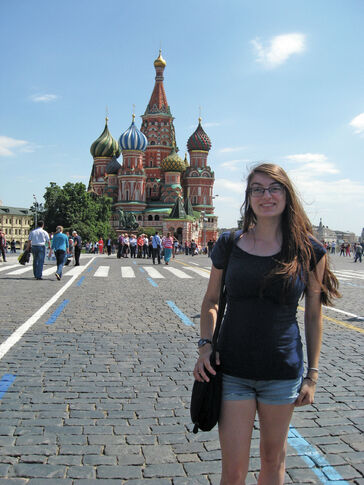
Mackenzie Stricklin, of Pennington, in front of Saint Basil’s Cathedral in Moscow, June 2014.
Mackenzie Stricklin didn’t have a reason for learning Russian. In fact, the Dickinson College dean’s lister made the decision somewhat whimsically.
Stricklin had studied Spanish through her high school years. As she began her college course of study, she decided she wanted to take a class in a language very different from what she already knew. “German and Russian were on the list. So I just looked at Russian and I was like, ‘I think I’ll learn Russian,” she said in a recent phone interview.
It’s fair to say that Stricklin and Russian hit it off. “I was picking it up really quickly,” she said. “It was a fun and different language for me — a different alphabet, different grammar cases. It was fun to learn, fun to listen to, fun to try to follow along in videos and books.”
Last summer, Stricklin spent the month of June in Moscow. Since returning, the senior has continued with her studies in the language. She is majoring in computer science, but she has enjoyed her experiences with Russian enough to make it her minor.
Stricklin has lived for 15 years in Pennington with her parents Anne Marie and Ron and sister Chloe. She attended Stuart Country Day School in 9th grade and Princeton Day School from 10th to 12th grade. She talked to the Hopewell Express about the experiences she’s had having chosen to study Russian. The interview has been edited for clarity and length.
Hopewell Express: It seems like learning the cyrillic alphabet would be a challenge.
Mackenzie Stricklin: In the first week or so of class, it felt like I was back in third grade learning cursive. For homework, in our workbook, we had those lined sheets where you would copy the letters and keep practicing the letters one by one. And for Russian, some of the letters in blocks (printed text) are different from how they are in cursive. So I had to learn the alphabet and then had to learn it again in cursive.
HE: Have you thought about using your major and your minor in conjunction, or are you studying them more or less independently of one another?
MS: It sort of started out independently. But I would love to be able to use them together in the future. I’d love to keep going with the language. It could make it a bit easier to find work in computer science.
HE: What was your month in Moscow like?
MS: I had classes in the morning, and in the afternoon I got to visit all the sites. I stayed with a host family. I didn’t really know who I was going to be with until I was off the plane. It was pretty nerve wracking not knowing, but the supervisor of the program brought me over to their apartment and helped introduce me so I wasn’t all by myself.
HE: Was it total immersion in the language? Did you have to speak Russian all the time?
MS: My host mother spoke a little English. She was actually trying to learn more, so sometimes she would speak to me in English and I would answer her in Russian. Having to speak it, being in the situation where you need to figure out how to say what you need to say, was really helpful. Even if there were phrases I didn’t really know, I was able to work around it.
HE: What was the general experience of being in a place like Moscow?
MS: In the beginning, I was definitely a bundle of nerves. I went to China for a few weeks in high school, but it was kind of a touristy trip, I didn’t have to speak the language at all.
Toward the middle of the trip the nerves wore off, and it was really exciting. I was walking around the city and I would be able to pick up on conversations I overheard, read all the signs and everything. By the end, I felt really great because I felt like my language skills had improved so much, but I was also pretty exhausted because my brain had to be turned on all the time.
HE: How did Moscow compare to what you expected?
MS: I didn’t really have an idea what it was like. I knew it was a city. I have not in the past been really good with cities. In Philly and New York, I don’t really feel comfortable. Moscow was completely different. There are not many skyscrapers. Everything was wide open, parks around almost every corner. It didn’t feel too overwhelming. It wasn’t exactly like a city in the sense that I had been used to. So it was not what I expected at all. That was great for me. I really loved it. I loved walking around, taking the Metro.
HE: And what was it like being an American in Moscow?
MS: People were very pleasant. They sort of keep to themsevles, no one really talks to strangers. But everyone sort of respects each other. They were very patient for the most part, whenever I would stumble over words or things like that. Sometimes people just started speaking in English if they knew English. That was a little bit sad because I wanted to practice more.
HE: What’s next for you with your Russian studies? Are you fluent or do you hope to become fluent?
MS: I think that’s definitely still a goal for the future. There is still a lot of vocabulary to work on, a lot of things I don’t know. I’d love to practice more and get to the point where I can start speaking in Russian without thinking about anything in English first.
,

