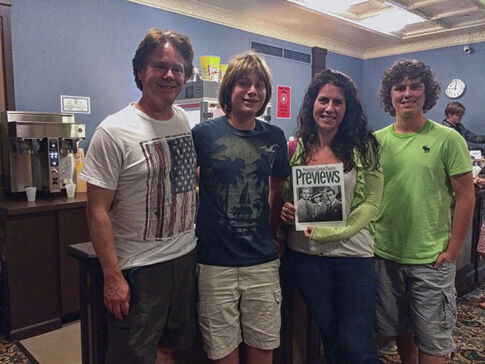
The Cushman family—Michael, Nicholas, Kimberly and Christopher—at Princeton Garden Theatre prior to the screening of Notorious.
By Jeanette Beebe
Megan Connor is a budding film buff. She’s headed to the New York Film Academy this fall, and she’s also a member of the nonprofit Princeton Garden Theatre on Nassau Street. She believes in movies. Even older ones. But she’s not convinced that the classics have any bite left — even Jaws.
“Jaws isn’t going to be scarier on the big screen—it’s like 40 years old!” Connor, 18, said with a playful smirk in the lobby of the Garden Theatre on June 25. As a Millennial, Connor was raised on easy, 24/7 access to small screen entertainment. At the Garden Theatre, she’s learning to love old movies—but with a filter of ironic nostalgia, because “classic” is cool, and “vintage” is hip.
Since last summer, the Princeton Garden Theatre has celebrated one of the Internet’s most popular social media trends—Throwback Thursday (#tbt)—with its weekly film series, Hollywood Summer Nights. On Wednesdays and Thursdays at 7 P.M. all summer, the Garden Theatre is reviving classic films from the Golden Age of Hollywood (Casablanca, Vertigo) as well as modern blockbuster classics (Raiders of the Lost Ark, The Godfather). The series began on June 4 with Singin’ in the Rain, and will wrap on Sept. 2 with North by Northwest.
It’s “Old Hollywood” at the “New Garden.” The Hollywood Summer Nights series is new for the Garden Theatre, which was transformed into a nonprofit by Renew Theaters in July 2014. Since 2010, Renew Theaters has screened classics in all of its historic movie theaters, most of which are in Pennsylvania: the County Theater in Doylestown, the Ambler Theater in Ambler, and the Hiway Theater in Jenkintown.
With the shy, charming cadence of a professional film geek, Christopher Collier, associate director at Renew Theaters, seems to know why classics like Jaws are attracting big crowds at the Garden Theatre this summer.
“Jaws is absolutely a big screen movie,” he said. “You feel the intensity of the audience around you. It was the first official summer blockbuster.”
Collier said the goal is to build the theater into a cultural landmark and to engage the community—especially young audiences. His team believes that these Golden Age films deserve their names up in lights on Nassau Street— and that they deserve to be seen again, with a fresh perspective.
“We want to attract film buffs,” Collier said. “And also cultivate the film buffs of the future.”
At the Garden Theatre’s 40th Anniversary celebration of Jaws, co-written by Princeton resident Peter Benchley, the lobby buzzed with activity. Manager Michael Kamison told me that the Jaws screening was so popular that the movie sold out online. The theater opened up its second screen, which enabled them to sell tickets at the door.
It was a packed house, but the operation was efficient: one fast-moving line of popcorn and candy enthusiasts snaked around the lobby’s perimeter toward a trio of teenagers competently managing the concessions stand, while a smaller, less patient group of moviegoers lined up directly behind the ticket taker, a chatty, unflappable and quick volunteer who “rips tickets for a half hour,” checks receipts on the phones that flash by, and gets to see films for free.
Jaws opens with a scene in bright daylight. The film is terrifying because the monster doesn’t hide in the shadows— it lives in plain sight. And when you feel the sea of nervous people crowded around you in the dark theater, and dread the inevitable shock of gore, the inky blood in the water, and the crunch of bone, you somehow forget that it’s still sunny outside. It’s a weekday in June.
That experience can only be felt in a movie theater, with surround sound, a dark house, and a screen big enough so that it’s the only thing you can see. A full theater is breathtaking: everything feels bigger, more intense, full of power.
Afterward, Abby Fisch, 15, of South Brunswick, admitted that the film was “scarier on the big screen.” Her friend, Eric Ciparis, added that even though he’d “seen it a million times” at home, the “surround sound atmosphere” of the theater made the film seem scarier.
Nothing compares to watching a film in a theater. Not a computer, a tablet, a phone, or even at home in a recliner, on a full HD flat screen TV. Yet many Millennials like me find it easier to download or stream movies than to pay for a ticket and make a trip to the theater. Many of us have converted to Netflix, Hulu, and Amazon, driving video rental stores and small theaters out of business.
In the last 10 years, many movie theaters—from the multiplex in the mall to the two-screen small town theater—have faced another kind of conversion: from 35mm film to digital projection. In 2013, Princeton University invested $500,000 to update the Garden Theatre’s projection equipment from film to digital.
Why would a historic art house theater leave 35mm film projection behind? Because now, Hollywood distributes most movies digitally, on DCP (“Digital Cinema Package”) hard drives. Theaters have had to change with the times.
As a freshman and sophomore at Princeton University, I worked as a 35mm film projectionist in the Frist Campus Center Film and Performance Theatre.
First, I would unload and examine the 35mm film print reels in the projection booth. Then I would carefully splice the reels together, and make up and lace up the film. When students took their seats and I was given the all clear, I would press the projector’s top button, which would feed the film and begin the screening.
The most difficult moments were when I had to monitor the film as it made the switch between projectors, when one reel ended and the next began. It was a painstaking but thrilling process.
Now, with digital technology, screening a film seems as simple as pressing “play.” But it wasn’t so easy at the Garden Theatre’s July 22 screening of Notorious, Hitchcock’s 1946 black and white espionage thriller. Moments into the opening credits, the film looked fuzzy, as if the image were off center or out of focus. I briefly wondered if this is what an old film “should” look like — but of course, it was a glitch; it’s digital.
In the lobby, three young managers tried to take the “keep calm and carry on” approach. “We’re worried about it for them,” they nodded toward the theater. “This is unheard of,” the projectionist stammered.
Whether processed through Technicolor, a black and white digital package, or a 4K restoration, the classics at the Garden Theatre have always looked vivid to me. After the movie, the audience stood in applause and walked out of the theater, where they were greeted with apologies and free movie passes. Though thankful, some patrons looked confused; many didn’t even seem to have noticed that the film had been out of focus.
One exception is Christopher Cushman, 17, who attended the screening with his brother Nicholas, 13, and his parents, Michael and Kimberly. “I noticed it, but that didn’t make me dislike it,” he said. When asked whether the fuzzy image reminded him of a pixelated online video, he laughed. “A black screen buffering in the theater like on Netflix or YouTube — that would be so much worse!”
Michael Cushman, a longtime resident who attended the Garden Theatre’s original 1975 screening of Jaws, decided to sign up the family as theater members last summer. (His vintage photo is featured on the Garden’s Facebook page.)
“I knew I would be taking my family to the Garden many times,” he said. “Now, they know a great movie is a great movie, no matter when it was made.”
Whether it’s shock and gore (The Godfather), old school suspense (Notorious), or a bit of both (Jaws), the classic films that have taken over the big screen at the little theater in Princeton are scaring audiences silly—and they keep coming back. The Garden’s first screening of The Godfather sold out so quickly that the theater had to turn people away (with free popcorn) at the door. Management decided to bring back the gangster classic for an encore screening.
Chatting before the opening credits, three twenty-somethings said that they’ve made going to the classic film series “a thing” because “these movies are just meant to be seen this way.” And it’s not just the big blockbusters that draw the crowds. “Even Vertigo was packed!”
In August, the Garden Theatre will screen blockbusters (Raiders of the Lost Ark, Aug. 27; Gone with the Wind, Aug. 30), romantic comedies (You Can’t Take It With You with Jimmy Stewart, Aug. 5; Roman Holiday with Audrey Hepburn, Aug. 20), noir thrillers (The Third Man with Orson Welles, Aug. 6; Hitchcock’s The Birds, Aug. 13; and more. A complete listing is online at thegardentheatre.com. The series will close on Sept. 2 with the Hitchcock classic, North by Northwest.
Princeton Garden Theatre, 160 Nassau St., Princeton. $11 general admission, $6 members, $3 students, $3 for patrons 18 years old or younger.
,

