After 30 years as the Off-Broadstreet Theatre, the building on 5 South Greenwood Avenue is scheduled to reopen as the Hopewell Playhouse. This transformation, set for January 2016, will be the fourth incarnation for a building erected in 1940 and located in the heart of Hopewell Borough.
Proposed improvements for the Hopewell Playhouse include an interior overhaul and the installation of new lighting and sound systems. Jon McConaughy, of Brick Farm Market fame, purchased the building in 2012 from Julie and Bob Thick. Joining him were two other Hopewell-based partners: Mitchel Skolnick, who owns Bluestone Farms, a racehorse breeding and training site, and Sky Morehouse, who runs Morehouse Engineering.
The new owners plan to expand programming and host a variety of performances once the Hopewell Playhouse opens, and the Thicks’ dessert theatre will also be returning.
“The ultimate goal is we’re trying to put as much technology as we can to make it a good performing venue,” Morehouse said. “We’re trying to concentrate on making the space technologically sophisticated so it can house any performance.”
The early years
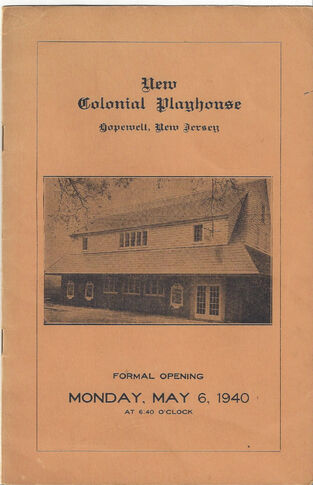
The technological improvements underway are reminiscent of the building’s origin as a movie theater. Then known as the Colonial Playhouse, when it first opened on May 6, 1940, the theatre was hailed for its state-of-the-art movie experience.
“Nothing has been left undone to give the people of Hopewell and its vicinity a theater not only of the most up-to-the-minute construction and furnishings, but with every latest device designed to improve vision and hearing irrespective of seat location,” announced the Hopewell Herald in its May 1, 1940 issue, which is available on the Hopewell Playhouse Facebook page.
The Hall brothers, Dick and older brother Jim, are lifelong Hopewell residents who as kids enjoyed the black-and-white movies at the Colonial Playhouse. Their mother was a member of the Pierson family, great-uncle George started the Hopewell Pharmacy next door to the theater, and they grew up on Centre Street.
The Colonial Playhouse replaced Columbia Hall, a two-story comunity center. Jim recalls Columbia Hall, describing a truly a mixed-use building. In addition to hosting film screenings, the firehouse was stationed in the building. Borough Council meetings and elections were convened on the first floor, and there was a dance hall on the second floor. A motorcycle repair shop was also sandwiched onto the site. A gentleman named Herbert Laird ran Columbia Hall, and led the effort to build the new Colonial Playhouse movie theater.
While attending high school across the street, in the building currently occupied by the fire department, Jim ushered at the new movie theater a few nights a week.
“It was a nice little theater. It was quite up to date in those days, and they had cartoon matinees on Saturday for the kids,” Jim said. “The pay wasn’t too good but the movies were. They didn’t open until late afternoon and they went up to something like nine ‘o clock.”
Soon after the original Playhouse opened, Jim enlisted in the Army and served in Europe during World War II. Upon returning to Hopewell he did carpenter work and later ran Jimmy’s Corner Store, which was started by his grandmother and located on Greenwood Avenue and Railroad Place.
Jim’s younger brother Dick was in elementary school when Colonial first opened.
“It cost 10 cents. Us kids would go down and stay for the whole day,” Dick said.
As a building contractor 20 years later, Dick installed fabrics on the wall and expanded the driveway for car access when the Gallup company converted the building into a public polling station. Dick did contract work for noted architect William H. Short, and he worked on Guernsey Hall, in Princeton, as well as Hillside Farm, owned by Betty Johnson.
In the 1960’s, George Gallup Jr., whose father founded the Gallup polling company, purchased the property and converted the movie theater into a public polling site.
According to Julie Thick, the “Mirror of America” site held religous and commericial polling in what is now the main theater area. Audiences were invited to watch movies, and they would be polled on the advertisements.
Bob Thick says Gallup was also a “thespian” who would host Gilbert and Sullivan operettas in the building for entertainment.
However, the Gallup company’s main building was in Princeton. The polling station in Hopewell was an extraneous building that became underutilized in the eighties.
The theatrical Thicks
A professional singer living in Princeton at the time, Bob was a tenor soloist at Trinity Church. Gallup also attended Trinity, and the two became friends. Bob remembers Gallup was responsible for adjudicating the Academy Awards, and a nervous Gallup would first rehearse his presentation to the Academy members with Thick.
When Gallup overheard Thick talking about the search for a theater space, he reached into his pocket and gave Thick the key to 5 S. Greenwood Ave., encouraging him look and see whether the building suited his needs. In 1984 the Thicks leased the building from Gallup and moved to Hopewell, purchasing the building several years later.
Starting a theater was always something Bob wanted to do. He grew up in Michigan and his parents owned movie theaters. As a student he performed at True Grist, a theater in the town of Homer, Michigan, and after college he toured as a professional singer.
“I always carried that idea of starting a theater in the back of my head,” Bob said.
Julie is from Piscataway and attended Douglass College, now part of Rutgers, on a gymnastics scholarship. A dancer, Julie met Bob when she was hired to teach him soft shoe tap for the role of Harold Hill in The Music Man.
When they first occupied what became the Off-Broadstreet Theatre, the building was in disrepair. More than thirty years later, the Thicks still remember the help they received from the community.
A creek runs behind the building, and Julie recalls the ground floor was flooded with mud when they first occupied the building. The fire department across the street helped pump out the mess.
They also needed a kitchen cabinet set. Luckily, the building was situated, and still is, between two community hubs: the post office and the Hopewell Pharmacy.
“Word spread that they need this, needed that,” Julie said. “The next day two kitchen sets were outside.”
And for a long time the door latches were broken, and Bob would tie the door together with rope after hours.
“Sometimes I’d forget to lock the building, but we didn’t need to,” Bob said. “We like Hopewell a lot.”
In the past 30 years the Thicks produced more than 245 shows of varying genres, going from 34 season ticket holders to more than 1,000.
Bob builds the set and directs the performance, while Julie handles the day to day operations and choregraphs the show. The couple form the theater’s play reading committee, and after pre-planning there are auditions and then rehearsals.
After selecting a play, the couple then spends at least several thousand dollars on production rights, and other costs include maintaining the building, providing dessert, and paying the actors.
“People think the production they see sort of happen,” Julie said. “They don’t realize all the preparation. I can’t tell you how many people say to me how nice it is you only work three days a week.”
The theater serves as a training space for aspiring performers. The Thicks estimate six current Broadway performers have previously acted at Off-Broadstreet, including Tera-Lee Pollin of Mamma Mia and Thom Warren of The Lion King.
Aside from theater performances, the Off-Broadstreet Theatre has served as a community venue, hosting concerts and fundraising events for local organizations such as the Hopewell Library.
Over the years, the Thicks have welcomed returning patrons, who then take their kids and grandkids to the theater’s children plays.
“The audience has aged along with us,” Bob said. “We’re seeing generations of people. It’s scary.”
The Thicks wish for the building to remain a space where the community will gather. They initially rebuffed Jon McConaughy’s offer to purchase the space, but in 2012 they sold the building and leased it back after both sides focused on the importance of community.
For the first time in decades, this year the Off-Broadstreet Theatre has not scheduled performances year round. The last play, Family Furniture, a family drama set in the 1950s, ended in its run in March and the site is undergoing an extensive renovations.
The theater is set to reopen in January as the Hopewell Playhouse. Faced with downtime for the first time in recent memory, the Thicks took their first vacation in 15 years, a Caribbean cruise, and have made a point to attend theaters the area over. Multiple rooms in their Prospect Road house have been painted anew. After sampling retirement, however, the Thicks conclude it doesn’t suit their taste.
“Having gone from 30 years nonstop to stop, it has been difficult,” Julie says. “We’re thinking of shows for after the holidays. As soon as they’re ready, we’ll be ready.”
Hopewell Playhouse
Initially, Jon McConaughy was the sole owner of Off-Broadstreet Theatre after purchasing the building from the Thicks in 2012. Soon after, Baxter Construction, a Hopewell-based firm owned by Jim Baxter, renovated the exterior, installing a new roof, windows, and siding. Baxter Construction is also the general contractor for the interior renovations currently underway.
McConaughy is now joined by three other partners, all based in Hopewell. There is Mitchel Skolnick of Bluestone Farms.
The other partners are Sky and Liza Morehouse. They moved to Hopewell in the mid-eighties and are longtime patrons of the Off-Broadstreet Theatre. Sky runs Morehouse Engineering, a firm that specializes in automating processes and electrical engineering, and Liza is an active volunteer, serving on the board of D&R Greenway Land Trust and Morven Museum. She also chaired McCarter Theatre’s Gala Benefit Committee this year.
“The concept of a dessert theater was great,” Morehouse said. “It started late, you could go out and have dinner and then enjoy dessert with a good, local performance. The building itself needed a face-lift, and that’s what we’re doing.”
In a nutshell, the partners are bringing the building into the 21st century. An engineer specializing in process control projects, Sky enthusiastically describes the technology systems being added to the theater, in which McCarter Theatre stage supervisor Stephen Howe and sound engineer Bill Kirby were brought in as design consultants. There are plans for a new lighting and audio systems, connected into central digital network, as well as video monitors. The building’s electrical and HVAC systems will be replaced, and fire sprinklers will be installed.
“The goal is to make it a more comfortable environment that can support multi-genre performances from music, to movie, to theatrical, to literary readings,” Morehouse said. “We want to bring enough technology so we can light it properly, and have appropriate acoustics for all of those performances.”
Extensive interior renovations are planned as well. Two sections of fixed seating will be installed in the main theater area, though a center section between the seating and the lower section toward the stage will remain flexible and feature tables and seats. The ceiling above the main seating area will be removed, replaced by a second floor mezzanine balcony. Removing the ceiling will also expose the audience to the wooden trusses bolstering the roof, and a new roof with exterior insulation will be installed.
In the lobby, there will be two bars for catered events, and handicap accessible bathrooms will be added to the ground floor. On the second floor, there will be a private cigar/special event room with its own HVAC and air control system. The room was previously a movie projection room, coated in concrete to fireproof the space from flammable film cellulose.
All told, the transition from Off-Broadstreet Theatre to Hopewell Playhouse hasn’t been cheap. Initial renovation estimates were $1.2 million, but the actual figure is approaching $2 million, according to Morehouse.Nonetheless, he estimates a whole new building would have cost at least twice as much, and given the building’s historic significance the partners never considered a complete tear down.
Once the improvements are complete, the partners intend to host more performances.
“Our goal is to have a performance every night if we could,” Morehouse said. The intention is to have a manager run the place. None of the three partners are in the [theater] business.”
The final theater composition will be akin to another technical performance venue, the Berlind Auditorium at McCarter. However, with seating currently at around 260 and an open format that may accommodate 100 more people, the goal is not to compete against McCarter, but to develop local artists.
“It’s the same old stuff,” Morehouse said. “The idea is it will be a comfortable and enjoyable place so you have enough momentum to get out of your house and bring people out into the community.”
A soft opening for the Hopewell Playhouse is scheduled for Jan. 10, with a performance series produced by the Thicks. The current lease between the partners and the Thicks calls for two series of performances, after which it will be eligible for renewal.
The Thicks eagerly await the unveiling of the new theater, they are particularly excited about the ground level bathroom, though of course after so many years operating in a familiar space, they are unsure what awaits them.
The acoustics in the Off-Broadstreet Theatre were impeccable. Formerly a movie theater, the main stage did not have fly space above for a performer to drop in, nor any wing space to send in set pieces, as curved walls flanked both sides of the stage. While this forced Bob to craftily adapt plays to make it work and fit into a space considered cramped by theater standards, the design formed a natural megaphone for performers. In 30 years only two plays involved microphones, and those were used for sound effects. The removal of the ceiling to expose the roof and the addition of the balcony are expected to change the dynamics.
“We’re not quite sure yet what that does to the acoustics,” Bob said. “Nobody does.”
In addition, the flat ceiling served as the attic floor, which the Thicks used to store the mountains of costumes, props, and furniture pieces that they have accumulated over the years. For easy access, theater storage is usually on site or in the next building.
Future challenges aside, the Thicks are content there remains a building where the community can gather. The stage itself will remain unchanged, and having reworked plays to fit into Hopewell Borough all these years, the newest iteration of the building on South Greenwood Avenue is simply the latest puzzle for the Thicks.
“One of the things we pride ourselves is we make it work in our space. For us, we can’t do Chicago like they do in New York City,” Bob said. “That’s the fun part of it.”`
,

