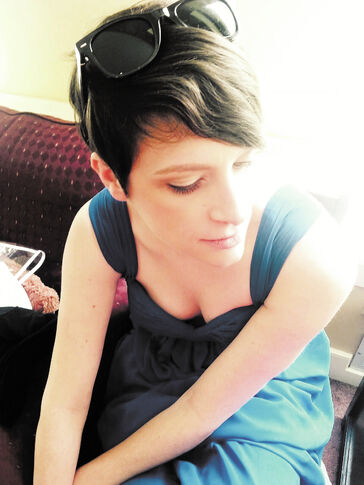
Michelle Hart, a Ewing native, is putting the finishing touches on her first book, a novel based on her own life experiences.
By Madeleine Maccar
It was during her freshman year at the Pennington School that Ewing native Michelle Hart realized she wanted to be a writer.
Bolstered by both encouragement and extracurricular reading recommendations from her teachers, Hart’s first ventures into word-slinging were punctuated by early victories, like having both a short story and a poem published in the private high school’s literary magazine.
“I was always in love with storytelling,” says Hart, who is currently living in Manhattan. “My freshman English teacher in high school—William Hutnik—encouraged me to write creatively. When I was the only freshman whose work got accepted by the literary magazine, it felt really great and gratifying.”
Hart then adds with a laugh: “I’ve been spending all this time trying to reclaim that initial feeling.”
Other high school teachers would subsequently take a special interest in Hart’s writing, suggesting that she keep a journal or simply fueling her creative spark. As an undergrad studying English and philosophy at Hofstra University, Hart found a similarly supportive network of professors—including writer Martha McPhee, who pointed Hart toward a graduate-level writing class.
Hart was 18 and continuing to develop her voice, when tragedy struck. Her mother, who Hart remembers having been sick throughout her childhood, finally succumbed to cancer.
“Eighteen’s a weird age because you’re at the cusp of becoming an analytical adult who can process things but you’re also still sort of a kid,” Hart says. “I was always young enough so I could not think about my mother being sick. I didn’t know that her death was going to be a possibility.”
Over time, Hart turned to writing to help in processing her mother’s death; by the time she was 22 and participating in an advanced writing class at Hofstra, she had found herself crafting a novel about the experience as her way of fully understanding both it and her mother.
“I was never interested in the short-story form as a writer, and so when it came time to submit something for a workshop, I had started writing a book about my mom—and I didn’t stop,” she says. “Now here we are, four years later, and I’m almost done with it.”
Hart has chiseled away at a fictionalized autobiography of sorts that has given her an avenue for talking about her mother’s illness and death when she wasn’t entirely sure how else to broach the subjects.
“I needed to write about it in order to understand it because, at the time, I didn’t really understand what was going on,” says Hart. “A lot of the first parts of the book deal with this kind of not knowing, this kind of a denial.”
Like scores of scribes before her, Hart, a self-described “malleable writer,” cites a range of literary influences, ranging from modern-day favorites to the now-classic Keats’ oeuvre that a keen-eyed high school teacher led her to more than a decade ago.
Despite feeling more at home with the novel form, Hart appreciates the short story’s place in the literary canon, especially as it relates to her longtime affection for Amy Hempel’s collections.
But it was a fateful run-in with Jeffrey Eugenides’ Pulitzer Prize-winning novel Middlesex that has broadened Hart’s perspective while also providing her a roadmap of sorts when it comes to writing about the importance of family in an individual’s singular narrative.
The first novel she read after her mother’s death, Eugenides’ sprawling tale of how one genetic quirk works its way through three generations is both a coming-of-age tale and a genealogical epic that struck a symphony of personal chords with Hart.
“I’ve never read anything like it before: It felt both epic and intimate at the same time,” she says. “It’s a book that’s very much about family, and the story also involves this kind of sexual and romantic confusion that I couldn’t help but associate with losing my mom. All those things sort of came together for me.”
Hart would eventually approach the novel from an academic perspective when it became the central focus of her undergraduate thesis.
But it was her emotional connection to the story—compounded by its awakening protagonist’s constant astonishment at discovering his parents had lived entire lives before his birth—that not only helped her cope with losing her mother but also propelled her toward her own novel about family and self-discovery.
A lifelong love of reading also has influenced Hart over the years, and she freely admits that fictional characters were some of her best friends growing up. She speaks of the “Harry Potter” series with the same fondness used to describe the literary idols of her teenage and adult years; in fact, she discovered Hempel’s works by attending a book reading from Chuck Palahniuk when she was 16 and bashfully asking who the subversive writer’s own favorites were.
For all the different wordsmiths from whom Hart has drawn inspiration over the years, the firsthand influence of one merits particular mention: Her father, David A. Hart, is a writer, too, with the young-adult series Adventures Along the Jersey Shore and Revolutionary War-era two-part saga Trenton among the media-spanning published works to his name.
“I grew up with Harry Potter and Hermione, as well as my dad’s books,” Hart says. “Just this past May, my dad was one of the featured writers at the Book Expo of America. It was a cool opportunity to be there with him: There he was at the more advanced stage of his career, and then there’s me sort of at the beginning of my career—it felt like the family enterprise.”
While not all parents can feel genuinely enthusiastic when their children voluntarily hurdle headfirst into the sometimes-turbulent future that comes with a writing career, Hart says that growing up as the only child of two imaginative and supportive parents made for “a household that definitely encouraged creativity.”
In fact, the elder Hart says that his daughter has been his inspiration to keep writing, as he and his partner on Adventures Along the Jersey Shore both had teenage daughters they kept in mind when they were populating their stories with teen protagonists. But he also says that his daughter is more like his teacher these days.
“Michelle has read everything I’ve written, and she’s always giving me comments and suggestions—and more and more, I see the validity of her advice,” he says. “I’m a historian by nature so I tend to read a lot of non-fiction and biographies, and she’s always telling me that if I’m going to write fiction then I’d better read more fiction.”
A lifelong Ewing resident currently residing in West Trenton, David Hart worked for a local insurance company for more than 40 years before recently retiring early to focus on his writing career. While he didn’t dedicate himself to the craft in earnest until a few years ago, David Hart has dabbled in everything from poetry to songs, from screenplays to novellas—and has even won a few awards along the way.
He feels that his daughter benefited from “the best of both worlds,” as his creative influence worked in tandem with his wife’s background in education. He says that his daughter was focused on an array of athletic pursuits until her English teachers at The Pennington School “gave her some opportunities that she just ran with.”
The father and daughter duo enjoy a close bond, and they see each other often for pizza and to watch movies and television shows that they later discuss and dissect—and, of course, to talk about their shared love of writing.
“Michelle was one of the reasons I got into writing,” he says. “It’s better than anything you can imagine for a father and daughter to share as many interests as we do and for her to pique my interest the way she does—she writes circles around me now. I’m more of a pop-culture writer and she’s more literary. We keep learning from each other, and I know she’s destined to be successful.”
In her ongoing evolution as a writer, Hart has also been taken under the wing of Akhil Sharma, an author whose sophomore novel Family Life won this year’s Folio Prize for fiction. Sharma is a professor within the creative writing MFA program at Rutgers University’s Newark campus, from which Hart recently graduated and in which she also works as an English professor.
“I met Akhil on my first day, and he told me that he was the one who pushed my manuscript to the front; ultimately, I think he’s a large reason why I got accepted into the program into the first place,” Hart says.
They worked closely together on her short stories over the next two years; when he became her thesis advisor during her last semester, Hart found no resistance upon deciding to switch her focus to the novel that puts a fictional spin on the very real resonance of her mother’s death.
“It’s funny how the timing works out: Akhil has just published his own autobiographical novel “Family Life” to a lot of acclaim,” says Hart. “It was a New York Times Top 10 Book of the Year, it won Britain’s prestigious Folio Prize, he was just awarded a Guggenheim Fellowship—he’s been amassing a lot of acclaim for this book that is very much about his life and his childhood and, as the title would suggest, his family life. And now I’m meeting up with him and going over revisions for my autobiographical book. He’s just been so gracious and I’m incredibly grateful for it.
As she nears the end of the writing process—“and endings are very hard,” she says—Hart has headed to the writing workshops at the New York State Summer Writers Institute at Skidmore College in upstate New York with the number-one goal of finding “some time and space to finish the book”—and also because of another well-timed twist of writerly fate.
“I’d be lying if I said that Amy Hempel wasn’t a big draw,” Hart said of the summer institute, where Hempel headed an advanced fiction workshop. “Once I heard it was a chance to work alongside her, it was is too exciting an opportunity not to take.”
Having already generated interest in her novel, Hart says that she wants to act on that buzz as quickly as possible but can’t do anything until she has a finished manuscript in her hands. It is that completed novel Hart hopes will join in the literary conversation she grew up listening to.
“I want to write a book that is very much about the female experience,” she says. “I’m hoping this novel injects itself into the cultural conversation in that way. I’ve noticed this larger dialogue going on about representation in media and how feminism is sort of a curse word, which is distressing.”
The ultimate payoff for Hart, though, is the thought of making a connection with another person as the writers she admires have influenced her.
“I grew up reading and writing, and the idea of participating in that exchange by having somebody who’s 15 take my book off the shelf and read it the same way I read Middlesex is just so awesome to think about,” Hart says. “That’s the dream, if you can reach even one person the way a book reached you.”
,

