Hopewell resident Martha McDougald would describe herself as a bleeding heart. After retiring from a career in psychiatric social work eight years ago, McDougald retained the desire to make a difference in the lives of others. A friend suggested that she become a child advocate with Mercer County’s Court Appointed Special Advocate (CASA) organization, and McDougald felt that it would be a good way to continue doing what she loves.
McDougald has lived on the McDougald Farm along with her husband Frank for the past 45 years. Together, the couple have four children, Molly, Annie, Mac and Tim, who grew up in Hopewell Borough. McDougald has a background in working with troubled kids and she and her family spent many years hosting children through Princeton’s YMCA Interim Homes program.
Growing up as an “army brat,” she attended over 16 schools across the country. McDougald couldn’t wait to settle down in one place after she got married. She and her husband decided that Hopewell was the perfect location set between their jobs in Philadelphia and New York City.
“Because I went to so many schools, I knew what it was like to be alone,” McDougald said. “I’ve always been concerned with who’s looking out for the underdog. So, I thought [CASA] would be the thing to do.”
A national organization that aims to represent and protect minors in family court, CASA of reports that each year more than 1,500 children in Mercer and Burlington Counties are sent through the foster care system due to issues of abuse, neglect or abandonment.
CASA volunteers observe their assigned child in his or her environment to provide a detailed report for the judge to use in court. The goal is to help the judge make the most informed decision when it comes to the fate of the child.
“For the judges, there was never a black and white,” McDougald said. “If there were two parents, the dad would say one thing and the mother would say something else. The judge had nothing to make a judgement on.”
Since CASA advocates are strictly volunteers, they are able to provide a straightforward report to the judge and an unbiased opinion.
“Because there’s no money or anything in it, we have nothing at stake,” McDougald said. “I’m advocating for a kid that has no voice. Everybody else in their life has an agenda. So, CASA is really important, we’re just there to oversee and protect them.”
McDougald began volunteering with CASA five years ago when she was assigned her first case: an 11-year-old boy with severe autism living in foster care. She has been working with him ever since, and has now seen him develop into a 16-year-old high school student.
McDougald says that her child representative was diagnosed with mild autism between the ages of three and five, but after experiencing neglect in his home life, his disability worsened. Though the teen was originally from Mercer County, he currently resides in a public academy by the shore run by the Department of Child Protection and Permanency.
“He has a DCPP worker that is his guardian, but there have been nine of them in the past five years,” McDougald said.
In situations like these, a CASA volunteer can be one of the few constants in the child’s life. He or she is therefore the most qualified person to help the judge decide what type of environment would best fit the child’s needs.
As a CASA volunteer McDougald visits her child about once every three weeks. She says that the amount of work involved depends on the family dynamic of the child. Volunteers that work with families typically see the child every week and often have more people to keep in contact with including a foster parent, a birth parent, a school and a psychologist.
For McDougald, a day of visiting involves getting see her child at six in the morning. She observes him as he prepares for school and shadows him throughout the school day to see how he’s doing with his academics and social skills.
McDougald stays in contact with her child’s teachers, aids and DCPP guardian. She is required to give an updated report every three months for the judge to assess in court.
Like many CASA children, McDougald says that her child comes from a difficult background. When McDougald first began working with him, he had just been transferred to a foster mother and it was clear that he had never slept in a bed before.
“I think when they got him, it was obvious that he never had a bed because when he went to a foster mother, he would take the mattress off and put it on the floor and sleep there.”
While many advocates and guardians aim to set their child up for adoption, McDougald says that this wasn’t the best option for her CASA student.
“The problem is the people that would adopt him, if they did, he would be a cash cow because you get paid a lot of money for special care by the state,” she said.
McDougald said that if the child was adopted, he would no longer have an advocate to look out for him and therefore would have no one to ensure that he is receiving proper care. The group of advocates determined that he would be better off living in the DCPP cottage with support aids, where he would experience a more social environment in public school.
After working to determine the best set-up for her CASA child over the last five years, he is fairly settled, McDougald said. The teachers and aids that he has are wonderful and will always contact her if he’s having a problem with something.
According to McDougald, her CASA child has a brother who was adopted by a couple in Princeton. She is currently working with the adopted mother to see if she will become the guardian for her CASA child as well.
Depending on the family and the situation, working as a CASA volunteer can be gratifying in many different ways.
“For me, it’s rewarding to know that there are people in the world to take care of kids who have no way to speak for themselves,” McDougald said. “It’s remarkable that in a little town there’s this many people who really will take care of this child. It’s amazing.”
CASA Mercer County is currently accepting new volunteers for those who are interested in helping children displaced from their homes. Information sessions for potential volunteers are held at the CASA Mercer County office twice per month. Sessions offer information about the program and the opportunity to ask any questions.
CASA’s next information sessions are set to take place Thursday, Dec. 10 at 10 a.m. and Wednesday, Dec. 16 at 5:30 p.m. at 1450 Parkside Avenue, Suite 22, in Ewing. Those interested should contact Jill Duffy at (609) 434-0050 or at jduffy@casamercer.org.
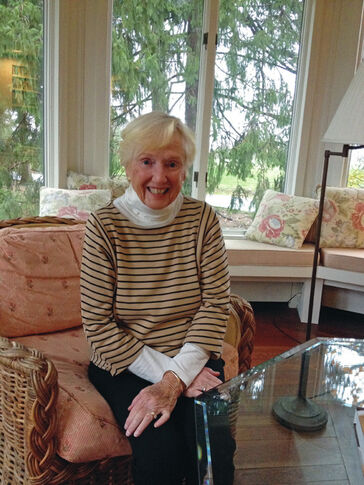
A retired social worker, longtime Hopewell resident Martha McDougald has volunteered for CASA of Mercer County the past five years.,

