Ewing’s Bob Smith has been a musical presence throughout the decades
By Scott Morgan
Few moments in life signify that you’re getting older like the first time you hear a recently released song and realize they’ve stopped making good music.
At the same time, few truisms are as true as: They don’t write ‘em like that anymore. And on the spectrum of great songs they don’t write ‘em like anymore, those from the Big Band and Swing eras are still the gold standard.
Standing guard over this eternal flame of classic American music is Bob Smith, who, along with his wife, Deb, has been playing exactly the kind of music that makes you lean back a little more relaxed in your seat and smile about wistful memories for years.
Odds are, if you’ve been out to dinner in a 25 mile radius of Ewing in the past 40 years, you’ve seen and heard Smith coax sweet melodies from his clarinet. And if it’s been in the past 10 years or so, you likely would have seen him with Deb accompanying him on the upright bass.
If you haven’t seen Bob Smith in person, you would have heard him if you’d listened to WBUD in the 1970s and 80s. His big band, the Lamplighters, was the station’s official band for a while then. Of course, that’s only one part of the Bob Smith story.
A more complete picture starts back in the mid-50s, when the 10-year-old Smith first picked up a tenor sax and studied under Anthony Schunk. Over the next seven or eight years, the young Smith played an enormous amount of sandlot baseball.
His father, who saw the great musical potential inside the boy, wouldn’t let him play on the Ewing High School teams because his father had invested too much money in his son’s music lessons to put him in danger of breaking his fingers.
Still, Smith is a lifelong fan of sports. “I think I could have been a really good baseball player,” he said. He was an outfielder, and not for the reason many young kids are stuck in the outfield (because they can move fast enough to play the infield). No, Smith could cover some ground and he could throw.
“Of course, I was about 100 pounds lighter then,” he laughs. “But I could really run fly balls down.”
OK, so maybe he wasn’t quite as fast as his brother, Rich, who played second base (“There’s a guy who could run like a deer”), but fast enough to snare hanging flies and strong-armed enough to get the ball back into play in the infield.
Smith at least got the chance to coach youth sports for his four children, an experience he found nearly as rewarding as his music career.
But let’s not get too far ahead of ourselves, we’re still in 1963, when Smith, now an accomplished clarinetist, joined the Ewing Dance Band and took the role of leader. He changed the name to Bob Smith’s Lamplighters, and a year later played at the New York World’s Fair, representing New Jersey.
That same year, the Lamplighters began playing weekly gigs at the officers clubs at Fort Dix and McGuire Air Force Base, and the band’s notoriety grew, according to Carla Gaiser, a longtime friend, occasional bandmate, and tireless advocate of all things Bob Smith.
“I met Bob when I was a sophomore in high school,” said Gaiser, also a longtime Ewing resident. “He was a senior; we both played in the orchestra. It was obvious how good he was, even at that age. After he took over the Ewing Dance Band, I played the piano for the Lamplighters for about a year when I was in high school.”
Gaiser was far from the only musician who played with Smith and the Lamplighters. Some 350 musicians found their way into the ranks of the band over the years. “Those who moved on always left as seasoned professionals under Bob’s direction,” Gaiser said.
And along the way, they learned to play some killer music. The Lamplighters’ oeuvre included interpretations of the works of Benny Goodman, Artie Shaw, Tommy Dorsey, Count Basie, Duke Ellington, and, Smith’s largest musical hero, Glen Miller. (Seriously, if you ever want to hear someone get lost in passionate discourse, ask Bob Smith about Glen Miller.)
As the band moved into the 1970s, Smith and his ensemble continued to back some of the greats, including Jimmy Holmes of the Ink Spots (“I Don’t Want To Set the World On Fire”) and find enough work at area clubs, restaurants, and events to play most nights in any given month.
Of course, a lot of the band’s success, Smith said, came from his fleet-footed brother, Rich, who served as the band’s arranger and booking agent for 38 years. Rich stopped working with the band because, Smith said, “he wanted to do a lot of other things. Education was his main thing.”
For Smith, the music just got better, as did his band’s ability to mimic the interpretations and smooth musicality of the great swing bands and big bands. None other than the great Otto Helbig, who produced and directed the only known recording of the combined Jimmy and Tommy Dorsey bands, told Smith, “You imitate the sounds of those original bands better than anyone I’ve ever heard.”
“That was maybe the best compliment I ever got,” Smith said.
From 1978 to about 1982, the band grooved exactly right for Smith. This was the era when his band sounded its best, he said. There were practices most weeknights and gigs all over the place, and “we really enjoyed playing those lush sounds.”
All this music was managed, by the way, alongside a career with the state Department of Transportation. And considering the amount of gigs Smith and the gang got, it’s for sure a tribute to chasing your passions, regardless of what’s in the way.
His says his most memorable gig was at the New Jersey State Fair, where he played for a crowd of 10,000, but there were several moments he enjoyed as much as anyone chasing his passions would.
The 70s, of course, brought Smith his greatest bandmate and ally, his wife Deb, whom he met in the delightfully old-fashioned way of a classified newspaper ad.
No, not that kind of classified ad. Smith was a bandleader looking for a bassist. Deb answered the ad and knocked his socks off with her musical abilities and, well, herself. The two have been playing together for 40 years, married for 37, and at age 68, Smith said this: “Without my wife, I don’t know what I’d do.”
The couple had four children, who grew up playing sports aplenty in the Ewing and Hamilton leagues. Smith coached baseball and softball, even after his daughter grew past the age to play. The kids, as you might expect, are quite musical, too. One son, Jimmy, played bass in the band Generation Next, another, Christopher, is a heavy metal drummer.
By 2003, the well-seasoned Smith decided it was time to try new things.
That year he started a new trio called Swing Trio and worked with the Dixieland jazz contingent from the Lamplighters.
This new group was called the Dixiecrats. Three years later, Smith retired from the DOT and started his current band, Ambiance The Duo with Deb.
The “dynamic duo,” as Gaiser calls them, have a 480-song repertoire that is always growing to accommodate new music that fits the clarinet-and-upright-bass vibe. They play the great American musical standards, from “The Very Thought of You” to “Everybody Loves Somebody,” but Smith said they are also making way for more modern pieces, such as songs made popular in movies like “Beauty and the Beast.”
“There are just so many great songs out there,” he said.
Ambiance the Duo has played at several local places, such as Villa Rosa, Paulie’s, the Revere, Palermos, Il Cielo, Trenton Elks, and Cafe 72. The band also has a standing gig on Saturday nights at Piccolo Trattoria in Newtown.
Occasionally, the Smiths add a plus-one (literally) to the duo. Gaiser occasionally plays piano and the trio calls itself Ambiance Plus One.
Whatever the name, and whatever the song, nothing can be done to change Smith’s opinion about great music, nor could anything affect his love of playing it as often as he can.
“Bob is the most passionate musician I know, and his interest, love, and knowledge of the Swing era is unbelievable,” Gaiser said. “In my mind, he is part of Ewing’s history.”
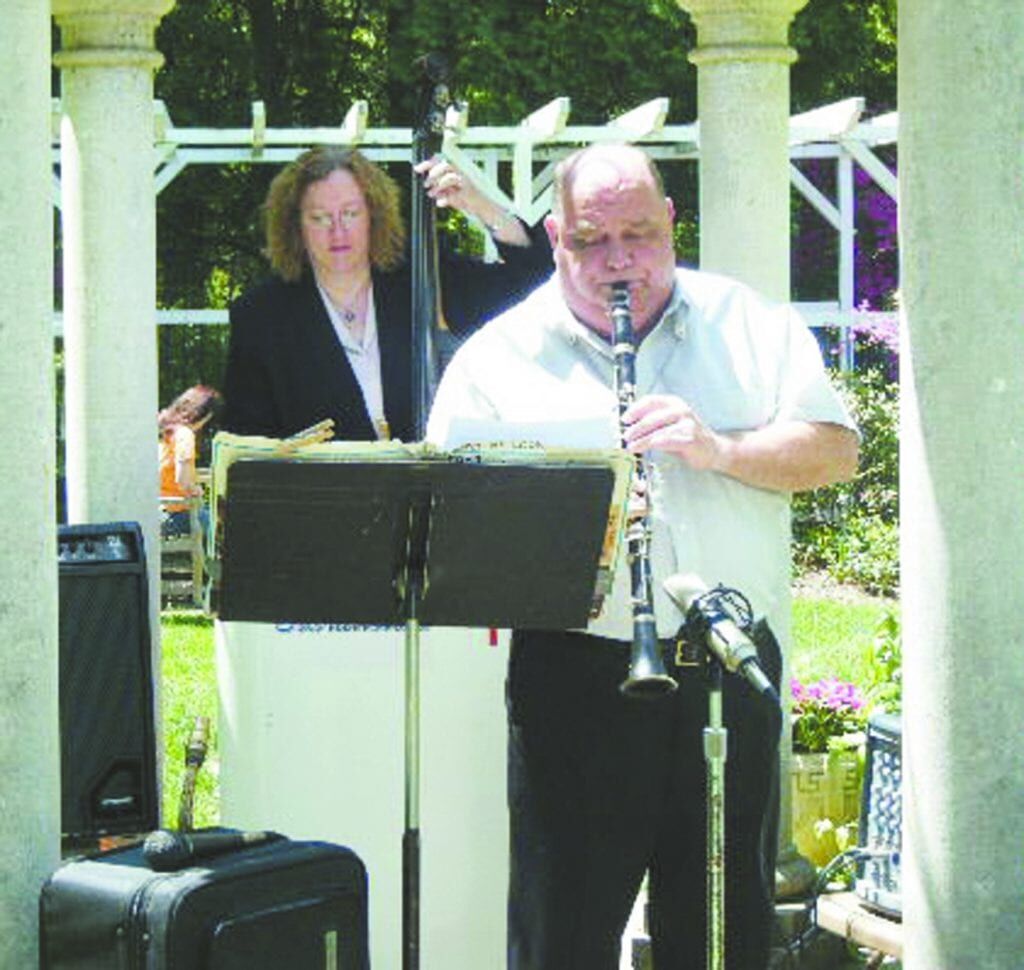
Ewing resident Bob Smith and his wife, Deb, play at the Azalea Festival at Sayen Gardens in Hamilton.,

