By Aliza Alperin-Sheriff
Many still play bridge, the activity that was social gaming before it went digital
Ewing’s Joe Coult might never have learned to play the game of bridge if his family’s only telephone hadn’t been in the same room where his mother and her friends would gather to play.
As a 17-year-old, Coult, now 71, would spend a lot of time on the phone talking to his girlfriend and, as a result, would spend a lot of time watching his mother and her friends play bridge. One day, his mother told him that there weren’t enough people there to play and Coult offered to help out. He was instantly hooked.
Barbara Schlosser, of Lawrence, learned to play bridge when she moved to the top of a very steep hill in the 1960s. There were only about eight houses at the top of the hill and one of Schlosser’s neighbors mentioned that it was going to be a long, isolated winter and asked if anybody knew how to play bridge. Schlosser, who already knew how to play pinochle, said that she would be happy to learn.
Others set out specifically with the intention of learning to play bridge. Tess Papp, 87, of Ewing, took a class on how to play bridge at the Ewing Adult School with a group of friends in 1958 and Lois Shindelman and a group of her friends decided to take bridge lessons about nine years ago.
Coult, Schlosser, Papp and Shindelman are among the regular players at the Capital City Duplicate Bridge Club. The club meets every Wednesday at 12:30 p.m. at Hollowbrook Community Center in Ewing.
Duplicate is a form of bridge where hands are dealt at each table at the beginning of the game. As pairs of partners move around the room playing at different tables, the cards are never redealt, meaning that the same hands are in play at each table no matter who is playing.
Shindelman, 64, of Princeton, described duplicate as “the way the game was meant to be played. It takes away all of the luck from it. If you play for fun, whoever gets a better hand wins. Here it’s what you do with that hand.”
The Capital City Duplicate Bridge Club is sanctioned by the American Contract Bridge League, a national organization that regulates play and hosts tournaments. Coult, the director and manager of Capital City, said that when you play at a sanctioned club “you get points. When you don’t play for points, you’re just playing for fun like at home.”
When people play bridge at an ACBL-sanctioned club, they compete to earn masterpoints. Masterpoints are given to players for winning or placing in games. Different types of masterpoints are awarded depending on the level of the game. An accumulation of masterpoints allows players to achieve life master status.
The weekly game at Hollowbrook wasn’t always sanctioned. When Henry Hood, the founder of Capital City Duplicate Bridge Club, started playing there, the game was informal, and drew 28 to 32 people every week.
But over the course of a year, the game lost more than half its players to health issues, moves and death. They advertised for more players, but they couldn’t get anybody new.
One of the players, Lois Weaver, suggested to Hood, who was already a qualified ACBL director, that the club apply to become a sanctioned game.
At first, Hood held the games on Friday afternoons, which was the only time available at Hollowbrook, but very few people showed up to the game. Hood went to the manager at the center and asked if there was another time the club could meet and arranged for the game to be moved to Wednesdays.
“From that moment on,” said Hood, who lives in Hopewell for part of the year and Florida for the rest, “we had a spectacular turnout—as many as 18 tables. We would have 78 people come to play bridge. That makes for a very successful game.”
Coult took over the Capital City club in 2006, when Hood started spending part of the year in Florida, and the club has remained popular, with people driving for more than an hour to go to games.
Another area ACBL-certified club is the Princeton Bridge Center at the Princeton Senior Resource Center located in the Suzanne Patterson Building at 45 Stockton Street in Princeton. The club holds a duplicate bridge game every Thursday and also a competitive game on Tuesdays at the Princeton Elks Lodge in Blawenburg.
The PSRC also hosts a social bridge game on Tuesday afternoons.
Princeton resident Chris Knigge, a fixture at the weekly Princeton game, said that the game at the PSRC was started and run for many years by Albert Hinds, the famous Princeton octagenarian for whom Hinds Plaza is named.
Knigge speculates that the game of bridge might not be popular with younger people today because it’s not as cutthroat or competitive as games like Texas hold’em poker.
“Bridge is a gentleman’s game,” he said. “Unlike poker, which is based on people lying or trying to trick each other.”
Fritz Marston, 74, of Ewing, said that he enjoys playing at Capital City “because of the high quality of the game. To win in this room, you have to play well or be on your toes. You can’t luck into a victory here.” He added, “Joe Coult, for reasons known only to him, has filled up this game with almost nothing but life masters, which makes for a very good, high-level game.”
Schlosser agreed that the appeal of playing duplicate was the competitiveness and the challenge.
“Once you get bitten by duplicate, you don’t want to go back to kitchen bridge,” she said.
Because they want to rank highly and earn masterpoints, duplicate players are very ambitious.
Hood said, “Up until three or four years ago, when I became a life master, I was really driven. I went to all the tournaments and traveled a lot.”
In addition to providing a stiff competition, Capital City is also a venue for socializing. Players start arriving at the club about an hour before the game begins for a chance to talk and eat lunch together.
Papp, who taught fourth grade at Lore Elementary School in Ewing before she retired, said that bridge is her “contact with people. It gets me out of the house every day. I’ve made a lot of friends through bridge. After my husband died, a lot of people that I went on trips with were people I met at bridge. I’ll tell you, I don’t know what I would do without bridge.”
On the Web: capcitydbc.com and princetonsenior.org.
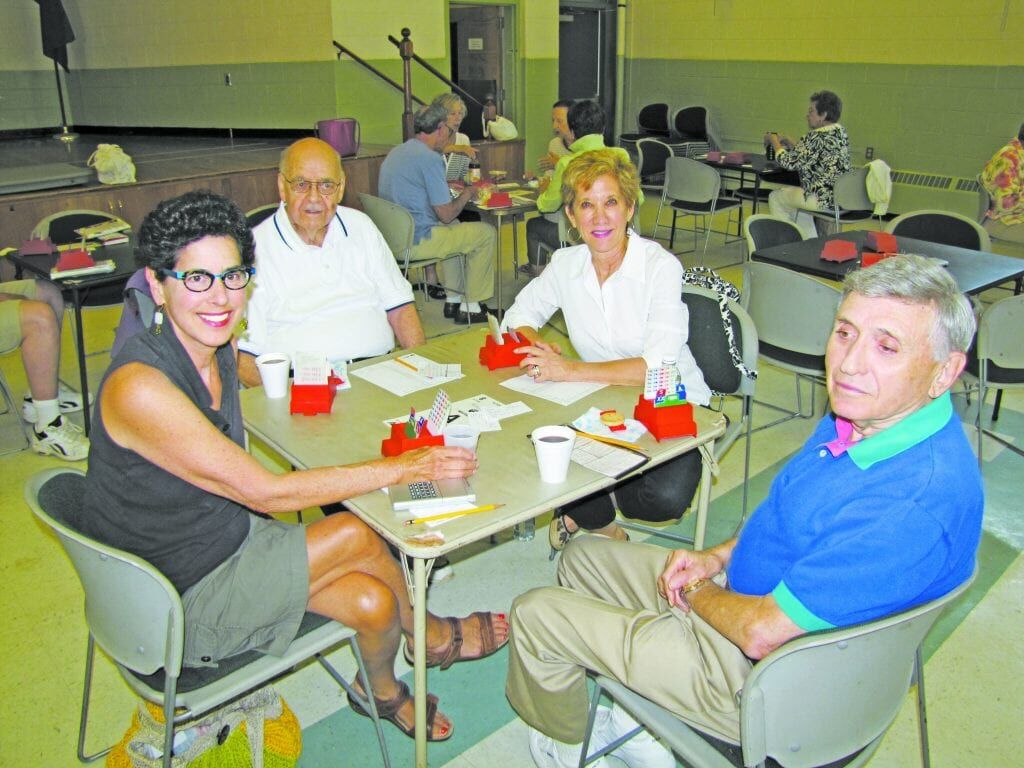
Capital City Bridge Club attracts players from throughout the region. Pictured at the game on Aug. 20, 2014 are Janice Gross (Lawrence), Al Cackowski (Monroe), Debbie Faigen (Lawrence) and Les Steif (Monroe). (Staff photo by Bill Sanservino.),

