By Bill Sanservino
Campus Town village center at TCNJ on pace to open by fall 2015
State, local and county officials gathered at the old General Motors site last month to break ground on the Parkway Town Center project, heralding it as a banner day for Ewing Township.
While ground has been ceremoniously broken, there remains plenty to do. The massive project must gain approval from the township planning board, and construction in earnest might not start until 2015.
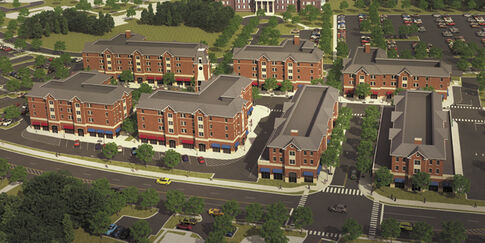
Meanwhile, on the campus of The College of New Jersey, it is the $86 million Campus Town that is set to make the most immediate impact. The development, which will feature 195,000 square feet of housing for 446 students and about 80,000-square feet of retail space, is being built on a 12-acre parcel on the TCNJ campus fronting along Pennington Road.
The project’s housing will be restricted to TCNJ students and will have no impact on the Ewing Township School District, said Greg Lentine, director of university campus development and vice president of sales and marketing for the PRC group, the West Long Branch-based developer of the project.
And starting this year, the township began to reap the rewards in terms of filling the township’s coffers with revenue from the development.
Because the project is built on public land, there’s a gray area as to whether the project is exempt from paying property taxes.
Mayor Bert Steinmann said he has entered into a PILOT (payment in lieu of taxes) agreement with PRC that helps solve the issue of the tax status of the property.
Under the agreement, the mayor said, the township will get $75,000 in 2014 and in 2015. Starting in 2016 and beyond, the developer will pay $390,000 a year to the township with an escalator each year based on the rate of inflation.
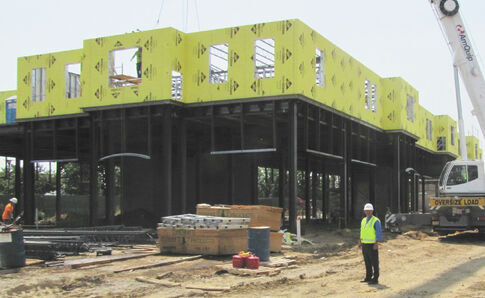
Lentine said construction at the site is already well under way. Steel is already up for six buildings, including the 14,000-square-foot Barnes and Noble, which will also serve as a student book store, and an 11,500-square-foot fitness center, which will be run by the college exclusively for TCNJ students and staff.
The configuration of the project calls for retail businesses to be on the first floor and the student housing to be built above the retail.
That means the retail portion of the project will need to be completed by next September at the latest for the housing to be ready for students to move in by the beginning of the Fall 2015 semester.
Lentine said PRC has already received more than 200 applications for student housing, and the retail space is already 50 percent rented.
In addition to the book store and fitness center, other retail businesses that have signed on include Piccolo Trattoria, Mexican Mariachi Grill, Red Berry Yogurt and Yummy Sushi.
The most-recently signed business is Panera Bread, which Lentine said PRC worked hard to bring to the site.
“That’s huge for this area,” he said. “We felt having a Panera Bread would be critical to the campus, our site and the entire neighborhood.”
The best-case scenario, Lentine said, is to have the retail businesses open and operating by the time the students arrive next year.
“The retail needs to be turned over to the retailers starting probably in May of next year. The way we deliver the retail component is to get the drywall up and then the retailers come in and do their finishing work.”
Getting the retail done as soon as possible is critical, said Lentine.
“Some of the retailers have a higher level of fit out so they need to get in there. Barnes and Noble, for example, has 14,000 square feet, and it’s going to take them a lot longer to fill that 14,000 square feet than a 4,000-square-foot restaurant,” he said.
As far as the types of retail, Lentine said PRC is looking for a certain type of profile business to locate in the center.
“When we started researching this project, we went out to a number of colleges that had projects similar to this,” he said. “We saw a lot of businesses that opened up and shut down because they miscalculated. We don’t want to see that here. So we’re looking at bringing in strong businesses with strong financial backgrounds.”
The project will have two entrances to the public from Pennington Road, with a traffic light at the main entrance. It also calls for a realignment of Pennington Road.
Lentine said students will be able to access the site and gated student parking from Metzger Drive, the main internal road on campus.
“There’s no cross access (through the site). You can’t get to campus with a car from there or from campus out to Rt. 31,” Lentine said.
Aside from the Barnes and Noble, the other buildings will have either two or three floors of residential built above the ground-floor retail. The apartments will be one, two and four-bedroom units, and each will have a full kitchen, a living room, dining room, washer and dryer. Each student also has their own separate bedroom, Lentine said.
“What we have are the type of modern apartments that students are looking for these days,” Lentine said.
“In fact, the students will move in here and it will probably be nicer than their first apartment. It gives the student a really nice lifestyle and allows them to focus on their education,” he said. “They have private space, which is one of the problems with traditional dorms.”
Lentine explained that the student housing is privately-run and that PRC has hired a company called Capstone Campus Management, based in Birmingham, Alabama, to manage the student housing.
He said they manage about 23,000 beds across the country and are the largest on-campus housing manager, so they understand how to work with the students.
“The project is a private development built on college property, built under the 2009 Economic Stimulus Act.
That measure allowed TCNJ to put up its state-owned land and allow a developer to come in and take the entire financial risk.
“It doesn’t affect the college bond rating if it’s done right, and then it’s up to the developer to fill it. We pay the college rent for using the land and pay for the development of the project. We take the risk. It’s all on our dime,” Lentine said.
In fact, the residences are actually considered by the college to be off-campus housing but located on the campus, Lentine said.
Lentine said that one major plus of the project is that it will play a role in helping to fill a shortage of student housing at the campus.
“It’s going to be a big benefit to the college,” he said. “They’re planning on taking some of their older dorms offline so they can rehab them, and that’s going to put more pressure on the college to provide housing. This (project) will actually help the college with that problem so they can start fixing up the older buildings.”
Lentine said it’s also good for township residents living in the area of the school, who have expressed concern over the years about disruptive students living in homes in their neighborhoods.
“The college is increasing the freshman population by 125 students a year for the next four years,” Lentine said. “They don’t have the housing for them, so the students have to go out into the neighborhoods. Sometimes it’s a mixed blessing having a college located near residential. Sometimes students aren’t as polite as they should be. They’re all young. They like to party and stay up at night. The person living next door might not want that. With Campus Town, we’re going to be able to pull back 446 of those students.”
According to Lentine, technically only the residential component of the project is called Campus Town. The retail component is actually called “31 and Main” (named after the intersection at the entrance to the development at Rt. 31 and Main Boulevard.
“We want residents to know they can come to us and not be afraid to come on campus,” Lentine said.
,