By Jessica Talarick
Presenters perfect their skills with the Toastmasters
If you’ve ever been on the receiving end of “just imagine everyone in the crowd is in their underwear” before giving a speech, you may want to consider attending a meeting of the Mid-Day Toastmasters.
The Robbinsville chapter of Toastmasters International helps members become confident public speakers, so comfortable in front of a crowd they don’t have to resort to coping mechanisms. The group meets the second and fourth Tuesday of every month at the Robbinsville branch of the Mercer County Library System to refine their speaking techniques. The next meeting of the Mid-Day Toastmasters is scheduled for 11:30 a.m. to 12:30 p.m. on Oct. 14.
The Robbinsville club isn’t the only chapter of Toastmasters International in the area. The Mid-Day group is one of about 20 community and corporate clubs in Mercer County and 200 in the state. There are many clubs to choose from, but the members of the Mid-Day Toastmasters think their group offers something unique.
“This club is ideal because it’s small enough that it’s not intimidating,” said retired librarian Sandra Johnson of Hightstown. The Mid-Day Toastmaster Club is made up of 17 members; a group that meets in Princeton has about 80.
One of the challenges of joining a larger club is the competition for speaking opportunities. While members of the Princeton club may struggle to find an opening to give a speech, Mid-Day Toastmasters have a chance to speak at every meeting.
The Mid-Day Toastmasters started as a corporate club at a U.S. Department of Agriculture office in Robbinsville. Joyce Rouba, president of the Mid-Day Toastmasters and USDA employee, said attendance started to dwindle, so they decided to open the club to community members and start meeting at the library.
The Hamilton resident joined the club 25 years ago because her job in USDA’s feeding programs required her to give presentations to state and local agencies. Rouba said before becoming a Toastmaster she was anxious about public speaking. Now, she leads the meeting with ease, welcoming members with an overview of the day’s agenda and introducing speakers with a booming round of applause.
With more than two decades of practice under her belt, Rouba still benefits from Toastmaster meetings.
“Even if someone is used to giving presentations, you can always learn something new,” Rouba said.
Mid-Day meetings consist of prepared speeches and Table Topics, one to two minute ad lib speeches prompted by a question from Rouba or a fellow member.
Speaking opportunities are monitored by the club’s timekeeper and grammarian, who keeps track of “ums,” “uhs” and grammar mistakes. There is also an evaluator, who gives an oral and written report on prepared speeches.
Despite the timekeeper, grammarian and evaluator keeping a watchful eye over the speaker, Toastmasters meetings are judgment-free zones. Club members agree anxiety about public speaking mainly stems from worrying about what the audience will think of you.
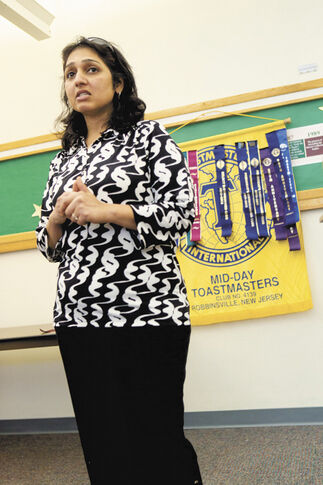
“I think it’s mostly the fear of judgment,” said Shilpa Rathi, who has been attending Toastmasters meetings for a few months. Rathi said people are afraid of imperfection and Toastmaster meetings fine tune speaking skills.
Another recent member Wally Kowrach of Hamilton said he was also afraid of judgment but realized the audience ultimately wants to support the speaker.
“I came to the realization that people in the audience don’t want to see you fail,” said Kowrach, who joined Toastmasters to become more comfortable while giving presentations about his company, The Exceptional Artisan, at craft fairs.
Kowrach is following Toastmasters International’s Competent Communication manual. The manual leads new members through 10 speeches starting with the Icebreaker, a four to six minute speech introducing yourself to the club. After completing Competent Communication, members can move on to 15 advanced manuals on specialized topics like humorous speeches and technical presentations.
In his Icebreaker, titled Emotional Revenue, Kowrach spoke of how being an artisan can be rewarding in more ways than just monetary compensation. Kowrach moved the audience with a story about creating a pen for a man named Jeremy who could not afford one of his handmade writing instruments. In his speech, Kowrach said Jeremy wanted the pen made of wood from a barn he worked in with his late grandfather. When he started to manipulate the wood with Jeremy standing by, Kowrach said the two men felt the grandfather’s presence and that helping Jeremy grieve was more satisfying than receiving money for his work.
Following the speech, the evaluator of the day, Johnson, gave an analysis on Kowrach’s speech. Johnson praised Kowrach’s storytelling skills and finished the evaluation with feedback on how he could improve. She also wrote an evaluation in Kowrach’s Competent Communication manual for reflection after the meeting.
Like Kowrach, many Toastmaster members attend meetings to improve their speaking skills to further their careers.
“I wouldn’t be doing what I do today if I had not been in an organization like this,” said Brenda Cusack, a minister from Hamilton who was a guest at one of the club’s September meetings.
Cusack has a long history with the organization, which she joined when it was still divided by gender—Toastmasters for men and Toastmistresses for women. Despite taking every public speaking class in college, Cusask felt uncomfortable talking in front of a crowd. She started attending Toastmistresses meetings and finally started develop the public speaking skills she needed to advance her career.
“Toastmistresses is the only one that felt right,” she said. Cusack credits the club’s frequent meetings, which forces members to practice public speaking.
With monthly practice, the Mid-Day Toastmasters are ready to face the crowd.
For more information, go online to 4139.toastmastersclubs.org.
,

