By Michele Alperin
Ewing resident teaches kids about Jewish history and the Holocaust
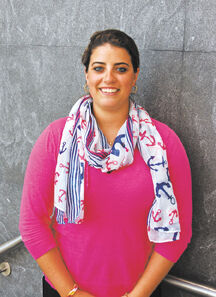
Margaret Smith might not be Jewish, but she feels it’s important that people remember the atrocities inflicted by the Nazis during the Holocaust.
This semester, Smith is putting her beliefs into action. She was one of 16 students selected to be a Lipper Intern for this semester at the Museum of Jewish Heritage — A Living Memorial to the Holocaust in New York City.
The internship involves college students learning how to teach 20th-century Jewish history and the Holocaust to young people.
“I don’t know an abundance of Jewish people, so that didn’t have so much of an effect; but I know about this topic; I feel for this topic; and I feel other people should know about this topic, just like I feel people should be informed about genocide in Rwanda and Darfur,” Smith said regarding her motivations for becoming a Lipper intern.
“I am a history and secondary education major, and it is right up my alley — it includes education and history,” added Smith, who was encouraged by other interns to apply.
Having just completed an intensive 10-week training for the interns in late August, Smith, a Ewing resident who is now a senior at Monmouth University, compared it with the elective she took last semester on the Holocaust.
“Lots of times museums and classes focus on the overall history of the Holocaust or World War II in general,” she said.
“What is unique about this museum is that it focuses on individuals affected by the Holocaust. Most of the artifacts in the museum can be tied to individuals and what is known about their story,” Smith said.
An example Smith offers is the dress Thea Gottesmann made in 1945 from black-and-white checkered material, given to her and other prisoners by the American forces who liberated the Mauthausen-Gusen concentration camp to make new clothes.
Gottesman, who had also been imprisoned at Terezin, Auschwitz, and Flossenberg, also made a large tote bag out of her striped camp uniform.
Betsy Aldredge, director of media relations at the museum, explains the genesis of this paid museum education internship.
“From the time we opened, we wanted to do something substantial for college and graduate students to help them teach about the Holocaust; we wanted to make sure we are training the next generation of Holocaust educators,” she said.
Museum educator Loren Silber said that even before the 10-day intensive training begins, the interns have material to study — largely books on Holocaust history and readings in both Jewish history and Jewish practice.
During the training they have homework every night. In addition to discussions about the readings, they have workshops where they learn about museum operations and museum careers.
They learn how to give student tours of the core exhibition, which explores life before, during, and after the Holocaust for the Jewish European population, and also practice how to teach both a pre-visit and a post-visit session with students at middle and high schools close to their colleges.
During the post-visit class, said Silber, the students talk about what they have learned, what an individual’s responsibility is, how they can be more socially active today, and what they can do to prevent something like the Holocaust from happening again.
Smith said she was moved by the survivor testimonies, including a Rwandan genocide survivor she heard during her training.
“No experience is ever the same, and no one ever reacts the same way,” she said. “I am always amazed at how people survived and how they have rebuilt their lives, and it constantly humbles me to think that someone could go through that.”
Bringing it to a more personal level, Smith added, “I don’t think a lot of people my age could imagine going through that. I don’t think I could survive without my phone, my car, doing what I want to do and wearing what I want to wear.”
The pre-visit, Smith explains, introduces the middle and high school students to many of the ideas they will encounter in the museum.
“For example,” she said, “the museum holds German marks, and we talk about the inflation at the end of World War I and how that had an effect on the German people.”
The interns also talk about Kristallnacht and the postwar displacement camps, keeping the focus on individuals.
One example is Jacques Wisniak, a 9-year-old French boy who was rounded up and sent to Sobibor, a killing center, with his mother, Rose, and his little brother, Robert, only because they were Jewish.
His birthday was March 26, 1933, and he lived at 21 Passage Dumas in Paris. “While six million Jews were killed, they were all individuals; and 1.5 million of the 6 million killed were children,” said Smith.
During the museum tour, the interns talk about how children were targeted because, not able to do manual labor, they weren’t helpful to the Germans. “It took away hope of a future generation,” Smith said.
Not really expecting to make friends among the 15 other interns, Smith said, “I feel like all of us bonded over this experience; it really does bring you closer to other people because you are seeing something that is so unnatural that you almost have to bond together.”
Silber said that the interns’ experience affects them very strongly, sometimes influencing their future career or educational moves.
The students are also moved by the program, based on evaluations they receive from every teen who goes through the program and all the teachers.
“We see that they are definitely thinking and learning, and it’s affecting them not only as a historical event but also in their own personal lives,” Silber said.
And, finally, the teachers have been happy with the program.
“The students get to hear from students closer to their age,” Aldredge said. “They feel free to ask questions, and the interns try to create dialogue. The post-visit gives the students a chance to ask more questions and delve deeper into the material.”
To draw both students and interns from the six northeastern states the internship covers — York, New Jersey, Pennsylvania, Connecticut, Rhode Island, and Massachusetts — the museum does substantial outreach to teachers and to colleges, although by now, many hear about the program through word of mouth.
Last year, 31 interns reached over 6,500 students.
“The interning students come from all backgrounds,” Aldredge said. “Some are grandchildren of Holocaust survivors; some had positive experiences listening to a Holocaust survivor in their own school; and some are interested in history or museum education.”
Smith graduated in 2011 from Ewing High School, where she played on the soccer, swim, and lacrosse teams.
At Monmouth University, she played D1 lacrosse during her freshman year. Junior year she was treasurer of the sociology club and interned at the Long Branch Historical Society, where she sorted over 5,000 artifacts: pictures, newspapers, journals, and logs. In addition to her history and education major, she is minoring in art history.
In a follow-up email, Smith reemphasized the museum’s focus on the individual.
“Many people suffered during that time — 6 million [Jewish] people were killed, but they were each individuals. They each had different experiences and reactions. They all came from different backgrounds — age, looks, social or economic backgrounds differed.”
,

