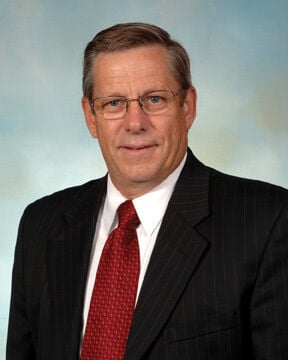
Ewing Mayor Bert Steinmann, a 68-year-old Democrat, is running for re-election to his second four-year term on Nov. 4.
Steinmann is a retired worker and pension fund administrator for the International Brotherhood of Electrical Workers, and holds a degree in electrical engineering from Trenton Technical Institute. He was a member of Ewing Township Council between 2000 and 2010 and took office as mayor in January 2011.
Below is a Q&A resulting from a recent interview between Steinmann and Bill Sanservino, the Ewing Observer senior community editor.
Ewing Observer: What are some of your accomplishments over the last four years?
Bert Steinmann: We had to change the way we were spending money when I came into office. We weren’t accountable for anything and spending money willy-nilly. We had to make everybody accountable to make sure that every department is fiscally prudent. I think we’ve accomplished that.
We’ve attracted a lot of new smaller businesses as well as some larger ones. Overall, I think the town is much better off than it was in the previous four years, or even before then.
What’s more important is that the majority of residents of Ewing Township are fairly comfortable with where we are at this particular point of time. For example, we’re getting really good comments on our parks. We had neglected them over a long period of time, but we’ve been able to redirect and make sure that the parks are good and safe for our kids.
Environmentally, we’ve done some really good things. When we renovated this building (this year) we kept the environment in mind. We installed LED lighting in the parking lots and the interior of the building, which has been remodeled after years and years and years of neglect.
EO: The township’s bond rating was recently upgraded to AA. What does that say about the town’s fiscal management?
BS: When I took office, Moody’s was going through an evaluation process and they dropped us down from a AAA to A- because we didn’t have out fiscal house in order. We had $7 million in debt that we had to come up with. We had to go hat in hand to the state Department of Community Affairs to see what we could do for them to help us.
We put some new fiscal things in place to make sure that we can meet the goals that we set for ourselves, and we had to say no to a lot of things. For instance, the July 4 parade. As trivial as the cost of fireworks may sound, it was $7,000 or $8,000 that we needed to cut from the budget. So we didn’t have fireworks for a couple of years until we were able to get to a good spot again.
We went to once a week trash pickup. It certainly wasn’t a very popular thing to do, but it saved us over $1 million. Privatizing trash collection also saved a lot. I had enough money in the budget to buy new garbage trucks because our fleet was old, but unfortunately our work force didn’t have the heart for it. I had long meetings with them and at the end of the day we decided we were going to privatize sanitation. That move saved us over $500,000. We also saved $1.1 million in disability claims that were coming from sanitation.
EO: What were some of the challenges you had when you first took over as mayor?
BS: The morale of the town wasn’t really all that high. Everything was kind of run willy-nilly and there was no direction. It took a little bit of effort and time to get the town back into a place where people felt comfortable. Where they were talking about the town again and saying things have improved.
From day one after stepping into office, I reached out to the business community. We had meetings with them and continue to meet with them constantly.
Just that alone, they talked about how great that was. Finally somebody was communicating with them. Believe it or not, I was the first mayor to go to N.J. Manufacturers for a tour. It boggles my mind that a there’s a corporation that size and one of the biggest taxpayers we have in the town, and no mayor ever went there.
No previous administration ever connected with the school board. We meet quarterly with them just to talk about things to see what things we have in common or areas where we might have shared services.
EO: How would you describe your style of leadership?
My philosophy is that in order for you to be an effective mayor, you need to be here. You need to see what is going on. Certainly, you need to rely on your business administrator and the people that are around you, but at the end of the day you’re the guy that the ball falls on. I have been hands-on from day one. My whole career its been like that. I’ve never been afraid to roll up my sleeves and get things done.
As far as personality, some people think that I’m a little tough, but that’s okay. I’d rather be considered a little bit tough and get the job done and make sure the town is in good financial shape, as opposed to just patting people on the back and saying, ‘It’s a great day in Ewing Township.’”
Well it’s not always a great day in Ewing Township. We’ve had a lot of bad days, and that needs to be recognized and dealt with. I’m not the fuzziest person in the world, but at the end of the day I believe that I am getting the job done.
EO: There’s a lot of things happening in terms of commercial development in Ewing. How have you worked to make that happen?
BS: When I first took office, that was one of our top priorities, to make sure that we wound up getting a good stable tax base. So from the very beginning, we reached out to the business community, to the developers of the General Motors site, the developers of the Navy Jet Propulsion site and other areas.
Also, before we even went to the developers, we went to the county, the state and federal government and we said, look, these are our plans and found out what needed to be done. That way when the developers came in, we were able to have that information ready for them.
As a mayor, you can’t rely on other people to do that for you. If you’re not the cheerleader for the town, and if you’re not the guy whose sitting there answering the questions from state agencies or from these developers you might as well be talking to nobody.
People like to see the mayor out there rallying those organizations to make sure Ewing gets it’s fair share, and Ewing has been getting its fair share over the last two or three years. Certainly, people are paying attention to us.
EO: Are you satisfied with the ratio of housing to retail/commercial space in the Parkway Town Center on the GM Site?
BS: Would I have liked to see a little bit more retail on that site? Probably, but I’m not so much concerned about the retail — although there is about 120,000 square feet — because I know what’s going on the other side of the street. There’s going to be another 330,000 square feet of retail on the Jet Propulsion site. Within walking distance, you’re going to wind up with almost 500,000 square feet of retail between the two sites.
EO: Your opponents have criticized the Town Center project, saying that it’s going to bring in a large number of kids into the town and create the need for the construction of another school, ultimately costing the taxpayers a lot of money. How do you respond to that?
BS: I think that’s hogwash. We looked at all those numbers. We looked at numbers from Rutgers University, which is a study that’s used by all major developers and towns (to project the number of school children resulting from development). Those numbers came out to approximately 170 kids coming out of that project.
We also have a track record of our own to look at. We have the Madison, the Jefferson and Scotch Run. The same people that are talking about the exaggerated number of kids that are going to come out of the GM site, also over-exaggerated those projects.
Scotch Run was protected to have 100 kids, they haven’t had more than 10. The Madison right now only has about 6 kids. The Jefferson has about 12. The numbers don’t bear out.
The type of development on the GM site are not single family homes. They’re condos, stacked townhouses and apartments. The stacked townhouses, I don’t think they’re going to produced any kids. The way they’re laid out are not good for a family situation. It’s mostly for people who want to downsize or young professionals.
I believe in order for the vitality of the town to keep moving forward, we need new places like this where people can go and get re-energized and feel good about the town again. We could have put a park there, but the town is starting to age, and if you don’t change and go with the times, you’re going to be in total decay. We are moving forward progressively.
EO: Looking across the street at the Navy Jet Propulsion site, how close are you to making something happen there? What do you see being developed there, and how will it help the township?
BS: We’re very, very close. That is going to be 100 percent retail, more than 300,000 square feet. There’s a big box store that’s going there. We’ve met with those individuals, but they’re not comfortable releasing the name at this particular point in time yet.
We’ve talked about architectural things with them and made it perfectly clear to them that it isn’t going to be another cookie cutter type store. It needs to be unique to blend in what’s going on across the street. The developer and the store people have come back with a design for the building that we’re 90 percent okay with.
EO: Jack Ball has criticized you for having a large tax increase the first year you were in office as mayor. How do you respond?
BS: We did have a big increase the first year, but it was all related to his fiscal mismanagement. There was $7 million that we had to make up for. There was $3 million that we owed to the Ewing-Lawrence Sewerage Authority, $180,000 in unpaid electrical bills and pension benefits that weren’t paid. In addition, there was a loss of $2.5 million in state aid that he didn’t fight for. At the end of the day that all had to be made up.
EO: The Ball campaign has also said that crime has grown rampant in Ewing since you took over and blamed it, in part, on a reduction in the number of police officers. Has there been an increase in crime in Ewing in recent years?
BS: No. In fact, the crime statistics have stayed fairly stable. Enforcement has gone up tremendously. Crime is not rampant as some people would have you believe that it is.
The reason for the reduction in officers was, for the most part, as a result of a large number of officers retiring in the last year. This year, for the first time in a long long time, we have 14 young officers, both male and female, in the police academy and we’re planning on sending another six in January to Monmouth. Our police force will be around 73 to 76 officers on the street.
EO: If you get re-elected, what would you like to see happen under your leadership?
BS: I’d like to make Ewing a destination spot. Four years ago people were staying clear of Ewing. Now people are coming here. That needs to be continued. We need to get younger and need to get different folks coming to the town to keep it vibrant. If you have a vibrant town, the people feel good about it.
People need to feel good that they live in Ewing and that they’re proud to live in Ewing Township. I think we’re getting there slowly but surely. I mean we still have naysayers out there, but I think we’re getting to that point. I think the perception of Ewing is the biggest part of getting people in here and getting developers in here.
,

