Remembering Eli Waller, the boy who captured the world’s attention
Andy Waller wants to be tired.
So tired he has no choice but to sleep.
It’s when he can’t sleep that he’s alone with his thoughts. It’s when he has the urge to rush to the bedside of his 4-year-old daughters just to be sure they’re still breathing. It’s when he stares at the ceiling, haunted by the possibility he could have done something, anything differently. Did he miss any signs? Was there anything he could have done to save his son, Eli?
It’s during the night when his mind races the most. When he’ll replay the events of Sept. 24 and 25—Eli nodding off on the couch as the cable guy switches the family’s TV service, the father-son bedtime promise to make tomorrow a great day, the discovery the next morning that Eli had died overnight.
Eli showed no signs of illness—Waller was sure of it. No runny nose. No cough. No fever. Not even a hint of the pink eye one of his sisters had. Yet, the Centers for Disease Control later determined Eli to be the first American to die from Enterovirus D68, a diagnosis that raised more questions than it answered.
It’s the questions that keep Waller awake, even if he has started to accept he may never have answers. He can only bring himself to sleep about two hours each night, and in the waking hours, he occupies himself.
He’s made a few changes to their lives. A crew of volunteers helped rearrange the family home—they moved Ava and Sydney out of the bedroom they shared with Eli, bought some new furniture, painted a few rooms. Waller and his wife, Suzie, pulled the girls out of Yardville Elementary School, not because of anything the school did or didn’t do. Just because going back there—to that classroom—every day would be too hard.
Waller isn’t wallowing, though. Early on, Andy and Suzie knew they had a choice: they could let the grief consume them, or they could use the pain for good. And so, just days after Eli died, the Wallers decided to start a foundation in their son’s honor devoted to helping special needs children. They called it the First Day of School Foundation, a nod to Eli’s excitement for school and the Wallers’ enthusiasm for education. Both parents are teachers.
This is where much of Andy Waller’s energy goes now. It’s how he keeps his mind busy.
With all the activity and not much sleep, Waller admitted he may not be thinking clearly. He admitted he underestimated the amount of work it would take to run a foundation. But he’s not about to stop.
“Eli went to bed Wednesday night, and he did not get back up,” Waller said. “I see now, in a much bigger way, that you have to make the most of every day. You have to. Some people may think that we started this too soon, but what am I going to do? Wait? Especially after something like that? It doesn’t make any sense.
“I’m tired, and it’s hard. Really hard. But I’m just going to go do it. If I screw up, I’m going to keep plugging away.”
That’s what Eli would do.
* * *
From the beginning, life did not come easy for Eli Waller.
Born premature, the smallest of the triplets, Eli spent his first months in the neonatal intensive care unit. He eventually grew strong enough to be released, but he remained tiny.
He became known to his family as a “plugger,” someone who refused to quit when he didn’t understand something or couldn’t master a skill. He would practice sounds or movements until he succeeded, even as the failed attempts piled up.
He loved dancing. He had just started playing organized soccer. He loved his sisters, and would let them dress him up in silly outfits.
He would get excited about Halloween, especially for the chance to wear a costume handmade by Andy Waller’s mother, Nancy, who does this kind of thing as a hobby. Eli saw the whole process, start to finish, as a treat, and he couldn’t wait until Grandma would come over to take his measurements. He would stand nice and still, so she could see exactly how much he had grown in the past year. And once Grandma had what she needed, off she’d go to work her magic, churning out Wizard of Oz-themed costumes or maybe Peter Pan ones.
The Waller triplets would match every year, and this year was to be the best theme yet—Nickelodeon’s Paw Patrol, costumes picked by the children themselves.
Eli, in particular, loved his costume. He was to be Chase the police dog. Eli had found a bit of a kindred spirit in Chase, a German Shepherd with allergies who doesn’t let his shortcomings deter him.
Eli never got to Trick or Treat as Chase. But the Wallers decided the costume fit Eli more than a suit, so they buried their son in his Chase outfit.
It was appropriate, for his family always saw Eli as a puppy, and he acted like one. He had speech and developmental delays that made communication difficult. He’d avoid eye contact. He appeared to be timid, but loved people. When he interacted with a person, he’d keep his head down, but peer his big brown eyes up, looking for acceptance.
More than anything, he wanted his parents’ approval. He would ask them, “Are you proud with me?,” and they’d answer, “Yes, we’re proud of you, Eli.”
And now, they’re trying to make him proud of them.
* * *
Andy Waller called his experience with Eli in the NICU “overwhelmingly positive,” which tells you more about the man than it does the hospital.
In quiet times, when he’s alone, Waller grapples with his grief. But in public, he shows nothing but optimism. He expresses gratitude to everyone who has helped his family in any way, and refuses to take credit for any success the First Day of School Foundation has had to this point. It’s because of aunts and uncles. Siblings and friends. They’re doing the hard stuff, he said. He’s just talking about it all.
Waller has noticed many people treat him now as if he is a slightly cracked eggshell, as if any wrong move or word would cause him to shatter. It’s misplaced concern. He doesn’t mind talking about Eli. Really. He’s more than happy to oblige. What’s not to like? He gets to brag about his son, a father’s greatest joy.
So, when people approach Waller, he treats them warmly, no matter if they have always been in his life or arrived recently. He’s not going to get mad at someone saying hello or checking in on him or asking him to talk about Eli, again, for the hundredth time. That’s not a bother. He’s already lost Eli; what more could be worse?
“There’s so little in the world that could upset me at this point,” Waller said. “I have a wife and family and friends, and that’s where I’m going to focus.”
And though the whole ordeal has proven nothing is for certain, Waller made himself a promise: his family will not break.
He and Suzie have invested plenty of time and effort to provide a good life for their children. Waller commutes 80 minutes each way to his job as a special education teacher at the Shepard School in Morristown. Suzie runs her own business in Hillsborough, Kreative Kids, and works shifts as a server at the Peacock Inn in Princeton to supplement her income.
Now, they will have to work hard to help their family through this. Soon after Eli’s death, the couple sat down alone. They swore that whenever life gets too hectic or the sadness too deep, they’ll stop everything, retreat from the world for a moment and talk.
“I’m very heartbroken about Eli,” Waller said. “I miss him very, very much. I look at my experiences in life, and I’m glad for every little bit. I love my wife and kids more than anything. We are going to get through this. We are going to pick each other up, and we are going to stick together.”
Only when he recalls the days after Eli died does Waller fade a bit, inadvertently mimicking his son—head down, eyes diverted but glancing up, a softened voice, a nervous tapping and scratching at the table in front of him.
But who could blame him? Those were frantic days, with people—lots of people—in and out of the Waller house. A battery of medical tests to ensure Ava and Sydney would be OK. Hundreds of cards and pounds of food arriving on the doorstep. There wasn’t enough time to process what was happening in front of him, let alone the tragedy that had just occurred.
Even after the waves started to recede, Waller had trouble shaking the shellshock. Two weeks after Eli’s death, Waller forced himself to go back to work, just for a half day, just to attempt to find something resembling normalcy. The panic nearly froze him.
“Driving there, I was terrified to go back,” Waller said. “I just didn’t want to be back in the world again.”
His students welcomed him with rousing greetings and corny jokes. And that’s when Waller knew he had nothing to fear. The world wanted him back.
But that can be easier said than done, especially when the world had just dealt him “a big, giant heap of perspective.” At the times Waller needs a little strength, he’s discovered a trick that works for him. He calls on Eli.
Waller doesn’t consider himself particularly religious or spiritual, but he’s started to believe he carries Eli with him somehow. And that Eli always comes through when Waller needs him.
“I got Eli with me,” Waller said. “You have to look for that out in the world. You keep him with you. You just give yourself the reassurance that he’s there with you, and then he is. I can talk with him. I hope he’s proud of me.”
Waller knows some people won’t understand. They’ll think he’s lost it, off the deep end. And he’s OK with that. There’s nothing to be ashamed about, he said. Go ahead and stare.
“Who cares?” he said. “I’m talking to my son.”
* * *
On Thursday, Oct. 9, Hamilton Township health officer Jeff Plunkett called Andy Waller, and suggested he meet with the media the next day.
Until that point, the family had been guarded. Waller had turned away reporters who happened to find his phone number or email. All the public had to go on was a written statement released by the family a week after Eli’s death that included some photos of Eli, Ava and Sydney. A lot remained unanswered about who the Wallers were and what happened in the days around Eli’s death.
Waller wasn’t so sure about Plunkett’s suggestion. On the surface, he didn’t know if the foundation would be ready for that kind of public scrutiny. It didn’t even have a working website.
But feelings of insecurity bubbled beneath, too. He’d have to face down cameras and reporters not just from Mercer County, but from New York, Philadelphia and national outlets. He thought about what Eli would do. Eli wasn’t afraid of failure, he reasoned, so what did Waller have to fear? He agreed to Plunkett’s suggestion.
By Friday, everything had come together. A friend of Waller’s brother completed the website. The business structure for the foundation was finalized, with the Community Foundation of New Jersey managing most of the financials.
But fear still nagged at him.
“I was terrified for that press conference,” Waller said.
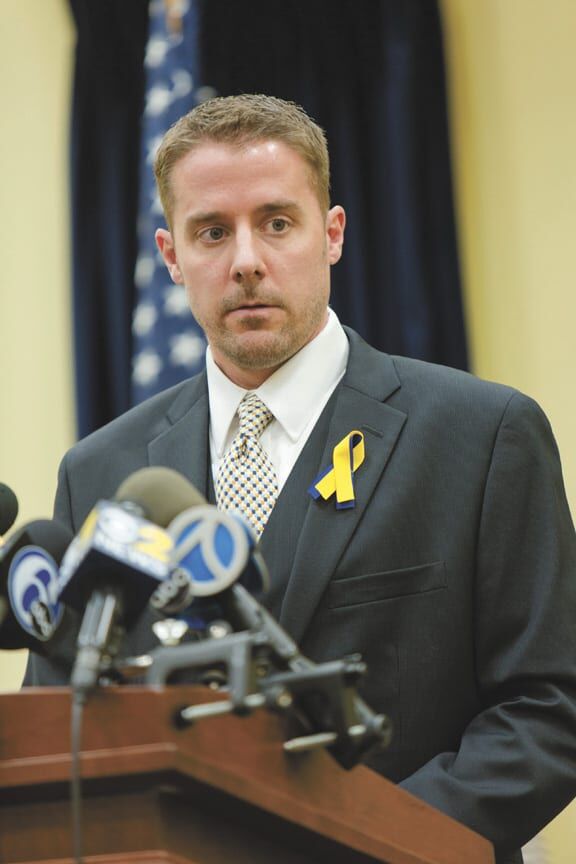
Waller waited in a back room at the township’s call center, the former clubhouse of the golf center, and looked through a window into the room where the media had gathered. He gulped hard, took a deep breath and told Eli he wanted to make him proud. Then, he stepped into the room, and strode to the front of it, as a storm of camera clicks erupted. Waller told the media about the foundation. He told them about Eli’s love of the first day of school and about his own hopes and fears and doubts.
Someone asked about the virus that killed his son. Plunkett cut in to answer, explaining how it took nearly two days to get the test results that ruled out influenza as a cause of death. With no answers, the CDC accepted the samples, and it took a week until the CDC had determined Eli had Enterovirus D68.
Once the results came in, the CDC called the state health department, which called Plunkett at 8:30 p.m. on Oct. 3. Plunkett was out with his son, but immediately started calling anyone he thought would need to know—the township medical director, the nurse practitioner, superintendent of schools James Parla, mayor Kelly Yaede and others. He also tried unsuccessfully to call the county medical examiner.
The next morning, Oct. 4, Plunkett finally caught up with the county medical examiner, Dr. Raafat Ahmad. Plunkett wasn’t sold completely that EV-D68 had killed Eli, so he asked Ahmad if she was “confidently sure.” Three times, she repeated she was. The autopsy revealed swelling of Eli’s brain and lymph nodes, signs she understood to mean EV-D68 had been the culprit.
The assembled media members, not satisfied, wanted more. EV-D68 cases had appeared in 12 New Jersey counties, and panic about the highly contagious virus ran rampant. All EV-D68 needs is an infected person to touch, cough or sneeze on a surface, and it then passes on to anyone who touches that surface next. The fear this virus could silently kill a child—coupled with the untrue rumor that another boy in Yardville Elementary also suffered from EV-D68—fueled the demand for more information.
Waller moved forward.
“Can I speak to this?” he asked Plunkett.
Plunkett stepped aside, and Waller took the microphone.
“I’ve thought a lot about what you guys are asking.”
He paused.
“And I really think Eli’s case is just an extraordinarily, unbelievable, unusual, exception to the rule. I just think it’s an extreme, bad luck, misfortune type of event. It’s a one-in-a-million kind of thing. That said, thinking about that really makes me determined to make the most out of what we have, the time that we have.”
Waller’s comments struck a chord. Eli had shown none of the usual symptoms of EV-D68, including fever, runny nose, sneezing, cough, wheezing or body aches. He didn’t have the usual downward spiral, where someone becomes sicker gradually. He had no underlying health issues. Eli merely died overnight, suddenly and without warning. Nothing could have been done to prevent it.
Waller answered a few more questions, and after he had finished, stood in the far corner to speak with reporters one-on-one. A couple gave him hugs.
Then, he drove to New York City for an appearance on CNN’s Anderson Cooper 360. As Andy Waller sat in Cooper’s studio, preparing to go on a program broadcast around the world, he again turned his thoughts inward, to the little spot where he keeps Eli.
“This is for you, little guy,” he said.
* * *
The world responded.
In the first three days after Andy Waller’s appearances, the First Day of School Foundation raised $35,000. The family has been floored by the support, coming from next-door neighbors and strangers as far away as the United Kingdom and New Zealand.
And it keeps coming. A school district fundraiser for the family netted more than $7,000 in one day. The Peacock Inn in Princeton will host a fundraiser for the Wallers Nov. 16 from 11:30 a.m. to 3:30 p.m. Plans are in the works for an auction this winter and a bike riding event in the spring. And, for much of October, Waller helped plan the First Day of School Foundation’s first major event, a Halloween-themed fair called Smiles For Eli where children could be photographed in their costumes.
It’s a lot, all at once, but Waller said people’s generosity has encouraged him to keep going. He already wants to start donating some of the foundation’s funds.
“I’m just learning how all this works,” Waller said. “To have success in the beginning, it makes it possible to just keep going. You don’t have to live on two hours of sleep a night for the rest of your life. You don’t have to worry about what you’re doing.”
* * *
It wasn’t even 10 a.m.
Many of the businesses in the Briarwood Shopping Center had yet to open for the day, but dozens of people milled about the strip mall. Gnomes, skeletons, Little Mermaids and Transformers packed themselves inside Erica Haller Photography Studios, waiting to get a photo. The line overflowed onto the sidewalk outside.
It was Oct. 26, time for the Smiles For Eli fundraiser. In the parking lot, costumed children ran from station to station, buying Rice Krispies treats or chocolate pops and stuffing fistfuls of hay into brown bags to make scarecrows. Volunteers in blue and yellow manned their booths dutifully. By the end of the day, they’d raise more than $7,000 for the First Day of School Foundation.
In one corner, Andy Waller surveyed the scene, and smiled. One of his daughters, Ava—wearing a brown and yellow puppy costume—ran to him, and clung to his leg. She hardly came up to his knee.
“Today is the Day of One Thousand Hugs,” he said, laughing, before picking her up, pretending to nibble her stomach and then gently placing her down. In the process, her dog tag tangled, and Waller knelt down, and straightened it out. A member of Pup Patrol has to have her dog tag.
Ava smiled, then ran off, into the arms of Ceil Plunkett, one of her teachers at Yardville Elementary School. Others seized the moment, and came from every direction, tapping Waller on the shoulder to say hello. He bounced from one conversation to the next, well-wisher after well-wisher. One woman remembered it was also Waller’s 40th birthday, and wished him a good one.
“Best birthday ever,” he said.
Ava skipped back to Waller—a bundle of excited energy—and Suzie and Sydney followed soon after. The four walked together to make a scarecrow, as a family.
The sun shone. From time to time, a soft autumn breeze blew. And one would be forgiven for believing Eli, too, was there.
For more information, go online to firstdayofschoolfoundation.org.

Eli Waller loved to dance and play soccer. He had just started his first season of organized soccer.,