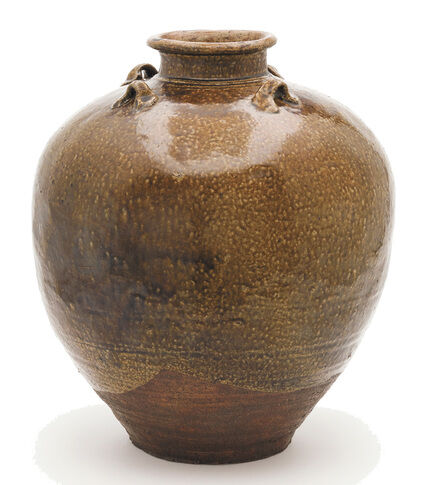
Chigusa, the centerpiece of an ongoing exhibition at the Princeton University Art Gallery, may look like a simple ceramic jar, but in this case, looks are deceiving.
Crafted in southern China nearly 700 years ago, Chigusa (pronounced chee-gu-sa) gained renown after arriving in Japan, where it became a celebrated collectible and achieved a cult-like status. The exhibition, “Chigusa and the Art of Tea in Japan,” will be on view through next Feb. 1.
Co-curator by Andrew Watsky, professor of Japanese art history at Princeton University, said the fact a seemingly plain-looking jar like Chigusa was so highly valued exemplifies that beauty is a “human construction.”
“People living in that particular place at that particular time had a notion of what beauty was, and Chigusa fit it,” Watsky said. “It’s not inherently beautiful, but we have insights into why people thought that it was.”
He explains that the exhibition includes quotations from historical writings and diary entries about Chigusa that help to show how and why people felt the way they did about Chigusa.
Chigusa, which stands about 16.5 inches tall, was created in China during the 13th or 14th century and was shipped to Japan as a common container for commercial goods. Once in Japan, however, it was deemed an aesthetic example of a tea-leaf storage jar and became highly desirable. The rare bestowing of a personal name — Chigusa, which means “thousand grasses” or “myriad things,” a phrase from Japanese court poetry — was a sign of reverence.
Watsky said that the exact date that Chigusa came to Japan is unknown, but it’s believed to have been during the 14th or 15th century. The earliest Japanese owner on record was a man named Inetsu, who died in the early 16th Century.
At the same time as Chigusa’s rise to fame, the art of tea evolved into a major aesthetic and cultural pastime called “chanoyu,” the name for the Japanese tea ceremony.
Chanoyu “was the avant garde performance art of it’s day,” Watsky said. “It was something that was evolving and changing, and very experimental in that sense. It’s the equivalent of our modern-day art collectors and was practiced by the people in society who had the means buy expensive things. They were all men, warrior elites and merchant elites.”
In addition to Chigusa, the exhibition features objects that help put contextualize Chigusa’s fame and its place in Japanese tea traditions, including a Chinese painting remade in Japan for chanoyu; a portrait of the tea master Sen no Rikyu; and Chinese, Cambodian and Japanese ceramics that were used over the centuries within the context of Japanese tea culture. In order to create the intimate feel of a Japanese tea gathering, the exhibition includes an abstracted tea room and a full complement of tea utensils.
On Nov. 7 and 8 the university will hold a symposium related to the exhibit titled, “Contextualizing Chigusa: The Arts in and around Tea in Sixteenth-century Japan.” The event, which will be held at 101 McCormick Hall at 4:30 p.m. on Nov. 7; and from 9:30 a.m. to 5:30 p.m. on Nov. 8. The symposium will feature international scholars who will present original research on areas of Japanese art that intersect with the world of Chigusa, including painting, calligraphy, ceramics and textiles.
On Nov. 9 at 3 p.m., the Art Museum will host, “Masters of Tea,” which features a a glimpse into Japanese tea culture presented by Nobuko Manabe of the Omotesenke School of Tea.
–Bill Sanservino
,

