By David Keddie
Walkable Princeton looks to fight against suburban sprawl
Imagine a town where more people walk to work than drive. Imagine a town where everyone who works here can afford to live here. Imagine an end to decades of sprawl and a return to traditional, walkable communities.
Walkable Princeton, a citizens group that I, along with some other Princeton folk, founded last year, exists to build just such community.
We imagine a Princeton that is affordable for everyone, with a sustainable environmental impact, providing access to a walkable lifestyle to all who wish it.
Princeton was once just such a town with homes for the wealthy a short walk away from working class housing in the Witherspoon/Jackson and Tree Streets neighborhoods.
At Walkable Princeton we hope to look to our past to plan for our future, drawing inspiration from Nassau Street and Hinds Plaza, rather than continuing the sprawling, car-dependent policies in place since the 1950s.
I first fell in love with Princeton as a kid, walking past amazing architecture to the seminary chapel for a cousin’s wedding. Years later when I visited as a prospective student, my parents cut me loose to explore the town and campus on foot. I was sold on Princeton for the beauty of the buildings alone, but our town offers something just as rare: the ability to live life without needing to get in a car every time you do anything.
Having lived in Princeton through my college years and now a decade as a townie, my appreciation of that walkability has only grown. In part, Walkable Princeton exists to celebrate walking and biking as an alternative to the automobile and to encourage new sidewalks and bike lanes.
Our greatest hope, however, is to address a serious challenge facing Princeton. Our town has grown increasingly expensive, catastrophically so for most people who work or study here. New housing in the heart of town is prohibited by zoning or fought tooth and nail in the courts while acre after acre of farmland and forest in the region is developed at densities that make driving the only choice. Walkable Princeton exists to advocate for new ideas, learned from the latest research as well as from Princeton’s history, which can help build a community that is affordable, sustainable, and walkable.
My wife Christina and I met while we were undergraduates at Princeton University. While she went off to law school at NYU I stayed in Princeton to work with the Princeton Evangelical Fellowship, a Christian ministry at the university. When we married in 2006 we lived on Vandeventer Avenue.
The arrival of our son, Joshua, in 2010 led us to move to Canal Pointe in search of affordable housing for our growing family. The arrival of our daughter, Sophia, in 2012 led to a similar move, this time to Grigg’s Farm in the former Princeton Township. We’re expecting our third child, a girl, in February.
I have worked with the PEF for 10 years, ministering both to undergraduates and grad students. My work with grad students made me aware of the serious difficulties so many have in finding affordable housing near the campus, an experience shared by myself and Christina. It is in response to this great need for more housing in the heart of Princeton that we founded Walkable Princeton.
What does the data say?
We often hear the objection that no one walks, that no matter where housing is built everyone will drive anyway. This claim ran counter to my experience living on Vandeventer Avenue without owning a car and with neighbors who almost all walked to work.
When we founded Walkable Princeton, we looked into the census data to see what the balance was between walking and driving, and discovered that in the former Borough, over 40 percent of residents walk to work, more than the number who drive. We discovered that even in the former Township that figure exceeded 10 percent.
Nearly 900 households in the combined Princeton don’t own any automobiles. Walking is the main form of transportation in the heart of town even though most housing is single-family homes with driveways. For apartment dwellers and those in housing without parking, those figures are much higher. Walkability in Princeton isn’t theory, it’s fact. It’s not a future hope, but a present reality.
We’ve also discovered a widespread belief, one which I used to share, that most people in Princeton work out on Route One. It certainly seems that way to anyone sitting in traffic on the highway looking at the acres of parking and roads surrounding the office buildings in West Windsor and Plainsboro.
As we looked at the census data, though, we discovered the opposite was true. The historic Borough of Princeton alone has more jobs than all of West Windsor. Those jobs also tend to be higher end as downtown Princeton office space commands a significant premium over Route 1 office space.
Sometimes we forget that many of the retail stores and restaurants in town have several stories of office space above them filled with architects, wealth managers, and other professional services. Many Princeton residents work in Princeton proper; indeed the former Borough has over four jobs for every employed resident, and Princeton receives more commuters from every surrounding township than it sends.
Looking at the core
In many ways the core of Princeton is an ideal community. It fits more than 20,000 jobs and over 12,000 residents in under two square miles, with vibrant street life steps away from quiet neighborhoods, a host of cultural, culinary, and entertainment options alongside parks and gardens. Everything one could need or want, including good mass transit links to airports and cities, is a short walk or bike ride away.
Kids walk to school, parents take their kids on foot to McCaffrey’s, high schoolers make their way to the library or Hoagie Haven, all without having to sit in traffic on one of our regional highways.
The heart of Princeton is the most popular place to live in the region, judging by the demand for housing, the most popular place to work, measured by commercial rents, and on top of that is the most sustainable part of our region by far, fitting in two square miles the number of people Montgomery fits in twelve, enabling walking to outpace driving as the main means of transportation.
Unfortunately, zoning has frozen the supply of housing in the former Borough to what existed before my parents were born, leaving the population the same as in 1950. Even worse, the core of Princeton was not taken as a model for the later development of the surrounding townships. Those same zoning regulations mandated that the former Township, and surrounding townships, develop at one-sixth the density of the Borough, with strict separation of offices and stores from houses. The result is near total dependence on the automobile and promiscuous use of land.
In West Windsor, even though a quarter of residents take the train to work, almost all of them have to drive to the train station. Even though it has fewer jobs than the core of Princeton, almost no one walks to work as the offices are lost in a sea of parking.
The united Princeton itself has seen the amount of traffic multiply ninefold since the mid-sixties, when it had almost the same population as today. Over two-thirds of the 180,000 car trips each day in Princeton come from outside the town. With the supply of housing in walking distance frozen we’ve reached a point where 80 percent of employees drive in each day.
With demand for walkable housing outstripping supply, affordability, and with it socio-economic diversity, have collapsed. My economics professors at Princeton were fond of pointing out how zoning and rent control destroyed housing affordability in New York City. Our town unfortunately proves that point as well.
Finding an answer
What is the solution? Is the opportunity to live in a walkable area going to be limited to a wealthy few? Can we restore affordability to what is one of the most expensive college towns in the country? Is there a more sustainable environmental path than endless low-density development?
Walkable Princeton exists to discuss and offer up answers to these questions. We believe that we need to restore an organic approach to land-use. The historic heart of Princeton was built before zoning existed and its mix of uses and densities represents the natural development of a town, with a variety of housing types, densities, and commercial uses that grew up based on people’s actual needs and desires rather than an arbitrary one-size-fits-all approach.
We believe that we need to recapture a diverse approach to land-use that allows the market to meet the demand not only for single-family homes but also for apartments in mixed-use neighborhoods. Walkable Princeton hopes to encourage the community to consider that in-town development is better for everyone than suburban sprawl.
The consensus among economists is that the lack of affordable housing is a product of our own zoning regulations and we believe we can return to the day when Princeton was a place where anyone who worked here could afford to live here. We hope to steer the discussion on building a more sustainable Princeton to consider how land-use has a dramatic influence on our environmental impact.
Walkable Princeton is doing three things to bring about these solutions. First, we are working within the system, on the Princeton Joint Pedestrian and Bicycle Advisory Committee and the Public Transit Advisory Committee, to build sidewalks and bicycle infrastructure, improve crosswalks and public transit, and make our town safe for pedestrians.
These committees always needs good members, so if you would interested in joining let us know and we’ll help you go through the process.
Second, we are seeking to persuade the public that this vision for a walkable Princeton is achievable and desirable for everyone, whether you want to walk or not. We do this through our blog, our Facebook group, and also through showing up at community meetings.We have had some fruitful discussions with both proponents and opponents of new housing in town and welcome anyone who would like to participate in public meetings to join us.
Third, we advocate to the town council for zoning reform. Ultimately, the power to make Princeton more walkable, affordable, and sustainable lies in the hands of our elected officials. We can have as much affordable housing as we’re willing to zone.
We can stop sprawl by accommodating growth in the heart of Princeton rather than the fringe. Often we’re told that Princeton is built-out, despite being a fraction of the density of other college towns. We need help advocating before the council for a new approach that makes it easier to allow growth in Princeton than through paving over farms and forests in surrounding townships.
Walkable Princeton welcomes feedback, both positive and negative, and hope to be a useful voice in our community. Please feel contact us via our website/blog at walkableprinceton.com, or our Facebook group, facebook.com/walkableprinceton.
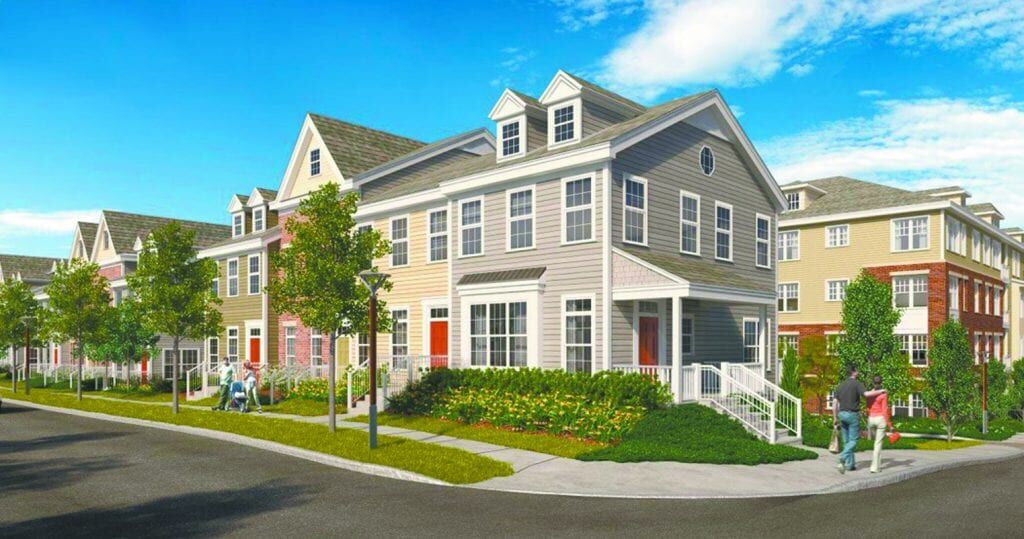
Walkable Princeton supports the construction of housing, such as the Avalon Bay project on the former Princeton Medical Center site, in order to provide more moderately-priced housing in town. Above is a rendering of the project.,

