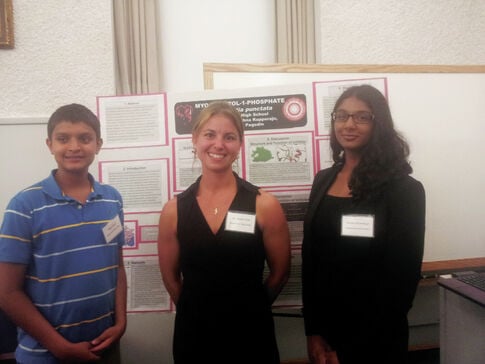
Robbinsville High School sophomore Rohan Shah, biology teacher Jessica Pagodin and junior Meghna Kuppuraju stand in front of a presentation about the research they completed at Rutgers’ Waksman Scholar Program.
RHS students participate in Rutgers University scholar program
By Jessica Oates
If duckweed winds up saving the world, you may have Robbinsville High School students Rohan Shah and Meghna Kuppuraju to thank for the discovery.
The pair took part in Rutgers University’s Waksman Student Scholar Program, in which they had the opportunity to complete advanced research during the summer. The program provides opportunities for high school students and their biology teachers to participate in authentic research projects in the fields of molecular biology and bioinformatics. Only 35 New Jersey schools per year are chosen to participate.
The yearlong program begins with a three-week seminar designed to prepare students to continue projects back at their high schools along with other interested students. The seminar is held at the Waksman Institute, located on Rutgers’ Busch Campus in Piscataway.
After a summer spent conducting genetics research on a plant called duckweed, Shah and Kuppuraju presented their work to the school board in September, leading to the establishment of a new independent study course at the school. The purpose of the in-school project is to sequence the DNA of duckweed.
Kuppuraju said scientists right now are realizing the plant’s possible uses in bioremediation, or the extraction of pollutants from soil and water.
“Some of the weed’s properties are beneficial to the environment, and our goal is to be able to figure out which of the plant proteins will help further the ultimate goal,” Kuppuraju said.
The students first cloned colonies of bacteria as their gene of interest, then copied and isolated DNA to analyze it. Once they analyze it and load it into the national database, the students will be credited with discovering the gene, said Jessica Pagodin, a Robbinsville High School biology teacher who has worked as advisor on the project.
Pagodin called the students “amazingly self motivated and incredibly bright.”
Shah, a sophomore, said he always has enjoyed science class, but became especially interested in science during a particular biology topic he worked on in Science Olympiad while he was in 7th grade. He is a member of the Mercer County Crew Team, the treasurer of the class of 2016, a member of the March of Dimes youth council, and also enjoys model UN. His father, Paresh Shah works in finance in NYC and his mother, Nita Shah, works for the state in Trenton. He hopes to work in experimental oncology.
Kuppuraju, a junior, hopes to work in microbiology one day. She first took an interest in science at an early age through conversations with her mother, Vidhya Veerappan, who began to teach her about biotechnology. Veerappan is a biotechnologist. Kuppuraju’s father, Nagesh Kuppuraju, is a software engineer.
Aside from science, Kuppuraju is interested in dance (jazz and tap) and robotics. She is the CFO of the high school’s robotics club.
She was also involved with the Science Olympiad, a competition where students participate in team events in a variety of science topics. It was through Science Olympiad that Shah and Kuppuraju worked together, and what gave the students the idea to partner for the Waksman Institute program.
“I knew she would be a great partner,” Shah said. “We both have similar interests and lots of knowledge to apply from the club. That is one of the best parts about our involvement in the program, the chance for hands-on experience, to perform tangible research.”
Shah found out about the program from a friend while he was in 8th grade. After doing some research, he set out to make the student scholar program a part of his high school experience. Pagodin said when Shah first approached her and asked her to act as their advisor, she declined out of concern that she would not be able to dedicate enough time to the program.
“Initially I said no, but Rohan was so persistent. He came to my classroom every day, and even got Rutgers to email me. He helped me realize that there were so many reasons why our school needed to be involved, and I’m glad I finally accepted,” she said.
Shah, Kuppuraju and Pagodin applied to the program and received notice of their acceptance in the spring. Over the summer, they attended various lectures on subjects such as DNA sequencing and analysis.
Shah and Kuppuraju will soon publish their findings and be recognized even more widely for their efforts. Both Shah and Kuppuraju expressed interest in pursuing careers in science and are enthusiastic about the opportunity to learn as much as they can throughout the program, and hopefully in the years to come, pending course approval.
Right now, the Robbinsville High School chapter of the research program has only three members, including Shah, Kuppuraju and Anthony Hewitt, a senior. Shah and Kuppuraju act as delegates, traveling to the Rutgers laboratories and bringing their studies back to school where they supervise the execution of the project.
“The aim is to bring what you learn back to your school and reach as many people as possible,” Shah said. “It’s a great way to bring real-world science into the classroom.”
Though the program lends schools much of the equipment needed to conduct research throughout the year, it still demands substantial funding. Right now, the program is in its trial stages and is being run as an independent study course, but the students are pushing to gain more participants and to become an actual class.
Pagodin said that she thinks that there will be lots of interested students.
“It is an opportunity like none other to develop lab techniques and skills,” she said. “The students present their findings to our lab department on a regular basis, which is important practice for them because scientists need to be able to communicate their research to others.”
,

