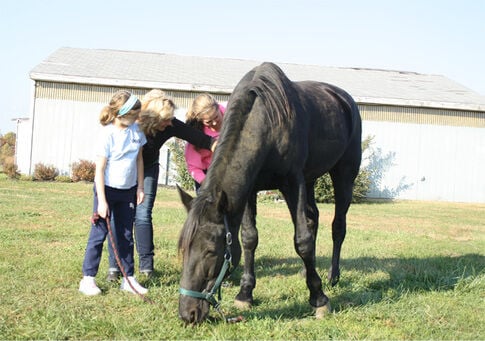
Standardbred Retirement Foundation business administrator Janine Kraus (center), along with daughters Jordan and Madison, brushes their horse Bubba at Winddance Farm in Hamilton. (Staff photo by Rob Anthes.)
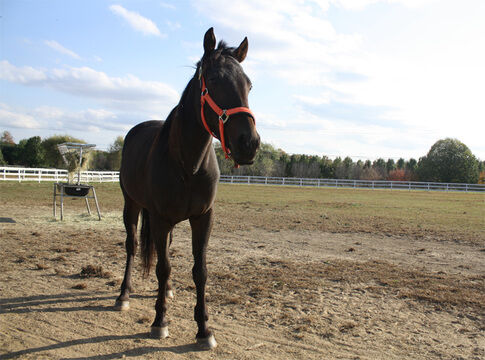
Retired racehorse Spring roams the corral at Winddance Farm in Hamilton. (Staff photo by Rob Anthes.)
Hamilton Township residents ensure retired racehores survive once off the track
Jannine Kraus didn’t understand the looks she received when she took her horse window shopping.
The Hamilton resident had brought the horse, Bubba, to Hamilton Plaza on Route 33 as part of a fundraiser for the Standardbred Retirement Foundation, a nonprofit Kraus helps run. After a few hours of standing still outside the Texas Roadhouse restaurant, Bubba needed exercise. So, Kraus grabbed a leadline, and walked the horse around the U-shaped shopping center.
People in the stores reacted with surprise, not expecting to be greeted by a horse after quick trips to Dollar Tree or A.C. Moore. They were almost as shocked by the horse as Kraus was by their reactions. Many of those she encountered said they’d never seen a horse, or at least acted like they hadn’t.
“You would’ve thought I was in the city,” Kraus said.
Kraus, though, has spent much of her life around horses. And she has made horses her life as business administrator of SRF.
The Standardbred Retirement Foundation was founded in 1989 to care for, rehabilitate and secure adoption of noncompetitive racehorses. In its 25 years, SRF has found homes for more than 2,800 retired standardbreds, a breed of horse best known for their harness racing ability.
SRF currently provides full care for about 180 horses daily, 112 of which cannot be ridden due to age or injury. The horses in SRF’s care have come off the track, many of them well used. It’s not uncommon to come across a SRF horse with bum ankles or stiff legs.
Since its inception 25 years ago, SRF has grown tremendously. At the start, the foundation operated out of the basement of a funeral home in Freehold, helping horses as it could. Today, it has an office in Millstone, a main farm facility in Cream Ridge and smaller facilities across the country, from Hamilton Township to Northern Kentucky.
Kraus joined SRF in 2010, when she saw an administrative accounting job available, just around the corner from her new home in Hamilton. She grew up in eastern Camden County—where she would take care of her neighbor’s horses in exchange for rides and lessons—but she moved to California, Texas and Massachusetts, and to a degree, away from her interest in horses.
Kraus returned to New Jersey several years ago to be closer to family, and found the SRF gig. The location was nice, but it was her love of horses that sold her. She got the job, and then took over the key role as the organization’s business administrator in March 2013.
Taking the job was a no-brainer, she said; any animal lover would support SRF’s mission. But Kraus has invested herself in the foundation’s objective. She even has adopted two SRF horses: 23-year-old Bubba and Crazy Character—Z for short—a 16-year-old who won $189,000 in a 126-race career.
As part of her job, Kraus has been across the country—places like Kentucky and Ohio—trying to spread awareness of SRF and search for horses to save. Even at home, the job has its demands. A sick horse can require her attention at any moment. She might have to leave the SRF office in Millstone after business hours and head straight to one of the foundation’s auxiliary farms to ensure the horses have enough hay or are wearing their winter coats.
“It’s not a 9 to 5 job,” Kraus said.
On top of SRF, Kraus also has a busy home life—she has two school-aged daughters, and she tries to involve them in her work. On one warm late October afternoon, Kraus collected the children at home and brought them to the Hamilton farm where Bubba and Z live. Madison, a freshman at Steinert High School, grabbed a brush and started grooming Bubba. Jordan, a student at St. Raphael’s, followed Kraus and collected some horse-related items for science class.
Then, a farrier arrived to trim the horses’ hooves, and Kraus attempted to pull Bubba into a corral close to the barn so the farrier could do her work. Bubba, on the other hand, wasn’t interested.
He bent down and bit off a mouthful of turf. Kraus gave a tug, but Bubba didn’t budge. He kept on chewing. Sometimes, dealing with horses requires a sense of humor.
“They’re great grasscutters,” Kraus said, smiling.
* * *
Bubba and Z live with seven other SRF horses on the farm, in a part of Hamilton where seeing a horse is about as common as seeing a human.
Beyond U.S. 130, the New Jersey Turnpike and Groveville, Hamilton’s eastern and southern borders come together to form a point. McMansions on multi-acre lots dot the landscape there, but, for the most part, the land sits undeveloped. In this corner of the township, on Sawmill Road, retired racehorses live on 12 acres of land called Winddance Farm.
PJ Pyrros bought the land in 1999, when it was 42 acres of soybean fields. He took two acres and built himself a house. He kept 28 acres as preserved space. And the final 12 became an area for horses.
Pyrros said township police officers he knew called this portion of Hamilton “the country,” seemingly a hard-to-achieve distinction for a parcel of land in the eighth most populated town in New Jersey. But that country pace is just what Pyrros sought when he bought the land. A Bergen County native, Pyrros works as a professional firefighter. His spread in Hamilton helps him unwind.
The house sits at the front of the property, close to Sawmill Road, and a gravel driveway curves away from the house and toward a blue-sided stable. Several large corrals surround the stable.
Next to the largest corral is a bumpy patch of dirt where Pyrros likes to practice motorcycle tricks. He competes in motocross—occasionally touring with a monster truck rally here or there—and his property allows him plenty of space to perfect his art. The horses don’t seem to mind.
Kraus lives just down the road from the farm, and sometimes, she and her daughters drive their ATVs from home to visit Bubba and Z. Other times, they’ll walk their horses from the farm to home, being sure to clean up any messes the animals leave behind.
The situation works well for all involved, but there was a time SRF thought it had found a different long-term solution: a permanent home for its horses on a farm on Old York Road, not far from Winddance. For five years, SRF occupied the Old York Road farm, near the intersection with South Broad Street. Anywhere between 25-45 horses lived there at one time, with plenty of room to grow.
But increasing rent forced the SRF from the farm in August 2012, and changed life for the nonprofit. It faced an existential crisis: How does a horse rescue organization rescue horses if it has nowhere to put them?
And that’s where places like Winddance Farm came in.
Most of the 42 horses that lived on Old York at the time found new owners and homes, the results of a beefed-up adoption effort. The foundation found offices in Millstone and a farm and training facility at Walnridge Farm in Cream Ridge. But SRF needed more room for horses.
Kraus already boarded one of her horses at Winddance, and she figured the farm may have had some space for SRF. Sure enough, Pyrros told her he did.
“He was one to definitely step up and help us,” Kraus said. “It’s the kindness of people like that who make it work.”
SRF has used Winddance Farm as an auxiliary farm since the move. The foundation has used auxiliary farms for several years now, but alternate locations became more important after the move from Old York. They allow the foundation to grow without overburdening one farm with too many horses.
Kraus wants to find more auxiliary facilities like Winddance, which would allow the SRF to expand even more. Whereas a dog rescue only needs a building or two, SRF needs a lot of space. Horses require it, after all.
“They’re big animals,” Kraus said.
It can cost $1,000 a month for full board of a horse, but SRF negotiates discounted rates from landowners like Pyrros. Working with the foundation has advantages, Kraus said. SRF provides horses in bulk, filling up whatever space owners want to offer. It also takes a hands-on approach to its horses, so SRF animals should require less of the person offering the boarding.
Kraus is hopeful she’ll find farms in Hamilton and the surrounding area to place horses. As much as it goes against stereotypes of the state, New Jersey actually has a reputation in the horse industry as a good place to be. In fact, the state government claims New Jersey has the most horses per square mile of any state. A 2007 demographics study by the American Equestrian Alliance gave that crown to Maryland, but New Jersey came in second, with 11.2 horses per square mile.
“It’s horse country out here,” Kraus said.
As it is, SRF has 50 horses at its main facility in Cream Ridge and nine more at Winddance Farm. The foundation also has a facility in Wallingford, Ky., two facilities in Virginia, one in Blairstown and one in New York state.
These locations play a vital role in Kraus’ job because, once the foundation finds a home for a horse, it can bring a new horse into the program. The foundation’s waitlist is long, with 120 horses waiting for admission into the program and the benefits that come with it.
Mainly, membership ensures the horses can live beyond their racing days. The owners usually reserve a spot for their horses in the program while the animals still are competing, but periodically, the foundation rescues horses from slaughter. In 2013, SRF saved more than 25 horses.
It costs money to stage a rescue, though. For each horse saved from slaughter, it costs SRF $300-600: the price it takes to win a horse at auction. The highest bidders can do what they please with their winnings. Usually, that means the horse’s demise.
Once SRF accepts a horse, though, the organization maintains a relationship with the animal until it dies. Horses adopted from SRF leave the organization’s custody, but are checked upon twice each year. Should an adoption not work out, the owner can return the horse to SRF with no problems.
Other horses remain with SRF at one of its facilities. People can sponsor those horses; the sponsorship fee alleviates some of SRF’s financial burden and grants the benefactor visitation rights to “their” horse, along with a profile and picture of the horse. Sponsorships start at $300 per year.
“You can own a horse without the liabilities of owning a horse,” Kraus said.
While owners have to find places to board their adopted horses, sponsors merely support SRF in the care of one horse. SRF retains ownership and responsibility of the horse. As such, SRF needs to ensure its sponsored horses have a place to live, places like Winddance Farm.
“It’s places like this that allow us to take more horses in the program,” Kraus said.
Horses like Spring Again—or Spring, as he prefers.
Spring had a successful career as a trotter at Pompano Park in Florida. In 156 races, he earned $289,000. Spring raced year-round for four and a half years, competing nearly three times a month for the duration of his career. Training and racing takes a heavy toll on horses, and such was the case with Spring. Ankle and joint issues cut his career short.
At 7, Spring is on the young side for a Standardbred. There are horses in SRF as old as 27, and standardbreds can live to be 30 or older. Spring’s only a quarter of the way through his life expectancy, but he will deal with sore joints for his remaining years.
When an ankle or joint bothers him, he shifts his weight away from the affected area, gently. Kraus gives him medicine occasionally, to deal with the pain. The cold winter weather seems to affect him more.
Despite his racing injury, Spring has an eager personality. When visitors come by his corral at Winddance, they grab his attention immediately. He’ll trot over to the wooden fence and greet the humans, turning only to chase away any other horses who dare seek to share the visitors’ affection.
Once the greeting ends, Spring will tap the ground with his foot. He wants food. A carrot or piece of apple should do the trick, although Spring never seems completely satisfied.
Spring is one of SRF’s sponsored horses, which means a couple has paid the foundation to ensure Spring has what he needs. He has a place to run and sleep, plenty of hay and grass and people to care for him. His sponsors even bought Spring a new winter coat.
This will be his existence now that he’s in the SRF program.
“He’ll be with us for life,” Kraus said.
And for Spring and his fellow racehorses, that’s a pretty nice retirement package.
For more information, go online to adoptahorse.org.
,