Buzash
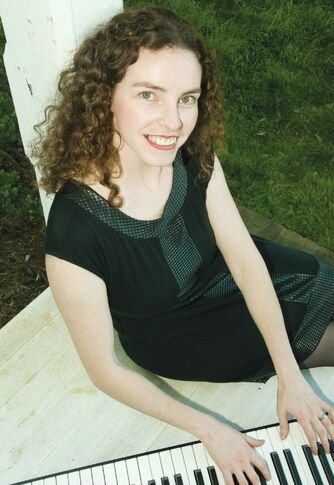
Versatile pianist Tara Buzash carving out a career as an artist and as an entrepreneur
Tara Buzash remembers the night in the Badlands of South Dakota when she learned to listen to the wind.
She and her husband Steve had gone out west to see a man about some fry bread. They’d received a box of Ansel Wooden Knife’s Native American specialty mix as a gift, and she wanted more of it. Wanted it enough that she was willing to travel more than 1,500 miles to get it.
The Buzashes have been to Interior, S.D. to see Wooden Knife three times now. They’ve become friends.
“We think in similar ways,” Tara said. “There was one night when Ansel took us out on plains of the Badlands, and he taught us to hear the wind — all different kinds of wind,” she said. “He said if you’re real still, you can hear the wind rustling along the ground through tiny blades of grass. You can hear it through the trees in the distance, and you can hear the general swirling of the air in the sky. Whoever thought you could be so attuned that you could differentiate the different sounds that wind makes, you know? That’s always stayed with me.”
Tara Buzash is more than a connoisseur of Indian tacos, and she has more than a casual interest in the nuance and complexity of sound. She’s a professional pianist and piano teacher who also operates a successful business hiring musicians to play at weddings and other functions.
She’s developed her own method of instruction that she calls Buzash Total Piano, and on Sunday, Feb. 2 she’ll be performing the last concert of the season for the Greater Princeton Steinway Society. But it wasn’t until about 10 years ago that she even knew her future was as a musician. Not until after she returned from China.
Buzash was born in Long Branch, the youngest of Frank and Carole Shingle’s four children. When she was four, the family moved to the Princeton area, where her mother still teaches art to nursery school children. Frank Sr. was a long-time special education teacher, English tutor and athletics coach who died in 2009. Buzash has an older brother, Frank Jr., and two older sisters, Melody and Lauri.
She attended Chapin School in Lawrence before following her brother to The Peddie School in Hightstown. There she was not only a star athlete, but she also helped start Peddie’s first jazz band.
Buzash’s drive to excel is something she says her father instilled in her from a young age.
“My father taught me to hold high standards for everything I do, to always strive to be better, to think, ‘How can this improve?’” she said. “That’s a good thing, you know? I’m grateful that my father raised me that way. I just read the book about Tiger Mom (Battle Hymn of the Tiger Mother by Amy Chua.) I would say I had a Tiger Dad.”
With her dad as coach and motivator, Buzash excelled at basketball and softball. She scored more than 1,000 points in her Peddie basketball career, and went on to play NCAA Division III softball at Lawrence University in Wisconsin.
She applied a similar focus to her music. She began with the piano at age 5, and by eighth grade was performing in front of 200 people at her graduation. When she was 14, she started taking lessons with pianist Keith Lesnick, who taught both classical and jazz piano. It was with Lesnick that she first became interested in jazz.
“Keith began to teach me jazz language because I was interested in improvising,” she said. “I liked the sound and wanted to learn what jazz was — learning chord symbols, reading lead sheets, improvising within a certain framework. I always knew that I loved creating sounds on the piano. Because I wanted it to sound a certain way. And so jazz is about learning how to transmit the sounds in your head to your fingers.”
Peddie at that time had no orchestra, no chamber ensemble, not even a marching band. So she and some of her fellow students took it upon themselves to start a jazz band. She remembers about eight students participating her junior year, and by senior year she says the group had already grown to 14 or so.
“That jazz band inspired the school to hire an actual faculty member to direct the band instead of a 16-year-old,” she said. “Now they have everything.”
At one point, she thought she might have a career as a journalist. She was editor of the school paper both in high school and college, and interned at the Christian Science Monitor as well as the International Center for Journalists in Washington. But ultimately she pursued a degree in East Asian languages and cultures, and after she graduated from Lawrence University, she moved to China, where she spent two years.
She split her time in China among three cities: Beijing, Dalian and Jinzhou. She spoke fluent Mandarin, and used her language skills to teach music to Chinese students, both in classes and private lessons. She says it was in China that she began to see music as a possible career.
“It just emerged,” she said. “I knew how to play jazz, and that was special to them. I had to lecture about the history of jazz in front of a hundred students, had to learn how to say that stuff. They were so happy to have an American.”
In China her jazz background and piano chops meant she was in demand as a performer, sometimes playing in clubs until 3 a.m. Although there are plenty of jazz fans in the country, there aren’t many practitioners. There was also the curiosity factor: as an American she learned to live with being stared at everywhere she went.
“You learn not to take it personally and not to let it distract you, whatever it is you’re doing. Living in a culture like that, you gain compassion and understanding and respect,” she said. “You always have to think, Why? Why are they behaving this way? Why are they staring at me? Well, if I had this rare opportunity to see someone who was not Chinese, I would stare at them too.”
She said the state media in China presents a certain image of Americans and she was frequently peppered with questions from people she met. Many wanted to know, for instance, if she carried a gun back home.
A dispute with the director of the music school after her second year closed some doors and led her to return to the U.S. But she says now that the time was probably right for her to come back.
“There seemed to be nothing left for me to do there — I could just feel my life going in a different direction. If I wanted to become a better jazz musician, I had to go where there are teachers, where there is an environment of that kind of music,” she said. “In China there are only a few devoted practitioners, and I have great respect for them for learning jazz in the society where they are.”
She returned to the U.S. in 2002, and soon after, she met Steve Buzash, a visual artist. They were married in 2003. The couple has lived in a house near the northern border of Hopewell Township for the last seven years. Steve works in acrylic and mixed media, photographer and digital art.
Having gained confidence as a performer while in the East, she started hiring herself out for weddings, and she began teaching at the Westminster Conservatory of Westminster Choir College. She performed in the faculty concerts the conservatory hosts each year, and soon people were asking her to appear at their events. She remembers one in particular from those early days.
“I had to play for ‘Company Spirit Day’ in Secaucus,” she said. “I had to take my keyboard in by all the cubicles and assembly lines, and the factory warehouse and through the breakrooms with the vending machines, down to this basement for Company Spirit Day, where the employees had to sing and dance. They had to — their bosses made them do this.”
At Westminster she gave private piano lessons and taught classes, and later was director of the jazz piano camp. “Anything that had to do with jazz, they looked to me,” she said. She began doing more concerts and events as well.
In 2011, Buzash was invited to participate in the Mary Lou Williams Women in Jazz Emerging Artist Workshop. As part of the experience she got to play in a concert at the Kennedy Center in Washington. But perhaps just as importantly, the workshop gave Buzash and other artists important advice about how to be professional musicians — how to market themselves, how to deal with record producers, even how to deal with the media.
She said she’s put much of what she’s learned to use, building a website, recording some music including a Christmas song she wrote, and developing her businesses. Since 2008 she’s been a partner in Sweet Harmony, a company she founded with violinist Heather Teffenhart. Through Sweet Harmony (sweetharmonymusic.com), Buzash helps clients hire musicians to play at their weddings, corporate receptions and special events.
In recent years she has also been developing a method of piano instruction she calls Buzash Total Piano. She says she has identified nine categories of piano learning, and that her program encompasses both classical and jazz approaches.
“This is the kind of pianist I am,” she said. “You can stick me anywhere — any ensemble or any band, classical or improvising, traditional or modern, and I can be at ease because I understand the connections. I think that’s something I can pass on to people if they’re serious about the piano.” More details are online at buzash.net.
Her Feb. 2 concert will be held at 3 p.m. in the recital hall of Jacobs Music Center, 2540 Brunswick Pike (U.S. 1) in Lawrence. She isn’t totally sure what she’ll play, but she plans to play some original compositions, some jazz standards and to do some improvising as well. “I think I’ll play ‘Sweet Child o’ Mine’ by Guns ’n’ Roses,” she said coyly.
She first became involved with the Steinway Society when she approached the board president and said, “You should do more jazz.”
“They said, ‘Why don’t you do it?’ And they asked me to join the board.” She said she is currently organizing the society’s first jazz piano competition for students.
While jazz is by no means the only kind of music she can play, it’s certainly what she’s becoming known for throughout the area.
“There’s something compelling about the sound of jazz. I think it reaches the human soul,” she said.
,

