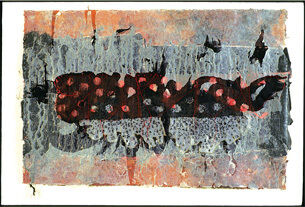
The Concentric Circles show at the Arts Council of Princeton features contemporary works, including the above image by Judy Brodsky.
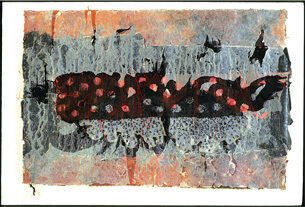
A work by Joan Needham from the Concentric Circles exhibit at the Arts Council of Princeton.
Concentric Circles of Influence project looks at importance of central Jersey artists
By Ilene Dube
A new and ambitious project called “Concentric Circles of Influence: Celebrating Central New Jersey at the Forefront of Creative Activity” focuses on art communities of central Jersey since the late 1930s.
In Princeton and the surrounding area there are a number of shows that will feature the various groups.
The following is an essay written by Ilene Dube, one the organizers, about the program. Dube is an active member of the Princeton arts scene, regular arts writer at Princeton Echo’s sister paper, U.S. 1, and has her own blog, the Artful Blogger (theartfulblogger1.wordpress.com).
From New Jersey’s elevated highways to its pastoral ruins, from its academic centers to its corridors of industry, artists have found inspiration.
Central New Jersey became a hotbed of cultural activity beginning in the mid 20th century. Throughout the region, different art communities were forming, often overlapping and influencing each other.
“Concentric Circles of Influence: Celebrating Central New Jersey at the Forefront of Creative Activity” explores several of these groups — the Queenston Press, the Artists of Roosevelt, the Trenton Artists Workshop Association, Princeton Art Association, Artworks, the Arts Council of Princeton, the Princeton Artists’ Alliance and MOVIS.
Beginning in 1965, a group of women artists came together to take classes in printmaking with Judith K. Brodsky in the old bank building at 14 Nassau Street. These women produced three portfolios, published by Brodsky and the late Zelda Laschever, two of which sold out. More importantly, they became a community.
Although educated as artists, they were in the midst of taking care of families and uncertain about how to further develop their professional careers. Few knew each other beforehand. Within the intense environment inherent in a printmaking class, these women forged lasting friendships and found the support necessary to continue to develop as artists.
Margaret K. Johnson, Marie Sturken, Joan B. Needham, Jane Teller, Helen Schwartz, Trudy Glucksberg and Lonni Sue Johnson, among others, have grown into important artists working in central New Jersey. To this day, nearly half a century later, many continue to encourage each other’s work. For those who have passed away, such as Jane Teller and Dorothea Greenbaum, their influence continues.
The women printmakers published under the rubric of Queenston Press, a play on the fact that they were all women living in Princeton.
Princeton’s roots as an art community can be traced back to 1948, when Rex Goreleigh was recruited by a group of Princeton University professors and members of the Jewish and Quaker communities to form a racially and religiously integrated arts organization.
Goreleigh directed Princeton Group Arts, emphasizing inclusivity in teaching theater, music, dance, painting, sculpture, writing and crafts. But despite such fundraisers as a Marian Anderson concert at McCarter Theatre, Princeton Group Arts folded in 1954. Goreleigh set up the Studio on the Canal to continue workshops in painting, printmaking, and ceramics and ran it until 1978. Some of the instructors were Glenn Cohen (sculptor), Hughie Lee Smith (painter), Vincent Ceglia (painter), and Stefan Martin (printmaker).
Goreleigh’s own work focused on farming culture in the late 1960s and early 1970s. He visited and painted farms in Cranbury, Roosevelt, and Hightstown, depicting aspects of the human condition while chronicling labor history. He served on the board of the Arts Council of Princeton and taught at Princeton Adult School.
Goreleigh also served as director of the arts and crafts program in Roosevelt schools in 1955-56, a town that was another hub for artists. Originally named Jersey Homesteads, it was the site for an experimental program during the FDR administration that brought Jewish garment workers out from the tenements to work as farmers. Ben Shahn came to create a mural depicting the project. Shahn knew Goreleigh, with whom he had worked on the Rockefeller Center murals with Diego Rivera.
Following Shahn and his artist wife, Bernarda Bryson Shahn, to the Louis Kahn-designed flat-roofed houses of Roosevelt came other artists: Jacob Landau, Gregorio Prestopino, Stefan Martin, and Sol Libsohn.
Some of the artists who joined Goreleigh’s Studio on the Canal went on to form the Princeton Art Association. The PAA offered classes to the community first at 14 Nassau Street — the same building where the Queenston Press artists met — then at Princeton Borough Hall, followed by a move to Ettl Farm, an art colony on Rosedale Road in Princeton.
Founded by sculptor Alex Ettl, a high school dropout who became a millionaire philanthropist by selling sculpture tools and making castings, the farm offered living and working space in a barn to a group of artists, some of whom went on to join the Johnson Atelier. Others taught at Rutgers.
Meanwhile, in 1979 the Trenton Artists Workshop Association (TAWA) formed and organized an arts festival, Eyes on Trenton, with 50 events including music, theater, to revive the capital city. Mary Yess, president of TAWA, went on to become executive director of the Princeton Art Association. Susan Hockaday, Judith K. Brodsky, and Pam Mount were on the board and supported Mary Yess when she proposed moving the headquarters of the Princeton Art Association to the old Sears warehouse in Trenton, where it could serve the economically deprived population as well as the affluent Princeton community. The PAA became Artworks in the early 1980s.
The TAWA artists had a strong connection to Mercer County Community College, and several TAWA members were MCCC faculty: painter Mel Leipzig, ceramic sculptor James Colavita, and photographer Lou Draper among them.
MOVIS is the newest group, made up of John Goodyear of the Rutgers group; Maggi Johnson, a member of the original Queenston Press group and Princeton Artists Alliance; Marsha Levin-Rojer, also of the Princeton Artists Alliance; Susan Hockaday, an original Princeton Art Association board member as well as Princeton Artists Alliance member; Berendina Buist; and Eve Ingalls.
The group met over a chance encounter at a Princeton cafe in the early 2000s, and the conversation proved so provocative, they decided to meet weekly, adding pianist-composer Rita Asch, who creates sound installations with MOVIS, and photographer Frank Magalhaes. Rather than critiquing each other’s works, MOVIS members discuss books they’ve read, exhibits and movies they’ve seen, and exchange ideas on theories of modern art.
Johnson, who studied at Black Mountain College with Josef Albers and Robert Rauschenberg and taught at the Museum of Modern Art, brings these influences on the group. And Goodyear — himself influenced by Marcel Duchamp, John Cage and Leon Golub — was taken by a talk given by Ben Shahn at the University of Michigan. Goodyear found himself working in the style of Shahn for a short while before graduate school. Goodyear also belonged to a breakfast group of artists attended by Vincent Ceglia, who once taught at Studio on the Canal.
After Queenston Press, Brodsky, who has been a professor as Rutgers as well as a curator, went on to found the Institute for Women and Art and the Brodsky Center for Innovative Editions at Rutgers, important art institutions inspiring and influencing countless artists on a national and international level.
Like the Utopian communities in New Jersey during the 19th century, central New Jersey’s visual arts communities of the mid 20th century became a vehicle for social change. Brodsky’s printmaking class opened the way for women to fulfill the ideals of the women’s movement of the 1960s.
Along with Princeton Arts Group and TAWA, it brought about greater integration of ethnic diversity in the central New Jersey region. Finally, organizations were repurposed to broaden the reach of the arts into culturally and economically disadvantaged neighborhoods, such as moving the Princeton Art Association to Trenton.
Concentric Circles of Influence shows the relevance and importance of these artists and the groups they formed. In the shadow of New York City, arguably still the center of the art world in the 21st century, central New Jersey artists then and now continue to standout and enrich contemporary arts and culture.
The project’s events and locations throughout the year are as follows:
The Queenston Press, The Woman Portfolio at Princeton Public Library through April 15.
The Queenston Press Bicentennial Portfolio at Historical Society of Princeton, Bainbridge House, through July 13.
The Queenston Press 10 Crucial Days Portfolio at Historical Society of Princeton, Updike Farmstead through July 13.
The Queenston Press Contemporary Works at Paul Robeson Center for the Arts, Taplin Gallery, through March 8.
Left of Central: TAWA, Artworks and Art in the Capital Region at The Gallery at Mercer County Community College, through February 20.
Artists of Roosevelt at New Jersey State Museum, through May 25..
America: Through Artists’ Eyes at New Jersey State Museum, from October 25 through April 5, 2015.
,