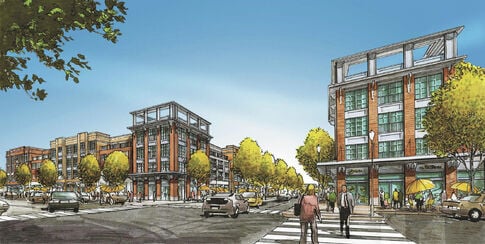
A concept rendering depicting the entrance boulevard into the project’s retail component from Parkway Avenue.
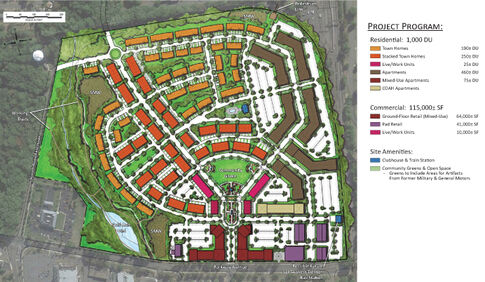
Lennar’s concept plan for tthe General Motors site shows the location of the various commercial and residential components of the development. Parkway Avenue is at the bottom edge of the plan and the railroad line is on the right side.
Lennar Corp. to develop residential and commercial space on the General Motors site in Ewing
Ewing Mayor Bert Steinmann has unveiled a proposed redevelopment project for the General Motors site that township officials estimate could create significant employment and generate millions of dollars in tax revenues at full buildout.
Steinmann, who publicly revealed the plan at a meeting of the Ewing Township Redevelopment Agency on Jan. 15, named the Lennar Corp., a homebuilder based in Miami, Fla., as the proposed redeveloper of the property.
The project includes 1,000 units of multi-family housing and 115,000 square feet of retail and commercial space. The mayor has said that construction could begin as early as this summer.
“This project is significant and will create hundreds of jobs — construction jobs and then permanent jobs once the project is done,” said Kevin McManimon, the township’s redevelopment counsel. “Also, the township currently realizes just over $10,000 in revenue total [annually] from the property. We expect that when the project is done that the municipality will realize approximately $3 million a year.”
“It will revive an enormous tract of land that’s more or less at the center of town, and it will do so in a way that is consistent with the vision expressed by the community and embodied in the [Parkway Avenue] redevelopment plan,” McManimon said.
ETRA, which is charged with the oversight of the Parkway Avenue Redevelopment area that contains the GM tract, was expected to vote on whether to name Lennar as the redeveloper of the property and approve a redevelopment agreement with the developer at a meeting on Jan. 29. See stry on page 11 to learn more about Lennar and RACER Trust, the owner of the property.
Also attending the meeting was a host of township professionals, representatives from Lennar and RACER Trust, members of township council, members of the school board and a handful of residents.
McManimon said that the purpose of the presentation before ETRA that night was to present the “high-level details” of the project and that a more “full and complete presentation” would be made in the near future, “at which time and place we’ll divulge a lot more details than we expect to cover tonight.”
If Lennar gains the necessary approvals from ETRA, the next step for the project would be to appear before the planning board for site plan approval. The township council would also have to ratify a financial agreement with Lennar.
“We still have a little ways to go, but this is all going to wind up being on the fast track. We’ve had some differences of opinion, but they all came around to see it my way,” the mayor joked.
More seriously, Steinmann said he has held discussions with school officials about the project and will continue that dialogue. One issue to be resolved is the amount of money the township will give to the school district during the years that Lennar would receive property tax breaks from the township.
Part of the deal with the township includes a tax abatement under which Lennar would make a payment in lieu of taxes. Last month the mayor told the Observer that under the PILOT, the developer will pay 55 percent of the property value from year 1 through 5, then 65 percent in years 5 through 10. That amount will increase to almost 100 percent by year 15.
McManimon said Lennar will create “urban renewal entities” for various sections of the project and each of those will make PILOT payments to the township.
McManimon also talked about the process officials undertook after the township approved the Parkway Avenue Redevelopment Plan last January. He said that the township worked in conjunction with residents during and after the process of approving the redevelopment zone to hone the plan.
“What emerged was a vision that included a host of retail and commercial opportunities, a desire for public open space that would create a place for residents and other visitors to go to — what’s commonly referred to as a destination — and new residents to help maintain a sense of vitality in the area even at night,” McManimon said. A plan that would also take advantage of the mass transit opportunities located adjacent to the site, including local bus routes, the West Trenton train station, and the Trenton-Mercer Airport.
After creating that vision, the township reached out to about 15 different developers, and then met face to face with eight of them to explain the township’s ideas and to gauge their level of interest in the site. In June, the town received two proposals — one from Lennar and a second from an Egg Harbor-based company called Sora Northeast — a development firm specializing in downtown redevelopment, college campus development and hospitality projects.
“Both RACER and the township reviewed both proposals and ultimately decided to recommend Lennar’s plan for approval by ETRA,” said McManimon. “After that, we met about fine tuning the proposal to make it a little closer to the vision laid out in the redevelopment plan.”
Sources have told the Observer that negotiations continued through the new year and that the final issues were finally resolved about a week before the ETRA meeting.
“It wasn’t all giggles,” said Robert Calabro, regional director of land for Lennar, of the process. “We did have our differences, but it’s healthy to have disagreement in working toward a conclusion that we can all live with. You end up with a better product. In RACER’s case, they’re probably unhappy with a few things. In my case, I know I am. And the mayor may not be 100 percent thrilled with everything he received either, but I think it’s a fair and balanced project that will benefit RACER more than if was a lopsided configuration.”
“Something I’ve heard from residents as I’ve been around town hall for the last six months is that there’s a real true desire to see progress in town,” Calabro added. “In their mind progress is taking site like the RACER site and turning it into something active and productive and exciting.”
He said that during the initial meetings with the township it was made clear that the township wants a project that is not only “highly walkable” but also one that is accessible to the entire community. Finally, they want something that will make a positive financial impact on the community.
“I think they deserve that,” Calabro said. “I’m sure the town has suffered for quite a while with regard to what they may have anticipated over the years with a property like this site when it was active. Hopefully we can bring back some financial activity in a good way to the town.”
Calabro presented to ETRA and the public a concept plan for the project that calls for 41,000 square feet of “pad retail,”which is defined as freestanding structures near the front of a project that usually host businesses such as banks, casual dining, or fast food restaurants. These businesses would be located along Parkway avenue on northwestern corner of the site near the train tracks. The plan also sets aside space in this area, along the train tracks, that could host a relocated West Trenton train station.
Proposed at the front of the site along Parkway Avenue and centered near the entrance to the project, is 64,000 square feet of ground floor retail, and 10,000 square feet of “live-work units.”
A “live-work unit” is actually a modern name for an old planning concept in which a business owner lives in an apartment over their first-floor retail business.
The residential component, which comprises about 75 percent of the site includes 190 townhouses, 250 stacked townhouses, 460 apartments, and 75 mixed-use units above the first-floor retail.
The redeveloper agreement with the township calls for 10 percent of the housing in the project to be set aside for Mount Laurel-mandated low and moderate income housing, most likely in the apartments. The plan also depicts a large community green, other smaller green areas throughout the project and a large clubhouse.
The eastern end of the tract, a large wooded area surrounding the Credit Union of New Jersey building and following the Gold Run waterway, would not be developed. The plan also calls for the completion of Sylvia Street as outlined in the township master plan.
McManimon talked about what he considered to be some of the “highlights” of the deal between Lennar and the township. They include:
Lennar will pay $300,000 to the township in a number of installments to reimburse the costs the town has incurred in working on the project;
Lennar will comply with “reasonable” requirements imposed by the planning board for public infrastructure improvements around the site;
Lennar will set aside space and dedicate an easement for a path for people to access the existing West Trenton train station from the project;
The township will fund help fund some of the cost of connectivity improvements between Scotch Road and Sylvia Street; and
Lennar must use union labor to construct the retail component of the project and meet with a representative of the Mercer County Building and Construction Trades Council to discuss a project labor agreement and the possible use of union labor in other areas of the project.
In answering a question from members of the public, Calabro estim ated that the price range for homes in the development would be between the “mid-$100s and the $300s.”
Another resident questioned the potential number of school children the development could add to the school district.
Township planning consultant Chuck Latini said that based on the township’s research thus far, they are estimating the development could generate between 120 to 170 school-age children.
He said that about 25 percent would go to the high school, 25 percent to the middle school, and 50 percent would be spread across the three elementary schools.
“We continue to refine those numbers. They’re not etched in stone yet,” said Latini, adding that the township will continue to work with superintendent’s office and and the school board to develop an accurate estimate of the impacts on the school district.
“This is a very important step for Ewing Township,” said Steinmann. “It is going to be a model and a destination spot not just for tomorrow, but for one that be here for 50, 75, 100 years. And that’s what we’re looking for. An anchor for this town. Not somebody who can put up a warehouse real quick, get a little bit of profit and then leave after a couple of years. This needed to be a sustainable ratable for this township which it truly deserves.”
The site, which formerly housed a GM parts manufacturing plant until it was shuttered in 1998 and was demolished three years later, is part of the Parkway Avenue Redevelopment Plan that also includes the Naval Air Warfare Center across Parkway Avenue from the GM site. The properties combine for a total of about 120 acres.
In December, Steinmann told the Observer that the township is also making progress toward an agreement with a developer for the Naval site for a project that calls for about 300,000 square feet of retail space.
,