By Michele Alperin
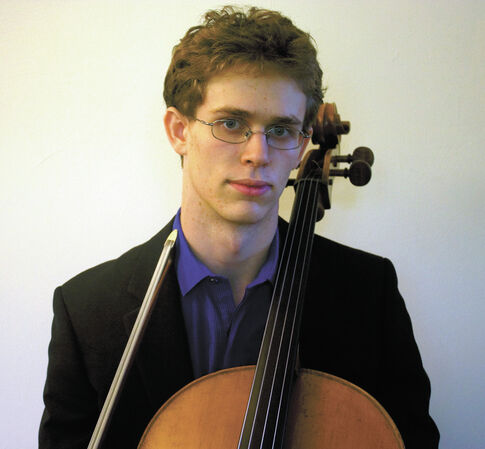
Cellist Zachary Mowitz is making a name for himself in the world of music
Playing an instrument was a natural for Zachary Mowitz — his brother plays the violin, his mom the piano, and his dad is a composer. “I thought that was what all other kids did,” he said. “It seemed normal that my parents started me on an instrument when I was four and a half.”
That instrument was the cello, and through elementary and middle school, he said, it became his thing — what soccer and Little League was for other kids.
The cello stayed his thing and now has become the professional pursuit of the newly minted freshman at the Curtis Institute of Music.
Mowitz will be performing as part of the Gail W. Snitzer String Quartet on National Public Radio’s “From the Top,” a show designed to interest kids in classical music by having top young performers play and talk about themselves from both a musical and a personal perspective. The show will be broadcast several times during the week of Nov. 17.
The quartet, which is part of the Settlement Music School’s Advanced Study Program, came to the show’s attention after winning honorable mention in the Fischoff National Chamber Music Competition earlier this year.
Starting at age 8 and continuing through his junior year in high school, Mowitz went every weekend to the Center for Gifted Young Musicians in Philadelphia, part of the Temple Music Preparatory Division. For his senior year he switched to Saturdays at the Juilliard Pre-College Program.
“It was just to have a different music scene for my last year before going off to college so I could get to know new players and a new city,” Mowatt said, “and because I found a great teacher there (Dane Johansen) who was willing to teach me even as I kept taking lessons with my teacher in Philly (Priscilla Lee).
Two pivotal experiences at Greenwood Music Camp served as turning points that got Mowitz thinking seriously about music as a career.
The first was the summer before seventh grade when, “people told me I could move forward, do a more serious repertoire,” he said.
So he switched from his studies with Lynne Beiler to lessons with Efe Baltacigil, a teacher who would move him at a faster pace, and who happened to be the associate principal cellist of the Philadelphia Orchestra and is now principal cellist of the Seattle Symphony. Mowitz studied with him for about three years and was his only student at the time.
“He gave me a lot of attention,” he said. “I never had a teacher be so hard on me.”
While working with Baltacigil, Mowitz’s attitude toward his music changed. “It was no longer a hobby, but was my thing, my defining activity — the one thing you are really good at and really love.”
The groundwork for the second turning point, which happened during a summer in high school, came as both his interest in music and the time he dedicated to it was steadily increasing. His mom was visiting the camp to hear a concert, and she asked him a crucial question: “So, is this what you want to do? Do you want to go to school to study this?”
Explaining why it affected him so much, he said, “Having my own mother ask me so straightforwardly and me putting out the answer pretty easily.”
Mowitz attributes much of his growing commitment to Greenwood Music Camp, which is devoted to chamber music.
“Small ensembles like string quartets and piano trios are what I love to play most, more than solo or orchestra; it is the music that has fulfilled me the most,” he said. “I’m also convinced that camp made me love music in general so much, especially chamber music.”
At Greenwood Music Camp in Cummington, Massachusetts, the kids both live and rehearse in cabins in the middle of the woods, playing music all day.
Mowitz said that the times he spent there each summer, “were always the best five weeks of my year. I learned things about being a musician and a person that you wouldn’t learn anywhere else: how inspiring your peers can be; how important a community is; how important it is to have relationships that satisfy you at different levels, both personally and professionally and creatively.”
“Music as a profession is very social,” he said. “A lot of how concerts and people’s careers work out is through contacts. It is a very informal network.”
Of course the camp also taught the young musicians about how to rehearse and the subtleties of playing music, especially chamber music.
Speaking about what enables him to maintain the discipline necessary to advance in the musical profession, Mowitz said, “Once I got old enough, it became almost an obsession. I would always be very uncomfortable if I couldn’t practice.”
Musing that probably no one naturally enjoys practicing, he attributes his focus to doing it consistently and carefully planning his time. “It’s hard, whether you practice for one hour or five hours,” he said. “It’s always hard to sacrifice the time that could be used to have fun or do homework.”
For Mowitz, practicing means, first and foremost, working on himself. “You have pieces you are working on, things you want to accomplish, but you are taking time away from your day to concentrate on yourself as a musician. By doing that, gradually you learn new things and get better.”
In the end, practice becomes something of an end in itself. “Eventually it wasn’t so much finding time as much as always wanting to get back to my practicing and keep working,” he said.
Asked about where the impetus to practice comes from, Mowitz said, “Partly it is getting lost in the music; I wouldn’t be doing if I didn’t have moments when that happened. But you can’t always be emotionally involved — nobody has the emotional endurance for that.”
But what practice does, he said, is to give him the technique and emotional maturity to have those moments when the music is “so enveloping and so overwhelming. You have to do the work to get those; it doesn’t just come,” he said.
Of course with practicing being such a primary focus, Mowitz had to make compromises at Princeton High School.
“It meant having to figure out your priorities,” he said. “If taking a certain class was too much, you had to accept that. If sometime you couldn’t get your homework done, you talked to the teacher.” Although he did play in the school orchestra, he said, “it was not my most significant or committed musical experience.”
One of Mowitz’s biggest decisions about music in high school was what to do next: an academic school with a good music department, a music school attached to an academic school with a double degree program, or a conservatory, where academics are more limited.
“I already knew I was going to have a career in music,” he said, “and where I really wanted to be is where music is foremost.”
He applied to six conservatories, five on the East Coast and one on the West Coast, but the Curtis Institute of Music was always on the top of his list. He liked its smallness — the school accepts as many musicians as it takes for a full orchestra, he said, and he is one of two cellists in the freshman class. He studies there with Peter Wiley, former cellist of the Guarneri String Quartet and the Beaux Art Trio, and Carter Brey, principal cellist of the New York Philharmonic.
The fact that Mowitz was accepted to Curtis shows his level of talent. According to a U.S. News and World Report survey, Curtis is the nation’s most selective conservatory, with an acceptance rate of only 4 percent. It is also one of the most selective institutions of higher learning in the country, according to the report.
Mowitz got his first taste of conservatory living this summer, when he spent seven weeks rehearsing music day and night with students in college and beyond at Kneisel Hall, a highly selective chamber music festival in Blue Hill, Maine.
At Curtis, Mowitz spends most mornings in class, but in the afternoon it’s all music — plus homework and a little time for himself.
“Whatever free time is not taken up by rehearsals or lessons, I practice,” he said. He tries to practice at least three hours every day, but five is the ideal.
Noriko Schneiderman of Princeton, who teaches piano at the Lawrenceville School, has been accompanying Mowitz since she met him in November 2012, through mutual friends. He lived nearby, and they began playing together.
“The first day when we played together at rehearsal at my place, he played the Brahms Sonata,” she said, “and from the first note, I knew, oh my God, this boy is something.”
The two have performed at a music club in Princeton that meets in people’s homes and at Salon 33 on Alexander Road. She also played with him at Juilliard, where he spent Saturdays during his senior year in the Pre-College Division. She also accompanied him in a concerto competition that he won and on audition tapes for both Juilliard Pre-College and for College.
Describing Mowitz and his music, Schneiderman said, “He is extremely mature musically. His music really speaks to you, comes to your heart. His music is very profound and very sensitive and very deep.”
“He has extremely good ears,” she said, “and he knows what kind of sound or what kind of character he wants to play, and he works very hard to achieve his goal.”
Schneiderman said she has learned a lot from this mature, responsible, and polite young man “in terms of the music making and the way he thinks about the music.”
For a taste of Mowitz’s playing, check out “From the Top” or watch his videos on his channel on YouTube.
Schneiderman is a big fan. “He’s going to be out there. Keep an eye on him,” she said. “I don’t think he wants to become famous. He wants to do string quartets eventually, and I think he will make it.”
,

