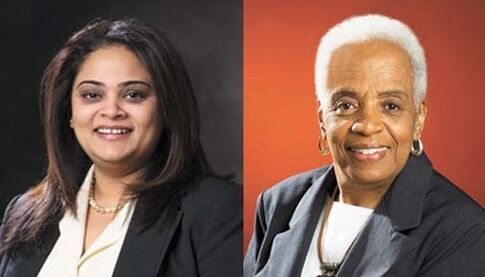
Rao and Flythe.
YWCA Princeton to recognize two Lawrence residents at annual Tribute to Women
On March 6, the YWCA Princeton will honor nine local women at its annual Tribute to Women Award Dinner, including Lawrence residents Barbara Flythe and Jigna Rao.
The event, which will take place at the Hyatt Regency Princeton, “recognizes women of excellence who live or work in the greater Princeton area, and who have made significant contributions in their professions and their communities.”
The honorees also embody the YWCA’s mission of eliminating racism and empowering women. Since the inception of the Tribute to Women award program in 1984, the YWCA Princeton has celebrated the accomplishments of more than 300 local women.
The women honored by the Tribute to Women are nominated by their peers and colleagues in an open nominations process. Following that, a selection committee reviews the nominees and chooses the winners based on diverse criteria including professional and academic achievement, leadership and community service.
“Our 2014 Honorees have been selected because they walk the talk of our mission,” said Nancy Faherty, the Director of Development for the YWCA Princeton. “By paying tribute to their achievements, we collectively honor our history and embrace our future. We also affirm why we must remain fearless in our efforts to stop discrimination and allow women to prosper.”
Additionally, every so often, when there is a worthy candidate, a woman is chosen to win the Waxwood Award for a lifetime of distinguished contributions to the YWCA Princeton. The award is named for Susie Waxwood, the first African-American Executive Director of the YWCA Princeton. This year the Waxwood Award is being given to Jane Dennison of Princeton, who has been a member of the YWCA for 81 years.
Flythe, one of the women being honored, is a retired educator and a longtime social justice activist.
“I’ve become involved in places where I can be part of the solution and the help,” she said about her activism.
Most recently, Flythe has been particularly active with the New Jim Crow Community Project, a group that focuses on fighting the mass incarceration of black men in the U.S. She calls the inequality toward people of color in the country’s justice system “outrageous.” Currently, her other major concerns are failing public school systems and human sex-trafficking.
Flythe said her impulse to better society was there from a young age. She notes that when you grow up as a black person, you recognize very early that the world lacks fairness.
Her father was raised in the south in a town with no high school.
“He had seen lynchings and was very afraid,” she said.
Seeking to escape the oppression of the south and search for a better life with more opportunities, Flythe’s father moved to Philadelphia. Even after his move, he had difficulty finding a job and often encountered signs that said, “No n****** or Irish need apply.” Eventually, he found a job with the Philadelphia Department of Streets and became very active in the union.
As the daughter of a union activist, Flythe said her childhood home and dinner table were filled with ideas about social justice and acting on one’s beliefs.
“People around me always talked about fairness and justice, and it became a part of how I thought and my view of the world and my responsibility to it,” she recalled.
Another important motivator for Flythe is her faith. She is particularly influenced by the Old Testament prophets and teachings of Jesus that focus on freeing prisoners and caring for people who cannot care for themselves. She thinks that her faith supports and strengthens the beliefs about justice and fairness that she acquired as a little girl.
Flythe said social justice was also a constant theme in her work as an educator. Although she held many different positions over the years—including as a school social worker, a high school guidance counselor, and the director of a Head Start program—wherever she went, her work involved at-risk children and their families. She said because she was helping people who live on the margins, “justice issues just kept popping up.”
Although she has witnessed a great deal of injustice, Flythe has never concentrated on being angry. Instead, her focus has always been on making a difference, on working to achieve justice.
“I am interested in being productive, not protesting. I’m interested in people coming to an agreement and fighting for change. Anything I’ve ever done, any system or institution I’ve worked with, I’ve stayed within the system to do the work that I do,” she said.
Being concerned about fairness and justice is a natural instinct for Flythe. She said that whenever she goes anywhere, she asks what is happening to people of color there. When she was on the Board of Trustees at Hood College in Maryland, the college was doing a lot of work in recruiting young black women.
“I was immediately interested in what happened to them once they arrived on campus, what type of support they were getting, what their outcomes were,” she said.
Flythe believes that there is a lot more that could be done to eliminate racism in the Princeton area.
“It’s challenging to engage the African American and Latino communities of Princeton because people are very comfortable with being with people who are just like them,” she said.
She suggests that the communities could be better reached if the staff of organizations like the YWCA better reflected their communities, and if programs were held in the community instead of expecting members of the community to come to programs.
“I am very fortunate in diversity in the range of people I know and call my friends,” she added.
Rao, another YWCA honoree, is a healthcare advocate who has worked tirelessly to raise awareness about tuberculosis and other infectious diseases.
In 2006, Rao, who was born and raised in Mumbai, and her husband decided to start a family. When she couldn’t get pregnant, she endured a year and a half of infertility treatments. She changed doctors and went to specialists, but she still couldn’t figure out the reason for her infertility.
By chance, one specialist discovered that she had pelvic tuberculosis, a type of extrapulmonary TB. This meant that instead of infecting her lungs, the disease settled in her pelvic regions and destroyed her reproductive organs.
Although the diagnosis was fortuitous health-wise, it was also difficult because it halted Rao’s hopes about getting pregnant. She discovered that because TB infection rates are so low in the U.S., doctors are often uninformed about the disease. The Ob/Gyn she had seen when living in India told her that since TB rates there are so high, doctors test infertile women for it right away. Because doctors in the U.S. didn’t test for it, Rao wasn’t diagnosed until it was too late.
“The delayed diagnosis cost me my fertility,” she said.
When Rao told others about her diagnosis, she immediately noticed insulting changes in body language from her audience. She realized that there are many myths and misconceptions about TB and how one contracts it.
“It is viewed as a moral failure in many ways,” she said.
Women face a heavier stigma when it comes to TB and other infectious diseases than men do, and that is doubled when paired with infertility, a stigma in its own right in many cultures.
At first, Rao was angry about how she was treated when she revealed her diagnosis, but that changed as she learned about the history of the stigmatization for those with TB.
“I found myself educating people about it rather than getting angry about it,” she said.
Rao was lucky to have a wonderful support system. Her mother, in particular, “encouraged and empowered me. She was the one who said that being a mother is not the only thing for a woman.” Rao’s mother also told her that she had many other things of equal value to offer the world, and that she should look at her infertility as an opportunity to do whatever she wanted with her life.
“That gave me a sense of power,” she said. “I was not defined just by motherhood, even though it was one of my biggest ambitions in my life.”
Her husband was also very supportive.
“I cannot imagine me being strong and carrying on to lead a healthy, happy life without him,” she said. “He is my rock. He said, ‘Go out and do all the things you want, I’m here behind you.’”
Rao wanted to reach out to others who suffered from TB.
“It’s a very isolating disease,” she explained. “You can’t share your pain or what you’re going through.”
She decided that if she spoke publicly people would realize that someone else out there had the same experience. Often, after she shared her story, people would come up to her and tell her that they, too, had TB, and admired her courage to speak up about it, saying it made them feel less lonely.
Now, Rao does a lot of advocacy work, campaigning for dignity, equity and health for all women. People tend to reach out to her, often after hearing her speak at a conference or reading an article about her in a newspaper. She has worked with a number of “courageous organizations” who share vision and goals. She says that these organizations “have shown commitment to work toward these issues, have given me all their support and guidance, and an education about being an effective advocate.”
Rao advocates for women’s health not just in the U.S., but around the world. She said she was fortunate to be in the U.S. when she was diagnosed with TB; not only does the disease carry less stigma here, there is superior access to treatment.
She noted that 325,000 women around the world died in 2010 from TB, a totally curable disease.
Nonetheless, she believes that the successful treatment of TB here is a double-edged sword. Congress has refused to pass some of the bills that fund TB programs, so the programs are facing budget cuts. Therefore, Rao is also a strong advocate for TB funding and education.
“The reason the United States has been so successful [in controlling TB],” she said, “is because we funded our TB programs. If we don’t continue dong that we will see an increase in TB again. Success has become a threat.”
She explains that both legislators and the general public need to be aware of the deadly nature of TB. It is one of the leading killers of people suffering from HIV/AIDS, is especially dangerous for people with diabetes, and as an airborne disease, can be easily contracted by visitors to countries with high burdens of TB.
Although Rao began her journey with a diagnosis of infertility, she isn’t sure if she has children in her future. She reveals that what she mourns isn’t not having a family, but that “the disease is curable and if found in time I wouldn’t have had to give up on my dream of motherhood. TB took that away from me.” Nonetheless, she says, even if life didn’t go the way that she planned, “it doesn’t mean the new plan is a bad plan or a substitute. It can be just as exciting and just as fulfilling.”
“If there is a child somewhere in the world that is for me, I believe I will have it,” she said, noting that for now, she and her husband are enjoying their lives. “We recently adopted a dog from a shelter. That is our new family for now.”
Rao considers herself lucky that she had so many women rally behind her after her diagnosis. She says that they were “ordinary women who gave me extraordinary wisdom and they shared it generously.” This is why she believes that her advocacy work is so important.
“You can be just one person and change people’s lives. That’s what happened to me,” she said, attributing her ability to dream again to the women who supported her. “I’ve started to dream big and dream more. I attribute that to so many friends and family and strong women who have stood behind me and beside me.”
Although the YWCA Princeton’s Tribute to Women is a local event, it has counterparts across the country and all over the world. The YWCA has 25 million members worldwide and many chapters have similar events.
,

