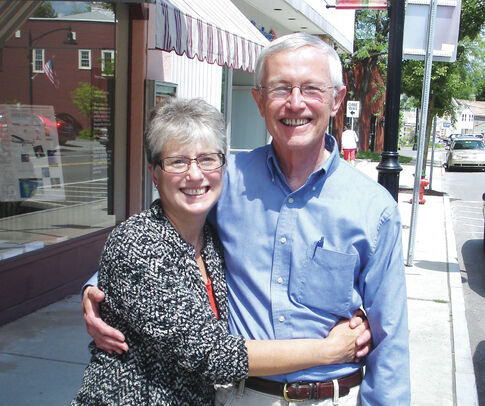
Thomas J. Callahan, Jr. (right) and wife Ellen in Chatham, N.Y., the author’s hometown.
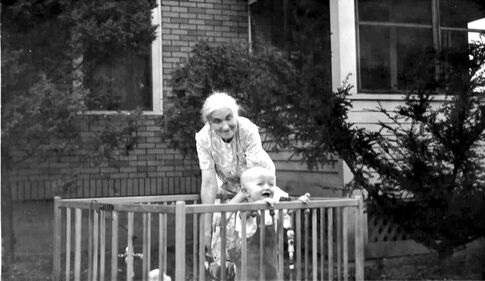
The author with his grandmother, Katie McCormack, in 1945.
Pennington author traces family history back to the Emerald Isle
Dr. Thomas J. Callahan Jr. is an Irish American, but growing up in Chatham, N.Y., he didn’t necessarily think that much about it.
“In our family, and where I lived in upstate New York (about 25 miles south of Albany), we didn’t really make a big deal about it,” he says. “Growing up, there was no St. Patrick’s Day parade, nobody drank green beer. It was like, ‘OK, we’ve moved on, we’ve come to America, and now we’re Americans.’”
Callahan, 69, lives in Pennington with his wife, Ellen. He was a British historian after finishing graduate school, settling in at Rider College, now Rider University, where he’s been for 43 years. One day when he was teaching an Irish Studies course, he observed that “a lot of the class roster read like the Dublin phonebook.”
“A lot of kids took Irish history because they were interested in their own background,” he said. “They would say they didn’t know anything about their grandparents or great-grandparents — don’t know why they came to America, don’t know when they came. I thought I knew all that stuff about my own grandparents, but it turns out I didn’t.”
Soon his students’ fascination with Irish history became his own, and with the aid of a summer grant from Rider, he made his first trip to Ireland to do research on his family history. He made discoveries about his own heritage, but more than that he found the history of generations of Irish just like his family, whose members had emigrated to the United States in the 19th and 20th centuries, most of whose stories had never been told.
The result of his research is a book, published last year in Dublin, called I’m Sending You a Shamrock to Remind You of Home. In the book he uses what he unearthed about his own family to illustrate the Irish-American experience on both sides of the Atlantic.
The biggest unanswered question about his own family was how many siblings there were in the generation of Katie McCormack, his grandmother. McCormack had come to the U.S. in 1897, joining some of her brothers in America but leaving many family members behind, including her mother.
“Pretty much everyone had their own idea (about the sibling count), and none turned out to be right,” Callahan said. “Fourteen, nine, eight — turns out there were 12, but two died young.”
In piecing together the life of Katie McCormack, Callahan was able to put together a pretty good picture of what so many Irish immigrants went through.
“The book’s about what prompted them to leave, and what happened when they got here,” Callahan said. “How they acclimated to American culture, and the process I went through to find them.”
What follows is the prologue and first chapter of his book. Callahan will be at the N.J. State Library in Trenton March 12 at noon to discuss I’m Sending You a Shamrock to Remind You of Home. He’s also scheduled to appear March 27 at 7 p.m. at the Lawrence Headquarters of the Mercer County Library.
An American Wake
By Thomas J. Callahan, Jr.
Excerpted from “I’m Sending You a Shamrock to Remind You of Home,” published by Dublin-based Glasnevin Publishing.
On a chilly early-April day in 1897, 20-year old Katie McCormack slowly made the rounds of her Slieveroe townland near Frenchpark in County Roscommon in preparation for yet another “American wake” for the McCormack family. She and her mother, as well as her sisters Bridget and Maggie, had been baking for days, and their neighbors would contribute poitin and porter. Four of her older brothers had already bid their family and friends farewell and set sail for America to begin new lives. As the eldest daughter in the large rural family, Kate had helped her mother keep the small two-room cottage and look after her brothers and younger sisters. But now she too was leaving. Her mother Catherine would be in good hands. James and Martin would help her father look after the farm, while Bridget and little Maggie kept house and worked on the land as well.
As was the tradition, Katie proceeded from cottage to cottage, bidding the Mahons and Farrells farewell, promising Pat Deignan to take a message to his son Peter in America, and hugged and kissed her friends and cousins. Her steamer trunk with her name newly stenciled on the end was packed and ready. Catherine, nearing 60, had already seen four of her ten surviving children perform this ritual and depart over the past decade, but this time was different. Kate was her eldest daughter, her namesake. Though she had known for years that this parting would probably come, it was still wrenching. As evening approached, it was time to escort Katie to Tibohine for a final church service and to receive Fr. McDermott’s blessing. Then came the wake — really more of a party, yet not unlike the bittersweet farewells to her two infant sons who had died before their time. Neighbors and relatives crowded into the small cottage, beer and whisky flowed, music and dancing lasted until dawn. All in attendance were determined to make the best of this departure. They knew Katie would be well cared for in America; brothers John, Patrick, Thomas and Michael were solidly established in West Orange, New Jersey, two married and with families already begun. Katie was excited to be going, yet sad and apprehensive too. She had read and re-read her brothers’ letters describing America and the opportunities ahead; still it was painful to leave behind all she had known and loved.
In the morning the priest came to the cottage for a final blessing, and the neighbors gathered to “convoy” her to the townland border. Her parents, brothers and sisters would accompany her all the way to the train in Boyle. Trying not to cry too much, she hugged and kissed her family, clung to her mother one last time and promised to write and to be a good girl. She told Catherine that she would return someday, though they both knew in their hearts that they would never meet again. Trunk loaded on the train, it was time for a final embrace. Be good, be well … God speed. Now, alone for the first time in her life, Kate McCormack was off to Dublin and thence to Queenstown, the RMS Campania and the beginning of her new life.
* * *
Young Kate McCormack who landed at Ellis Island on April 17th, 1897 was my grandmother. I remember her but dimly as I was only 7 when she died. I knew little of her past except that she was Irish. When and why had she left her home and family? Did she have friends or family waiting for her in America? As a historian teaching Irish history, I felt should know these things, but I did not. So, in 2010 I began in earnest to uncover her “roots” and the following story is the result.
The genesis of this study began 30 years earlier on a vacation that my wife Ellen and I took to Ireland. As we were preparing for the trip, I remembered that I had inherited a document that listed Kate’s place of birth in Ireland as Frenchpark. Where was this, and were we going to be anywhere near there? I discovered that Frenchpark was a small village in rural County Roscommon in north-central Ireland. The guidebooks ignored it, as did most tourists. Still, Ireland is a compact country, and the drive from Cashel, where we were staying, to the McCormack “home town” was only an hour or two, depending on how many sheep or cattle were blocking the rural roads. So we headed north to see where Kate McCormack had been born.
We parked in what seemed to be the town center, though there was not much town in evidence. I walked into the post office, which doubled as the pub, and asked if any McCormacks still lived nearby. Of course having the family name wouldn’t necessarily mean that we were related, especially nearly a century after my grandmother’s departure for America, but it was a place to start. “Ah,” replied the postmaster, “You’ll be wanting J. P.” He proceeded to give me detailed directions to J. P. McCormack’s farm. “Go down this road until you get to the monument. Turn right and go to the pump near Lavin’s Shop. Then go up the lane and it’s the last house.” We did as instructed, and, with some trepidation, I knocked on the door. I asked the woman who answered “Is this the McCormack house?” “Oh no,” she answered, “It’s the next place.” Next place? I was confused because we seemed to be already at the end of the road, but there was indeed a faint track beyond, though I could see no house. We had come this far, and it seemed foolish to give up, so I drove on, hoping not to lose the rental car in a ditch or rut. Another cottage appeared ahead. I stopped in front and watched a balding, middle-aged farmer walking slowly toward us looking very curious. He was obviously thinking that we must be the most lost tourists in Ireland. “Are you J. P. McCormack?” I asked, “My name is Tom Callahan.” He smiled and replied “Ah, I had an Aunt Kate who married a Callahan from Cloonfad.” I had come to the right place.
By good fortune I had found John Patrick, better known as J. P. McCormack, son of my grandmother’s youngest brother Martin. Even better, he still lived at the original family farm, from which my grandmother and had left for America many decades earlier. He invited us in for tea and told us a bit about the McCormacks in Ireland. There were, he said, nine children in my grandmother’s generation — I would later discover that he was wrong about this — most of whom emigrated to America in the late-19th and early-20th centuries. He knew nothing of his American cousins save a couple of surnames, and it became clear that there had been no contact between the American and Irish branches of the family since the late 1940s. He rummaged around in a box and gave me a couple of photographs to bring home, including one of the original house which had since been demolished and the foundation turned into a pig sty. After a delightful hour or so, we exchanged addresses and Ellen and I headed back to Cashel. Over the next few years we exchanged annual Christmas cards with short notes included, but I made no attempt to dig much further into the family history. By the time I did, J. P. was dead and it was almost too late.
“I’m Sending You a Shamrock to Remind You of Home,” is available online at Amazon.com.
,