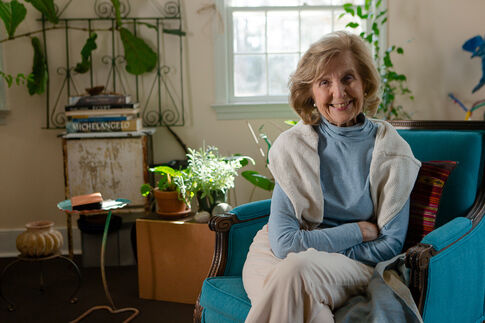
Anne Reeves has spent decades as an advocate for the arts in Princeton
By Michele Alperin
Growing up the oldest of six children, Anne Reeves experienced the power of community and the arts from a young age.
Reeves played piano and her sister the violin as they put on elaborate performances in their home for their family, complete with tickets and a raised stage on a space three steps up from the library.
Her parents also took her and her siblings to hear George Szell and the Cleveland Orchestra, to visit the Cleveland Art Museum, and once a year to see the opera when it came to Cleveland, which was “a big event in my family’s life,” Reeves said.
“Our home really did have a life in the arts,” Reeves said.
The sense of community that was developed in Reeves’ family as well as her love of the arts came with her to Princeton when she moved here with her husband, David, in the mid-1960s. It all came together in the 1970s when local architect Jerry Ford asked her to get involved with the Arts Council of Princeton.
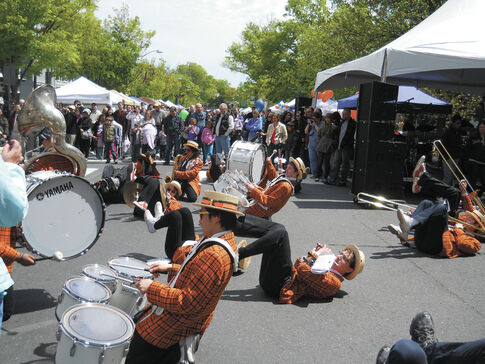
One of the first ventures Reeves helped organize was the Art People’s Party — an event that was the precursor to the annual Communiversity celebration. This year’s event is scheduled to take place on April 27.
“Jerry named it, and all three words are equally important,” Reeves said. “At that time there wasn’t anything that gathered people together — creative theater people, the ballet society, students.”
With the Art People’s Party, the Arts Council endeavored to bring together members of the arts community with other people in town. Over the years, the events included: a Street Eat featuring campus singing groups and food from local vendors for a to do on Witherspoon between Nassau and Spring streets; a Kite Day at the Princeton Battlefield featuring the Betty Ruth Curtis Community Band, whose instruments, available for kids to bang on, were garbage cans; and a party at Lake Carnegie that turned the Washington Road bridge into a local Ponte Vecchio, with people dressed in antique clothes who were invited to “come by land and water.”
Reeves also recalls a Shakespeare festival when Michael Redgrave was performing at McCarter Theatre.
“We had a procession down to McCarter, with people dressed up as Shakespearean peddlers,” Reeves said. “It was a wonderful way to promote McCarter, to have the whole town go down to the theater.” On their arrival, Elric Endersby read from a scroll welcoming the town to the theatre.
Summarizing the Art People’s Party events, Reeves said, “It was well rounded, for multi-aged people looking for fun. We always had food, and puppy dogs were always welcome.”
Asked about her own role, she is modest. “Planning, executing, getting people to participate. I ran it, but had all these people helping me; without the community, I am nothing.”
The Arts Council itself, founded in 1967 by people interested in community arts activities, started out as an advisory council on arts and culture to the Princeton Borough Council.
“There was a need for the arts to know one another,” said Reeves, who recalls Bill Selden initiating the group and getting all the papers signed. But her own role was a little different.
“One of my jobs was to make it live,” she said, “to see how it could draw the community together.”
Early on, the Arts Council served largely as a publicity channel for promoting all the different types of art going on in town, from concert and dance performances to art and photography exhibits. Reeves, who started as a volunteer, was hired in the 1970s as the Art Council’s first paid director.
In the beginning, the Arts Council met in a variety of spaces, at the library, in the Ballet Society’s offices, or, most often, at the Maclean House at Princeton University, through Bud Vivian, the university’s long-time director of community and regional affairs.“Bud Vivian was my hero,” Reeves said.
Reeves remembers what Princeton was like when she first moved here and the divide between the town and the university.
“It was almost as though there was glass in the middle of Nassau Street — half to the university and half to the town, and there was very little mixing,” she said.
In 1987, the Art People’s Party was renamed Communiversity to capture the town-gown spirit of the event, with the hope of making the wall between the two more permeable.
“The idea was to mess it all up, put it all together, and have fun, and grow, learn, and meet people from different parts of the country and the world,” Reeves said. “That’s how we became integrated.”
It took a while to get the university and the town entirely in the same place. Reeves remembers an early discussion, for example, where the university was a bit uncomfortable with the idea of chalk drawings on the street. But after it was pointed out that rain would take care of any residue, the chalk was okayed. “Now we have the most beautiful paintings done in chalk,” Reeves said.
Communiversity was formed with the help of two Princeton University students, Lillian Osliva and Doug Platt, who worked with Reeves on the event. Bud Vivian was also actively involved as the public relations person.
“He was instrumental in having us all make it happen,” she said. “He got the mayor and that crowd and the police and the university and saw that it worked.”
Communiversity took over the feel of those early Art People Party events, but it quickly developed its own traditions. The day opened with a proclamation from the president of Princeton University and the mayor of Princeton Borough. Thanks to Paula Chow, who headed the Davis International Center at the university for over 35 years, the event included a parade of students carrying flags from all over the world (a tradition that Jeff Nathanson, current executive director of the Arts Council who took over from Reeves in 2005, says he is thinking about restarting).
Another early element was the maypole created by Audrée Estey of the Princeton Ballet Society in front of the Presbyterian Church.
Local groups like the Girl Scouts and League of Women Voters had booths, but any artwork had to be made locally. “Anyone who made earrings in their house or children who made little cards that you could send to your grandmother, all of those tables were part of Communiversity,” she said, adding that as the event grew the local standard was not adhered to as carefully.
“We were also in a position where we could do a lot of teaching,” Reeves said. So all the environmental organizations came to teach about what they did, and the Princeton Symphony would bring trumpets and violins, which they called “the instrument petting zoo,” so all the children could try them.
A Latino table represented Princeton immigrant groups, and a large world map was available where everyone could plot their origins. “People were interested in understanding that they too were immigrants,” Reeves said.
Communiversity also serves the Arts Council’s role in connecting Princetonians with the town’s organizations, schools, and classes. Reeves remembers university students performing flamenco dancing, and she said, “You could ask them, ‘How did you learn? Is there any place in town we can do that?” And in fact the Arts Council still teaches flamenco dancing.
Looking back on her own role in all this, Reeves said, “It was so easy for me, because I was interested in everything that was going on.”
She recalls with some excitement how Communiversity pulls people together. “People were eager to meet one another,” she said. “They were nosey — how come you do that dance? Where are you from? What language do you speak?”
Communiversity also succeeded in breaching the town-gown divide. “Other things happened because of Communiversity,” said Reeves, who notes that after it began, she could easily get the Tigressions, a campus a cappella group, or guitarist Caroline Moseley, a writer and editor for the university’s communications office, to sing at the hospital.
Looking back on Communiversity’s evolution, Reeves said, “The Art People’s Party was very homespun. We still have some of that, but it is a little different because we’re a little bigger.” The purpose has not changed, she said, but adds that “it has gotten so large that it loses some of it.”
In fact, Nathanson said, changes have been occurring to take the festival back to its original conception as an arts festival with nonprofit community and artistic organizations offering not just information but also interactive activities.
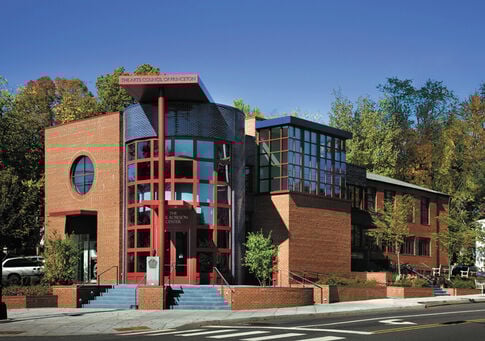
Under Reeves’ directorship, the Arts Council first rented and then purchased the building at 102 Witherspoon, which had earlier been the YMCA for the African-American community during segregation, then a neighborhood community center (which closed because of funding problems), and ultimately a place for Princeton Borough offices and storage. The Arts Council reopened the building as a community arts center in 1982.
“There was some controversy over the years because of members of the Witherspoon-Jackson neighborhood who wanted it to be like the old days when it was a community center,” said Nathanson, who adds, “I think there were some racial tensions because the leadership of the Arts Council was white, not black.”
At the same time the Arts Council has worked to serve the community around the building. It has a permanent display of photos called “Neighborhood Portrait,” which document the Witherspoon-Jackson community.
About the building, Reeves said, “It was open to everyone, but it took time for people to feel comfortable. Change is difficult, and it was a matter of time that they could start trusting and it was often through the children.”
Fees for the Arts Council’s classes were modest, said Reeves, and the Arts Council offers free events like valentine-making, the Halloween parade; the Day of the Dead, which celebrates Mexico’s El Día de los Muertos with strolling mariachis, Mexican paper flower making, sugar skull decorating, professional face painting, and Mexican dishes; black history month; and Martin Luther King Day.
The Arts Council has a scholarship fund that is open to anybody. “We try very hard to make all of our clases and programs access to everybody,” said Nathanson. “We really feel that money should not be a barrier.”
Looking back to the early days at the building, Reeves said, “Just two of us were running it; all the rest were volunteers.” Today there is a staff of 12.
They kept expenses down and a volunteer ran the gallery. Reeves remembers a show based on shopping bags from different venues. “It was an inexpensive way to draw the attention of people that the shopping bag is an art form,” she said.
Also under Reeves, Summer Sounds, which morphed into the weekly summer concerts at the Princeton Shopping Center, got started with Caroline Moseley playing guitar in Palmer Square and people singing. Then it got larger and moved to Community Park North. “We had wonderful bands, and it was mostly teenagers and young people,” Reeves said.
Under Reeves, the Arts Council also created Curtain Calls, a New Year’s Eve event of performances throughout Princeton, that ran for about 14 years.
Another Arts Council project that Reeves is fond of involves poetry for children 18 and under. “They bring their poems in, or their teachers usually do, and we have an editor who reviews them,” Reeves said. The poems are published by the Arts Council in a book called “A Muse.”
“It’s very exciting, and the children love it,” she said. “Once a year we have a publication party where you come in with your parents and you read your poem.”
In 1998, when the building was deemed too small and falling into disrepair, said Nathanson, a campaign started to expand, and it became controversial again, because some people in the neighborhood didn’t want to see the building expanded. “Anne was the director through the whole process,” he said.
The capital campaign for the new building, designed by Michael Graves, was launched in 1998, the final plan approved by the Planning Board in 2005, and the ribbon cutting in June 2008.
“Anne was very creative, energetic, and social, and she got a lot of people excited about art and culture, and through her leadership she really built this organization up,” Nathanson said. “I don’t think we would have been in a position to have a famous architect like Michael Graves to renovate the building if it weren’t for Anne getting a lot of people excited and willing to put up some money.”
With the new building, the Arts Council has been able to expand on the fundamental mission that Reeves set in place. Its outreach programming, which brings free art classes to underprivileged students and a creative aging program that connects seniors with music and art, all got started under Reeves.
Reeves is particularly proud of the artist-in-residence program she started seven years ago that bears her name, noting “the wonderful mural of bubbles” that artist Illia Barger painted as part of the program.
“Anne has always felt very strongly that having an artist-in-residence is an important part of what the Arts Council should be doing,” said Nathanson. “What we are interested in is how can the artist learn and grow by having that interactive input from people who come to see their work and process? In turn, how can the artists teach people about their work and process?”
The new building also has the Anne Reeves Studio on the building’s upper floor, and the Art Council’s yearly fundraiser raises money for the Anne Reeves Fund, which supports the artist-in-residence program and also funds the community arts outreach programming.
Reeves solicited a major contributor, Robert N. Wilson and family, to purchase a Steinway piano for the renovated Paul Robeson Center, right before the new building opened in 2008.
“We take very good care of it and have a little fund, so that when needs to be tweeted, we have someone who comes in and tunes it,” Reeves said.
Reeves is probably best known for her role with the Arts Council, but she has always been involved in a variety of Princeton-area projects.
Reeves has been active throughout the Princeton community. She had her hand in the creation of a program where artists visited young people in detention centers as well as in a summer program, “the Red Umbrella,” through the minority education committee of the Princeton Regional Schools, where storytellers read to children in the Mary Moss Park at John and Lytle streets.
Currently she is interim president of the Princeton Middle East Society. “I felt like it was important to have us better understand the Middle East,” she said. “The more we can understand, perhaps the better things would be.”
But as is not unusual for Reeves, it is the arts of the Middle East that are the biggest draw for her. “My major interest was culture, music, art, food, and tribes,” she said, noting a recent tour of an exhibit of veils and traditional dress from the private collection of Isabella de la Houssaye, who is also on the Arts Council board.
The group has about 100 members, and Reeves is hoping to bring more young people into it.
Reeves grew up in Cleveland Heights, where she graduated from a class of 49 at the Hathaway Brown School. “I was pleased to go because it was a private school, and my family sacrificed to send me there,” she said. “I had to go and I had to do well.”
Her favorite teacher taught science. “That was unusual, because I loved art, music, and sang in the glee club,” Reeves said.
Her father, a lawyer, was a consultant for architects, and was on the foreign affairs council, an organization in most big cities that hosted speakers. Her mother had a flair for the arts and for color, and Reeves recalls how she she floated a couple pieces of popcorn on each portion of soup at Reeves’ sixteenth birthday party.
Musing on the tiny but beautiful gardens that each child in her family tilled, she said, “I was in that pocket of the arts, and it surrounded me. I found it everywhere.”
She went to Marymount College because, she said, “My father thought it would be wonderful to put me with good nuns.” As an English major, she said, “That was where I really learned how to read more than just what was assigned.”
The East Coast, not as friendly as Ohio, took a little adjustment. “Many people had first names for last names, like Brook,” she recalls. “In Cleveland, we had names like Mary, Jane, and John.”
After college, Reeves moved to New York where she worked in the promotion department for “Life” magazine. “Because I was interested in photography, it was a real treat,” she said. “It was very rewarding, and I grew a whole big bunch.”
She got married and moved to Princeton in the mid-1960s.
Reviewing where the Arts Council is today, after nearly 50 years, Nathanson suggests that it all goes back to the house Anne Reeves built.
“Anne set the tone and really developed the mission and the broad scope of visual and performing arts programs that the Arts Council has,” Nathanson said.
“Anne has always had a great passion for how the arts can provide positive impact on people’s lives,” he added.
And the ideas haven’t stopped. “My dream is to have Witherspoon Street turn into a cultural corridor,” Reeves said. “From Nassau to Valley Road, it already has a church, swimming pool, schools, nonprofits, and Hillier’s architecture firm. It’s on its way.” But she adds that it will depend on what happens to the hospital site, where the Arts Council is working with AvalonBay to get some sculpture outside.
“The arts scene in Princeton has grown tremendously,” said Reeves, “and with the university’s new Lewis Center for the Arts it’s going to get even better.”
But in the end, for Reeves, the Arts Council and Communiversity and all her creations are as much about the people as the art. “I’ve met so many wonderful people I would never have met otherwise,” she said. “One can have neighbors, and children and their friends, but it’s pretty wonderful to have this interest in the arts and promote it.”
,