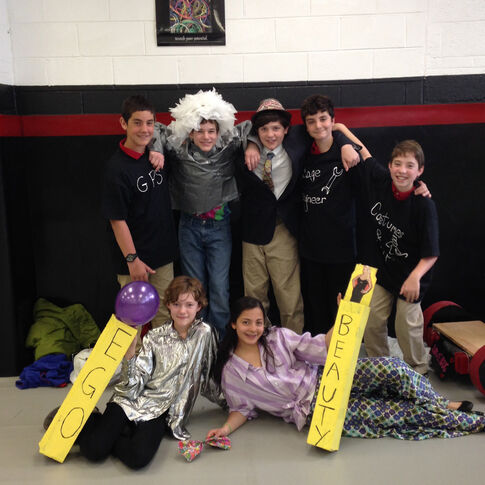
The Pennington School’s Odyssey of the Mind team won first place at a state tournament April 12, 2014. Front: Abigail Bulger (Hopewell) and Sophia Amaro (Yardley, Pa.). Back: Cole Felsher (Pennington), Benjamin Dorph (Washington Crossing, Pa.), Nicholas Micheletti (Milford), Jacob Essig (Princeton) and Harry Wasnak (Washington Crossing, Pa.).
The Pennington School’s Odyssey of the Mind team took first place in its division at the state tournament in Ewing Township April 12.
That team will advance to the world competition to be held at Iowa State University in May.
A second team from the school, competing in a different division, took third place.
Members of the winning team are eighth-graders Jacob Essig of Princeton, Cole Felsher of Pennington, Benjamin Dorph of Washington Crossing, Pa., and Nicholas Micheletti of Milford; seventh-grader Harry Wasnak of Washington Crossing, Pa.; and sixth-graders Sophia Amaro of Yardley, Pa., and Abigail Bulger of Hopewell.
Both teams began preparations for the competition in November of last year. Odyssey of the Mind is an international educational program that provides creative problem-solving opportunities.
The chosen problem for Pennington’s winning team required the students to build a ride-on vehicle that permitted the driver to perform certain tasks in a driver’s test.
At the regional contest in Haddonfield in March, the team won the Ranatra Fusca Award, which is presented to the one team among all divisions that demonstrates the greatest creativity.
Pennington’s team was praised for its creativity in designing an ultralight vehicle able to carry a driver despite being made almost entirely of cardboard, including its wheels, with the sole exception being its axles. Its forward motion was powered by rubber bands, and it used a ratchet system for reverse.
Students in the tournament must demonstrate both long-term and spontaneous problem-solving skills.
For the long-term portion of the competition, the students are given a problem ahead of time that they work together to solve over several months, then present their solution at the event.
The spontaneous competition requires the students to collaborate in solving a problem they have never seen before, often having to build or create something on the spot. The scoring especially values creative thinking.
Faculty advisers for the teams are Stephanie Heyeck and Susan Wirsig.
,

