“Trenton became an anchor of the past for me,” says contemporary American poet Yusef Komunyakaa about his adopted home.
It’s a quiet Saturday afternoon, and the poet sits in his West State Street home that he has owned since the late 1990s, coming to the area to teach at Princeton University (he now teaches at New York University). He’s talking about the city and his journey from Bogalusa, Louisiana, to Vietnam, to writing. He is also talking about the blues.
“Trenton is interesting,” he continues. “ The history of the place fascinates me. The culture and the great potential fascinate me even more. One of the collections that I’m writing is called ‘The Country Across the River,’ and I think it’s about Trenton. I’m slowly discovering what the essence of that is. I think it’s going to take me a little while to write that collection.
“I think what happens is that we internalize a landscape, and that’s how we view the rest of the world, emotionally, psychologically, spiritually. There’s something that seems as if I have been here before. I lived in a small town, and that’s one appeal. I wish I had I had known what (Trenton) was like earlier.
“It seems that there’s a Southern enclave here. I think a lot has to do with the rituals and how people interact with one another. I started thinking about the great migration — and I felt slightly at home. The other reason that I ended up here in Trenton was that (novelist and Princeton University faculty member) Russell Banks told me that he wished he had purchased a place in Trenton instead of Princeton. I think that says something of the artist in him. Here there are down-to-earth-people — which is the blues.”
The author of more than a dozen volumes of poetry books and the 1994 Pulitzer Prize winner for poetry smiles and says, “The blues has always been close to me. It has been in the background of my emotional existence. I grew up in a small place. I think that growing up in a small town the blues was behind everything.”
Komunyakaa’s poetry uses fluid images, visual and aural rhythms and pulses, and references that fuse ancient voices and modern jazz to explore human longings. There is also the connection to the blues and the souls that birthed it: African slaves whose vocal music traditions enabled them to harness their passions, affirm, and endure. The color assignation is connected to a British expression referring to sadness and depression.
The blues, however, runs deeper than a hue. “The blues is political. We don’t think about the blues as political, but the blues musician could talk about things that were universal or public. And if not directly, through innuendo or signifying [a form of wordplay], which takes us back to the heart of folklore,” he says.
“(My) whole thing with the blues goes back to when I was five years old. I was listening to the music, but I was making up the words. I would make up the lyrics. It may have been my initiation to poetry. I didn’t know what I was doing, but I loved the musicality of language. My very first memory of music was actually listening to a folk musician. We called him Pete. He was blind. And he knew hundreds of songs. The voice was very soulful, uneducated, but searching … a voice that was searching for a place that would accept him, a place that he would feel safe, a place that he felt grounded. Just imagine being blind and being open to whatever came in your direction. This is one of my first memories. I was about three.”
Komunyakaa defines the blues as a feeling communicated in sound and tone. “It may be even akin to the Spanish concept of ‘duende’ — that which is informed by the earth. (The 20th-century Spanish poet Federico) Garcia Lorca talks about his poetry being informed by an element of duende. I think that place is located in the body. I think that passion is related to the land. People had gotten their hands in the dirt and learned how to raise their own food and learned all the rituals. Not farm work but work that took care of the body and psyche. So the fingers had already been in the dirt before they touched a guitar.”
Komunyakaa says additional early influences included the blues and gospel-infused music on the radio: Mahalia Jackson, the Five Blind Boys of Alabama, the Jordanaires, and the queen of early rock ‘n’ roll, Sister Rosetta Tharpe. “Sometimes late at night one could key-in radio stations that were distant, coming out of Jackson, Mississippi, or farther away. I like the power and the universality of music. It can travel across so many borders, and often it is beyond geography and beyond biography.”
The poet says that he links his move to poetry from an unexpected decision. “I volunteered to write a poem for my class (in high school). I had never written a poem before and was too shy to read it. But I kept reading poetry. And that is how one becomes a poet, more than one writing poems. One is taken over, and then he or she has a pencil and paper and will start writing images, lines, metaphors. And often he or she will say, ‘Where did that came from?’ One is alive in the act of writing. The young writer thing is temporary, but, before one knows it, time has taken one over, and one has been writing for a few plus years. One finds oneself in the act of doing it. It’s already in motion. You’re in the middle of the process.”
Komunyakaa — born James William Brown but later taking his African-Caribbean grandfather’s name — had no thoughts of becoming a poet or receiving an M.F.A. from the University of Colorado in 1978 when growing up in 1950s and ’60s in the small paper-mill town also known by its nickname, “Klantown U.S.A.”
The son of a Baptist carpenter says that he had a sense that hard work would bring salvation, and though he did well in school he thought he would become a florist. But after high school he enlisted in the army and in 1969 found himself in Vietnam. “I was in the Americal, the largest division in Vietnam at that particular time, about 24,000. I was stationed at Chu Lai. I was there for a year,” he says.
His book “Dien Cai Dhu” (Vietnamese for crazy in the head) records the shrapnel of images of voices in a world where “a web of booby traps waits, ready/to spring into broken stars” and “ghosts share us with the past & future.” The volume closes with several poems that deal with the personal wars that the veterans continue: “After Nam he lost himself, not trusting his hands with loved ones” (from the poem “Losses”).
It is a theme that continues into subsequent books and appears brutally raw in the prose-poem “Nude Interrogation,” where during an intimate moment a woman presses her veteran male lover with the searing question, “Did you kill anyone over there?” The painful final lines follow: “’Yes.’ I say. ‘I was scared of the silence. The night was too big. And afterwards, I couldn’t stop looking up at the sky.’”
While Komunyakaa’s works speak of the Vietnam War, his poems are more than one year’s experience and are informed by the trials of daily existence and internal struggles — some shared by all, some understood more keenly by Americans of African ancestry, and others uniquely his own. And while he favors rhythmic juxtapositions of tones and images, his volumes reflect experimentation in form to create music-like sets that extend expression.
The poet says that in his work he wants to create an active discussion. “It is a dialogue that gets us closer to the mechanics of questioning. It keeps us alive (if) we pose questions and not necessarily expect to come to a single answer. To realize that time is always part of the equation. Time knows how to deal with us. I think it’s a continuous search. I don’t think we become static. What was true was 25 years ago is no longer true now. Truth may be shifting and alive the same way that tectonic plates shift underneath the earth itself. I’m thinking that the truth is always becoming. When we touch a reality until it fits into a little box then perhaps we have wounded ourselves.”
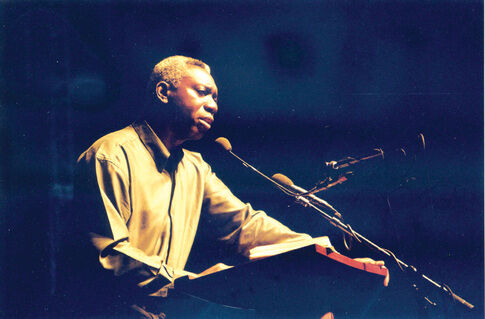
More recently his work has moved onto the stage, and this past October he saw the release of the CD “Big Apple Blues,” writing lyrics for music by Brooklyn-based guitarist and vocalist Tomas Doncker. The two had previously worked on another blues project, “Mercy Suite.”
Though Komunyakaa has been writing blues songs in his thoughts for more than a half-a-century, his involvement with music — and the stage — is something that emerged. “The first (musical) collaboration I did was (in 2000) with (New York based jazz vocalist) Pamela Knowles, a CD called ‘13 Kinds of Desire.’ I wrote all the lyrics for that. I also wrote ‘The City’ for the Youth Choir of New York City.” For that work he collaborated with Susie Ibarra, with whom he created “Shangri La,” which received a workshop performance at Passage Theater in Trenton in 2004.
Other projects include “Love Notes from Mad House,” with music by saxophonist John Tchicai (who played in bands led by John Coltrane and Cecil Taylor), and a stage work with dancers based on his poem “Warhorses,” a stage version of the ancient epic “Gilgamesh,” and the 2008 premiere of the play “The Deacons.”
“Maybe I have been pulled beyond the page,” says Komunyakaa about his performance pieces. “But the page is very important to me. The page is a place of graphic illumination. I write everything in long hand, and then I type. But this is the way that I relate to language. Tactile with the pen and pencil pressed against the paper.”
Also important is the blues, something he finds in the Trenton air. “There’s also an element of the blues here. I hear it. I don’t know why, because the Delaware is not the Mississippi. I hear an element of the blues, this yearning for what is to become as well as for what was there. It’s that beckoning. The foundation exists, but also the dreaming. That’s what it is all about. I call it ‘extended possibility.’ It’s great when artists begin to see it”
For more information on “Big Apple Blues” and Tomas Doncker, go to www.tomasdoncker.net.
To hear Yusef Komunyakaa read “Facing It,” go to www.youtube.com/watch?v=90yxqlVrLP8.
Facing It
by Yusef Komunyakaa
My black face fades,
hiding inside the black granite.
I said I wouldn’t,
dammit: No tears.
I’m stone. I’m flesh.
My clouded reflection eyes me
like a bird of prey, the profile of night
slanted against morning. I turn
this way — the stone lets me go.
I turn that way — I’m inside
the Vietnam Veterans Memorial
again, depending on the light
to make a difference.
I go down the 58,022 names,
half-expecting to find
my own in letters like smoke.
I touch the name Andrew Johnson;
I see the booby trap’s white flash.
Names shimmer on a woman’s blouse
but when she walks away
the names stay on the wall.
Brushstrokes flash, a red bird’s
wings cutting across my stare.
The sky. A plane in the sky.
A white vet’s image floats
closer to me, then his pale eyes
look through mine. I’m a window.
He’s lost his right arm
inside the stone. In the black mirror
a woman’s trying to erase names:
No, she’s brushing a boy’s hair.
From Dien Cai Dau.
,

