Paul Ressler works to popularize law that could have saved his son’s life
In a span of two years, Paul Ressler lost his eyesight, his career, his son and his marriage.
Those years tested him emotionally, drained him financially and threw his life into disarray. But now, they are what guide the 70-year-old Hamilton resident.
They have led him to where he is today, sitting in his Kuser Road office, trying to figure out a way to help people. His main focus is the Overdose Prevention Act, a state law passed in 2013 that Ressler believes could have saved his son, Corey.
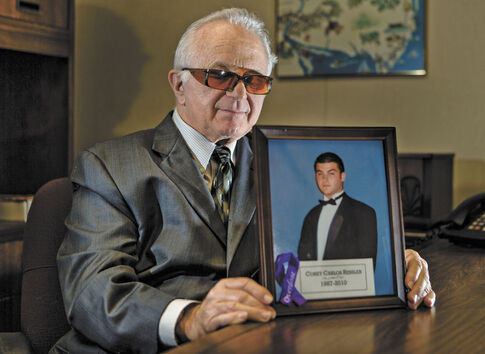
Corey died from a drug overdose in 2010 at age 22. When Ressler collected Corey’s belongings, he noticed someone had attempted to call 911 but aborted the call before it connected. Whoever called must have been afraid of being found with drugs, Ressler believes.
The Overdose Prevention Act contains two major components: it grants immunity to anyone acting to save the life of someone overdosing, and allows emergency personnel and police officers to carry Narcan, a drug that stops an overdose in its tracks by clearing opioids like heroin from the brain’s receptors.
Had the Overdose Prevention Act existed in 2010—and Corey’s friends known about it—that 911 call might have been successful and a police officer might have been able to use Narcan to save Corey’s life. It’s a lot of “ifs,” but Ressler has put all his effort into spreading word about the law with the belief the act could have changed his son’s fate.
Now, he has started a firm called The Overdose Prevention Agency Corporation, with the express goal of educating the public about the law he helped create. He spends his time meeting with mayors, police chiefs, school boards and community groups, spreading the word. He wants to ensure no one ends up dying like Corey did.
“Why am I so driven?” Ressler said. “It’s because my son died from an overdose. He was only 22 years old. His life never really began. I don’t want him to die in vain. I just don’t. I couldn’t walk away from this. I just have this burning passion to help people with addiction, and it’s what I’m going to do the rest of my life.”
* * *
Ressler grew up in Union City, before moving to Fair Lawn, where he graduated high school in 1962. He enrolled at Rutgers University-Newark, but soon decided the school wasn’t his scene.
He dropped out of college, and found himself drafted into the Army and headed to Vietnam a few months later.
“We make choices, sometimes they turn out OK, sometimes they don’t,” Ressler said. “It could have been a bad choice. It was a bad choice, to be honest.”
When he returned from Vietnam, he felt something wrong with his back, a chronic pain he dealt with until deciding to have spinal fusion and decompression surgery in November 2008. He woke up from the surgery with his back healed, but his sight gone. A mishap during the procedure had caused him to go blind.
He had made a career as an accountant, working for Arthur Andersen and Mathematica Policy Research in Princeton before starting his own firm in Hamilton in 1985. But working as a CPA became impossible without his eyesight. He had to sell his business, and kept only one client: Southside Johnny and the Asbury Jukes, a band for which he once served as manager.
He had to learn how to live without his eyesight, how to do simple things like walking and maintaining his balance. At the same time, his life crumbled around him. His Mercerville music store, Rock Dreams closed. He and his wife began the process of divorce, brought on by the stress caused by Corey’s addiction. Corey went in and out of rehab, moved to a halfway house in Jersey City and then to an apartment with friends, where he soon would overdose and die.
Ressler acknowledges his life has been tough, but he isn’t despondent. Instead, he channels his energy into his work.
“I wake up every morning, put my feet on the floor and realize that I’m blind,” Ressler said. “I curse it. And that’s the end of it. I get up and go about my business.”
* * *
Corey Ressler was like many kids growing up in Hamilton.
He played baseball at Nottingham Little League, where his dad coached and served on the board of trustees. He wrestled for the Hamilton PAL wrestling program. He had an interest in technology and could build computers on his own at 11-years old.
But Corey’s life took a turn a few years later. In 2000, at age 13, he started experimenting with alcohol and drugs. Corey started with beer and wine before moving on to hard liquor, then to marijuana then to opioids like heroin. His grades in school started slipping.
Ressler and his then-wife realized Corey had a problem, but it wasn’t until a few years later they realized what the problem was.
“All the gossip we heard about him we didn’t believe,” Ressler said. “We were in total denial.”
They took everything away from him—phone, computer and other perks—but it didn’t make a difference. He would still disappear without a trace. He would still get high and party. When money ran short, he’d sell drugs on the street for cash. He was arrested several times.
Corey earned his diploma from Steinert High School in 2005 while in treatment at a rehabilitation center in Mendham called Daytop New Jersey. He went into recovery for more than a year before relapsing. He entered a cycle of recovery and relapse. He did what Ressler calls “a tour” of facilities in the Northeast, entering rehab five times. At one point, he attended classes at Ocean County College, but wound up dropping out. Life was chaos for everyone in the Ressler family.
“It destroyed our family,” Ressler said. “There’s a lot of anger and resentment in our family, which is a result of his addiction. It’s a family disease. There’s no doubt about it.”
* * *
At some point during Corey’s struggles with drugs, his father looked at him and—with resignation—said, “I can’t help you.”
Ressler decided then that if he couldn’t help Corey, he had to try to aid people who had a chance to be saved. He joined the Hamilton Municipal Alliance. He continued his work with Daytop New Jersey. He met with the Hamilton Township Board of Education and convinced it to install drug-awareness programs and student assistance counselors in the schools. He met with students in schools elsewhere in New Jersey.
He did work with NCADD-NJ, an addiction advocacy group, and earned an appointment to the Governor’s Council on Alcohol and Drug Abuse.
He redoubled his efforts after Corey’s death, turning his grief and anger into motivation.
“I realized there were two ways I could go with this: up or further down,” Ressler said. “I didn’t want to go further down.”
Ressler joined the state’s Overdose Prevention Taskforce, which investigated how New Jersey could best institute laws like ones in Massachusetts and New York. The initial effort in New Jersey took the form of two bills: one a Good Samaritan policy and the other allowing Narcan into the state.
Ressler testified at the statehouse in support of the Good Samaritan bill several times. He said he faced concerns the bill gave a free pass to drug dealers.
“I always had a different senator or assemblyman kind of get in my face about it,” Ressler said. “They didn’t listen, and they didn’t understand.”
It eventually passed both houses in Trenton, but Gov. Chris Christie vetoed the bill conditionally in October 2012. Then, the same thing happened to the Narcan bill.
But attitudes shifted in November 2012 when Stephanie Bongiovi, the daughter of rockstar and New Jersey native Jon Bon Jovi, overdosed while at college in New York State. She survived, and her father lent his support to the effort to get an Overdose Prevention Act passed in his home state. The two vetoed bills were combined into one, and Christie passed them into law in May 2013. Similar laws now exist in 20 states.
Ressler then turned his focus to educating the public about the law, and trying to get Narcan into the hands of as many people as possible. He made sure he had the ear of officials at the Mercer County Prosecutor’s Office as they prepared to provide Narcan to every law enforcement agency in the county. The program launched Nov. 1, and police officers reversed four overdoses in its first two weeks. Three of the overdoses were in Hamilton Township.
“Paul Ressler has been a big supporter of the Narcan program,” Mercer County First Assistant Prosecutor Angelo Onofri said. “He’s always weighed in. If you know his son’s story, [Narcan] could have made a difference.”
He has also contacted Mayor Kelly Yaede and the Hamilton Police, and has been trying to get Narcan into the Hamilton schools. He said he has been met with resistance, particularly by the school district, which had been advised not to allow Narcan in schools. School nurses aren’t allowed to diagnose and treat ailments. Yet, they are trained how to use a defibrillator, Ressler said, pointing out that’s a much more difficult device than Narcan’s nasal spray canister.
“I’ve been screaming about how bad the drug problem is in Hamilton, and it’s very bad,” Ressler said. “It’s an epidemic.”
In the meantime, he has started a corporation narrowly focused on implementing and educating about the elements of the Overdose Prevention Act. Ressler said he needs to raise $100,000 to ensure his Overdose Prevention Agency Corporation can achieve his goals.
The nonprofit currently has four volunteers, but Ressler hopes to hire employees and spread OPAC’s influence to every county in New Jersey.
Ressler has partnered with City of Angels, an addiction recovery and support group founded by Hamilton councilman Kevin Meara. Together, they hope to train families, counselors and anyone interested in how to use Narcan. They have two locations lined up—the Dwier Community Center in Groveville and Summit Behavioral Health in West Windsor—as well as the support of Dr. Seeta Arjun, a West Windsor-based physician who has offered to do the training for free.
But they don’t have any Narcan, nor any money to buy some.
Ressler said, for now, he would pay for the Narcan, once it becomes available. His hope is to earn grant money eventually.
But he said his main focus is getting Narcan into the hands of the people who need it most—the families of addicts—as well as ensuring the Overdose Prevention Act and the difference it makes stays in the public consciousness.
“We need to keep reminding people about it,” Ressler said. “We can’t let it slip and be forgotten. You know what happens, it’s popular, but within the year, they’re on to something new. I don’t want that to happen.”
For more information, go online to overdosepreventionagency.com.
,

