By Scott Morgan
For the Raritan Valley Flying School, soaring into the wild blue yonder has been a family affair since 1973. Back then, Naoimi Niernberg founded the school at Kupper Airport.
Since 1985, RVFS runs out of Princeton Airport, but it remains in the Nierenberg family, with Naomi’s son, Ken, as the owner/manager and her nephew Steven, who oversees the flight school as the director of operations.
He’s responsible for the instructors and the eight-aircraft fleet, which, unlike a lot of other schools’ fleets that feature craft built during the Ford and Carter administrations, are newer single-engine planes.
Steven himself is a former attorney who spent 25 years in law—and several other gigs.
“I’m on like my 10th career,” he said. “This one’s less stressful but there’s more to do. I’ve never worked so hard in my life, but it’s a little more fun [than law].”
Nierenberg’s job is to see that those who want to learn how to fly get the best flight training possible. He needs to make sure the lessons are up to date and informative, that the instructors and prospective instructors meet the criteria to be great teachers, and that some practical 9if not always fun) items get ticked off the agenda. “You ever try cutting a lawn at an airport?” he asked.
More than the education, of course, Nierenberg and the school must contend with several post-9/11 realities. The Transportation Safety Administration requires that all Americans who study flight training prove their citizenship with a passport or birth certificate and all non-Americans must be screened. Then there are the myriad FAA regulations and testing requirements that could keep anyone busy.
However, if you have the $8,000 to learn to fly and satisfy the government, Nierenberg and RVFS will do their best to make sure you get your wings.
“RVFS has a staff of instructors who have flown and instructed for many years as well as new instructors who are energetic and anxious to share their newly acquired knowledge,” says the RVFS website.
“This mixture serves the needs of the students as some instructors are part time employees while others are at the school on a full time basis,” says the website.
“Every student and instructor follows the Jeppesen Guided Flight Discovery curriculum for standardization via the syllabus,” teh website says.. “Periodically students will fly with another instructor for progress checks to assure that the student meets the school standards.”
And you’re never too young to start learning. Actually, if you’re tall enough to reach all the controls, your age doesn’t matter, Nierenberg said. The school’s youngest student, in fact, is 11.
You can’t fly solo until you’re 16 and if you want a commercial certificate, you’ll have to wait for adulthood, but past that, you’re good to go.
“If they can reach the pedals, they should turn to their parents and say ‘It’s time for me to learn how to fly,’” Nierenberg said.
Of course, the thing that will get you your wings is yourself. You need discipline to learn how to fly because there’s lots to know and lots to remember. Flying, after all, is heavily regulated, for a reason. Nierenberg recommends once or twice a week to devote to taking lessons. More or less than that, you run the risk of forgetting or burning out on the info.
At any one time, the school has 80 to 100 students, all of whom fly on their own schedules. And how long it takes you is up to you.
Raritan Valley Flying School at Princeton Airport, 41 Airpark Rd 1, Princeton. Phone: (609) 436-5311. Website: princetonairport.com/flight-training-staf.
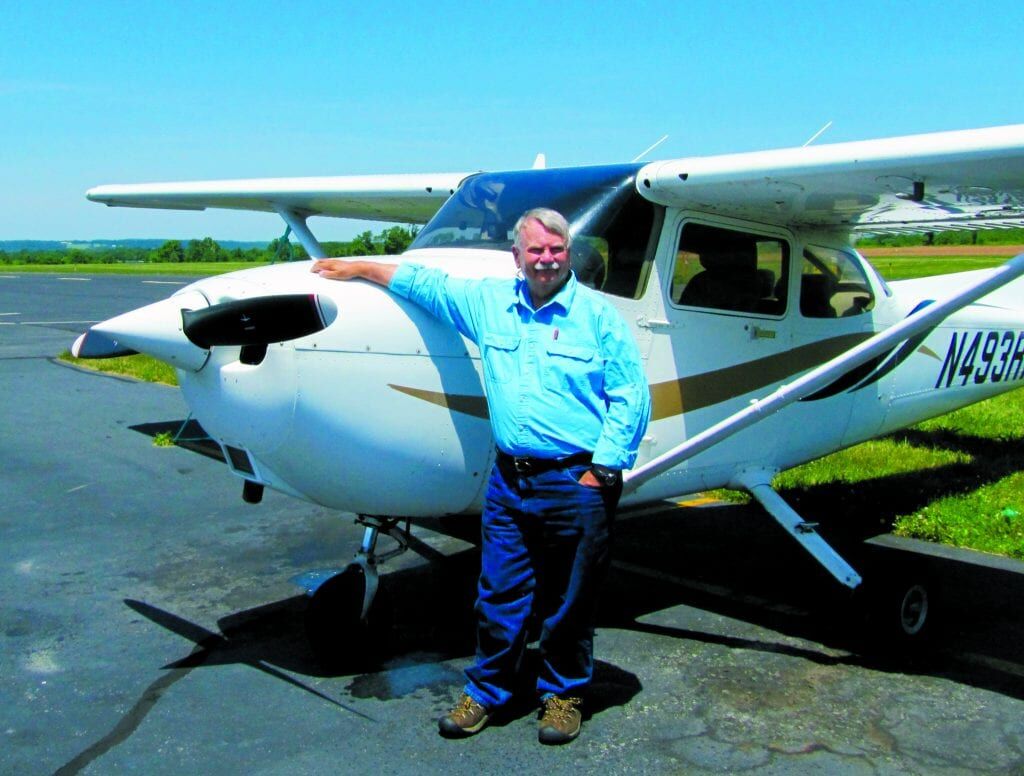
Steve Hansell, a flight instructor at Raritan Valley Flying School, with one of the school’s planes at Princeton Airport. (Staff photo by Bill Sanservino.),

