Ewing resident Courtney Banghart honored by Princeton Chamber of Commerce
By Scott Morgan
Courtney Banghart has 14 kids—all of them smart, all of them athletic, all of them female.
Her day centers around inspiring this group of young ladies to be better today than they were yesterday. And unlike a lot of people who oversee the minds, bodies and spirits of young women, Banghart can see the results of her effect on her charges in big, bright numbers overhead.
That’s, of course, if one were to only measure results purely in terms of scores or by the digits in the win/loss columns. As the head coach of Princeton University’s women’s basketball team, the numbers are only half the story.
The other half lies in the leadership example Banghart sets for her players as they ready to leave their court lives behind and start their lives and careers after Princeton.
Banghart’s example is solid enough to be recognized off the court. Last month, she was honored by the Princeton Chamber as a Woman of Achievement for “encouraging young women to strive for excellence” at the chamber’s annual award diner on June 17.
Chamber chairman John Thurber said that recognizing Banghart, a Ewing resident, goes beyond her coaching prowess.
“As we learned when she spoke at a Chamber luncheon, what really distinguishes Courtney is her commitment to several key leadership principles that we can all learn from,” Thurber said. “The importance of nurturing a sense of community, offering inspiring instruction, providing empathetic communication, and the strength that comes from belonging. The legacy she hopes to leave is focused far more on how she shapes lives and builds character than on how many wins her team achieves.”
Judith Hutton, CEO of YWCA Princeton and a member of the selection committee, said that Banghart’s “philosophy is that coaching is teaching and she has taught life skills, leadership, and social responsibility to her team and beyond.
“She is a true mentor and has created a passionate and warm environment for women to make a difference and take on leadership roles.”
One thing Hutton likes is that Banghart annually oversees the “Princeton Plays Pink” game, in which the team has pink jerseys and they provide education throughout the game to celebrate survivors and encourage mammograms.
Banghart herself sees her role as one of more than just winning games as well.
“As a coach, my whole life is one of impact,” she said. “I have the opportunity to inspire young women, and to be recognized for that is just really exciting.”
Banghart’s impact on the young women she coaches begins with an understanding of what it means to be part of a team.
And while sports is filled with tired clichés and pithy sayings, Banghart says the most important lesson comes from a basic concept—you are who you surround yourself with. Creating a team means creating a culture built on striving and achievement. That, she says, doesn’t happen if you’re surrounding yourself with the wrong crowd.
And that lesson is as true for sports as it is for business, Banghart says. Any system or organization is only as strong as the resolve of everyone connected to it. Teach the wrong lessons, bring the wrong attitudes aboard and—bam—the results will be immediate and unflattering.
Banghart, however, counts herself lucky in that she is surrounded by Ivy League students who come in already ahead of many others on the motivation scale. Her players, she says, are competitive, eager to learn and eager to work together. This intense competition aspect, she says, is a definitive female trait, though she admits she has not had any real experience coaching males and cannot draw an apples-to-apples comparison.
Banghart herself was a high school athlete. She grew up in New Hampshire, one of three children. Her mother, Anne, was a nurse practitioner, and her father, Jim, was an electrical engineer. Both enjoy sports — tennis for Anne and hockey for Jim — and they encouraged her to enjoy and excel at sports.
Banghart started her coaching life by overseeing a high school varsity tennis team, as an athletic director at Episcopal High School in Alexandria, Va., in her first year out of college.
Always into sports, she went to Dartmouth, where she played basketball and earned her bachelor’s in neuroscience. As a basketball player herself, the New Hampshire native racked up an impressive resume. She was a first-team All-Ivy League all-star in 1999 and 2000; won the Ed Seitz Award as the best 3-point shooter; played in NCAA tournaments in 1999 and 2000; and was inducted into the Dartmouth College Hall of Fame in 2004 and the New England Basketball Hall of Fame in 2006.
Banghart returned to Dartmouth after graduation to coach basketball and earn her master’s in writing and leadership development. As an assistant coach, she helped lead the women’s team to Ivy League championships in 2005 and 2006.
Despite the coaching and love of sports, she expected to be something in the education field—a principal, maybe, or school district administrator.
“I started coaching sports because it was a passion,” Banghart says. “I didn’t think it was a vocation.”
But sports came calling. By 2007, Princeton was looking for a new head coach for the women’s team, so she applied. This past spring, Banghart finished her seventh year coaching Princeton women, and has racked up an even more impressive resume than she did at Dartmouth.
To begin with, Banghart took over a team that had never been to an NCAA tournament. In her seven years, she’s guided Princeton to the NCAA tournament four times, winning the Ivy League championship consecutively from 2010 through 2013.
She was named the New Jersey Sports Writers Association Women’s College Coach of the Year in 2010, and in 2012 was named to the USWBA Coach of the Year Watch List and named College Sports Madness Preseason All-Mid Major and Ivy League Coach of the Year.
If you’re doing the math, you’ll realize that Banghart has won half the Ivy League championships in the past 16 years, which works for her because she loves coaching in the Ivy League.
The players, she says, are more rounded, as is an Ivy League school’s approach to student players.
The fact that they’re referred to as student players and not players at the school is an indication of where the focus lies.
But Banghart loves the whole-student approach that the Ivies bring to the table. So much so that she turned down a half-million-dollar annual salary to take over the women’s basketball program at USC. She didn’t want to sacrifice what she considers her core values to turn out well-rounded graduates who learn something on the court as well as in the classroom. At a large Division I university, she says, she might lose touch with those values. So she doesn’t see herself leaving Princeton (or at least the Ivies) for a long time.
Certainly her players wouldn’t want her to go. “I cannot imagine my college career playing for anyone other than Coach Banghart,” 2013 Princeton graduate Lauren Polansky said. “I will be forever grateful to Coach Banghart for surrounding me with such talented and amazing people and for acting as our constantly selfless and inspirational leader.”
“I took a chance on Princeton because of the fact I had faith in Coach Banghart’s plan,” said Niveen Rasheed, Polansky’s teammate and classmate. “In the next four years, she accomplished more than I could have ever imagined, which will later go down in Ivy League history.”
Her commitment to winning jibes well with the university’s commitment to the whole person. More than that, being in a place like Princeton and coaching the type of young women who make it to the varsity court keeps her focused on the whole person, rather than on the money a larger school might offer.
“This business is too hard to not do it for the right reasons,” she says.
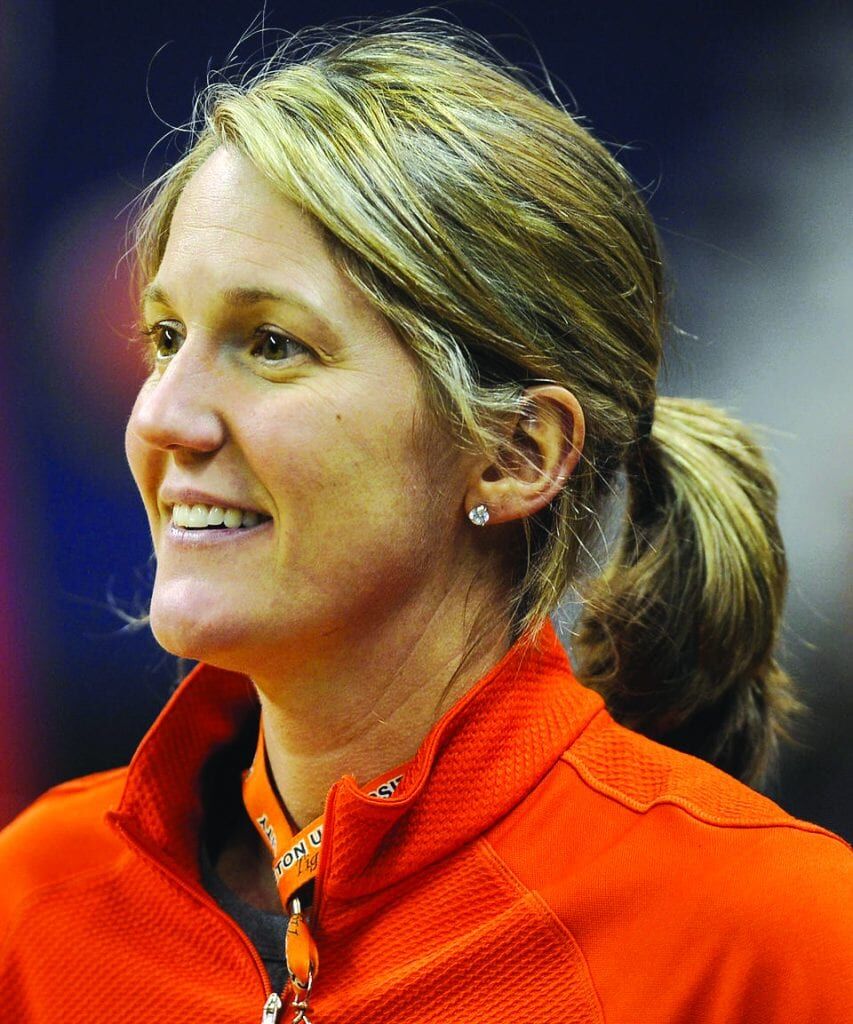
Ewing resident Courtney Banghart, the Princeton University women’s basketball coach, was honored as a Woman of Achievement by the Princeton Regional Chamber of Commerce in June 2014.,

