By Scott Morgan
Retired educator uses robotics to teach kids how to learn
There are two ways to look at education. One is to teach the textbook and the standardized tests; to base education on performance goals. In other words, to teach knowledge.
The other is to teach practically so that students understand applications; to give form to the abstract. In other words, to teach wisdom.
Former high school teacher David Peins believes in the latter. To him, education is about understanding how things work; the wisdom to understand what to do if something is not working, and the urge to solve the problem by rolling up your sleeves and getting down to business.
And he does it with robots.
As with many children born between Sputnik and the moon landing, Peins fell in love with science and technology as an offshoot of the space race. Circa 1960, the five-or-six-year-old Peins joined his family and some neighbors on the sidewalk, in the dark, to watch a blip of light sail past in the deep, dark sky. This mysterious craft was a satellite, and seeing it put the bug in young David’s head to go to space.
The Hamilton resident never quite made it to space, but he found that a lot of his friends wanted the same thing.
“It seemed like we all wanted to be astronauts,” he said.
But though he’d remain bound by gravity, Peins stayed in love with technology and fused that love with the pure joy of tinkering.
A lot of his reason for believing in practical applications and learn-by-doing came from actually doing, after all. By age 10, Peins was pretty comfortable building stuff and using tools like table saws in his father’s basement. Peins’ father worked for the telephone company after a stint as a waist gunner in a World War II B-17. The elder Peins had been in the pilot training program, but the Air Corps needed gunners. Eventually, he was trained as an electrician and specialist for P-38 fighters and to work on Rolls Royce V-12 engines to help the British war effort.
This handy background paved the way for a basement full of tools and projects, where seldom was heard a discouraging word for Peins. He was allowed to go where his imagination took him. This hardscrabble, hands-on approach to learning was the foundation for his teaching philosophy, which put him at odds with the traditional education establishment.
“I used to tell the kids there’s nothing wrong with leaving high school and actually knowing how to do something,” he said.
He was nearly 20 years old when he graduated high school himself (“I was definitely a social promotion”). Peins got his bachelor’s in education (industrial arts) from Trenton State College in 1978 and started teaching electronics at Manalapan High School in the Freehold Regional School District in 1985. In 1997, he earned his master’s in vocational education from Rutgers University.
Like a lot of teachers who entered the field a few decades ago, Peins grew ever-wearier of the way schools viewed education. Most in the system, he says, view education at 75 percent science and 25 percent art. Peins views it as the inverse, or even more so, in favor of art. Learning actual wisdom, he says, is an intuitive journey, where doing teaches you the importance and practicality of what you know.
This, naturally, didn’t mix well with the current trends in education, where standardized testing is king. By 2010, Peins had had enough and decided to leave to start his own business, Robodyssey Systems in Trenton, where he sells robot kits and teaches kids how to solve problems using robots. The idea for robot-assisted learning started in Peins’ classroom. In order to convey how circuits and computer commands actually worked, he started using small robots to get his students thinking about very basic things—how to make a left turn, for example.
Out on his own, Peins applied his applied-knowledge approach to get kids past the basics. Yes, school districts use robots and programming to move them, but Peins said the typical approach is to give kids the programming, have them type it in like dictation and go on to the next lesson. Such an approach doesn’t teach kids how to actually do anything, though, he said.
Peins’ program starts with a basic interface, where the kids program a connection he dubs “Hello, Computer.” This is just what it sounds like—the kids establish a link with the computer that will tell their robots what to do. Robodyssey furnishes (and retains) the robots, which the kids use to solve a simple maze.
But don’t be fooled. Simple steps, like travel X-many inches and then turn right, take actual thought and planning. Kids need to know the value of X and how to tell the computer what to do, Peins says. It’s much more involved than simply regurgitating data.
“We don’t beat the kids with C programming,” he said.
Typically, the kids use BASIC programming to learn the roots of what to do. Occasionally, Peins runs into someone who thinks he’s a bit arcane in his approach. They will ask him why he is teaching stuff that’s been figured out and not just giving them the programming. He counters that robotics is about movement, and he is teaching the kids the basics of movement. The kids learn how to move their robots through mazes and do dances.
The course, which Peins teaches in libraries around New Jersey and a few times at the New York City Public Library, often lasts 10 weeks for a couple hours each session, but Peins can reconfigure for shorter or longer times.
Wherever he operates and in whatever time frame, Peins appears to be winning over the crowd.
“David Peins’ Robodyssey program was a tremendous hit at Caldwell Public Library,” said the library’s director, Barb Hauck-Mah.
And while attendance at teen programs is often a challenge, “we were pleased to have a record number of 12- to 17-year-olds participate. There were lots of spectacular fails, but the teens learned as much from the crashes as from the successes.”
Peins loves fails, by the way. Whenever someone says her robot’s not doing what everyone else’s is doing, he pipes an approving “Excellent” (or something similar). “That means you get to figure out how to fix it,” he said.
And he knows he’s doing the right thing, because he sees something in his kids that he said he started seeing less of around the public school system: engagement.
“It’s interesting, the kids always start out shy, and by the end of the day, they’re high-fiving each other,” Peins said. “I’ve had parents pick up their kids and say ‘My son didn’t even want to come to this, and now he doesn’t even realize I’m here.’”
Yes. Robots are really that cool.
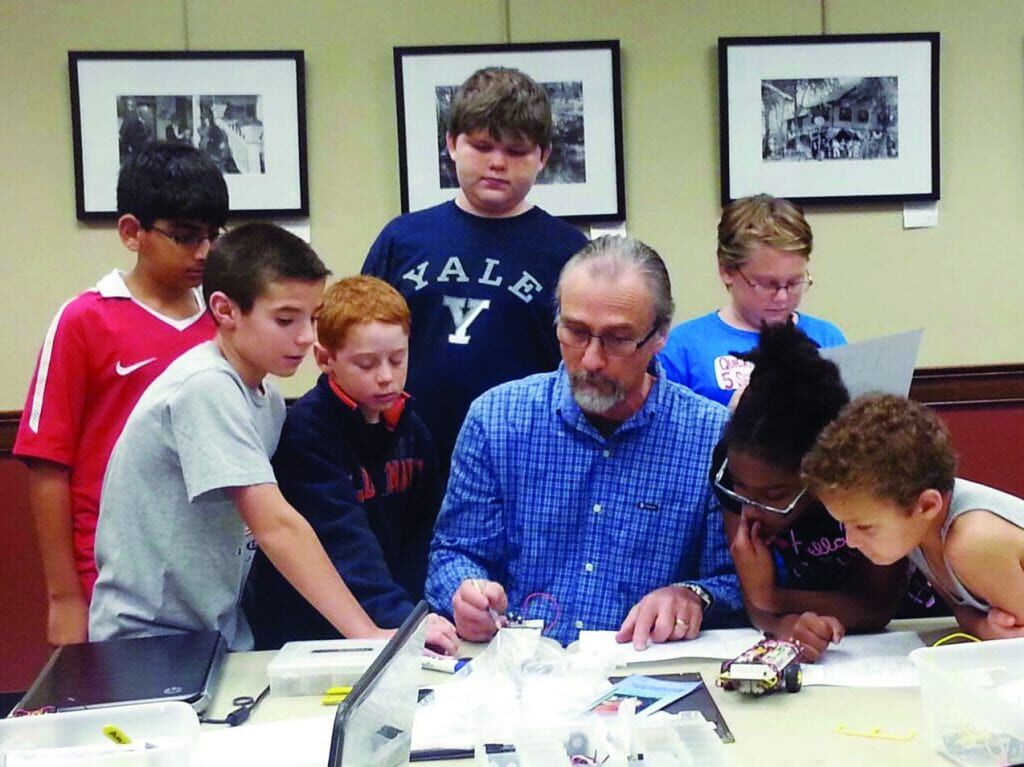
Hamilton resident David Peins, center, teaches robotics to children during a class at the Pemberton library this summer.,

