1:1 Learning Environment aims to provide ‘21st century skills’ to Timberlane Middle School students
By Alicia Waltman
Timberlane Middle School eighth graders will all receive laptops for school use next fall, with the goal of creating a learning environment that fosters 21st-century learning skills.
The program, providing one laptop to each child in what is called a “1:1 Learning Environment,” is being piloted this spring in two eighth grade geometry classes at Timberlane. It gives teachers and students access to technology at any time in their classes.
It also allows teachers to do lessons and assignments on laptops without encountering conflicting hardware, software and other glitches that occur when students use their own phones, laptops or tablets, as they have been doing under the Bring Your Own Device policy currently in place at Timberlane and Central High School.
The 1:1 initiative uses technology as an effective tool that supports inquiry-based learning. Students are given questions and find solutions through research and innovative thinking, and by using what are known as 21st-century learning skills. Skills include creativity and innovation; communication and collaboration among students and teachers; research and information fluency; critical thinking and problem solving; and digital citizenship.
“Our students are what we call ‘digital natives,’” said Anthony Suozzo, Timberlane’s former principal, who became director of human resources and Special Projects for the district starting July 1. He will oversee the program along with Timberlane’s new principal, Rosetta Treece.
“The students have never lived in a world without digital devices. All students using the same laptops in a meaningful way in class will enhance their learning of the curriculum,” Suozzo said.
Treece added that the program will provide students and teachers with the opportunity to collaborate on a more meaningful and purposeful level through technology. The Hopewell Valley Regional Board of Education approved the new program as part of their 2014-15 budget.
“The 1:1 program enhances classroom instruction by increasing student engagement during class,” said board member Adam Sawicki, who is chair of the board’s Educational Program Committee, a member of the technology committee, and is a structural engineer and technical fellow for the Boeing Company. “Teachers can get instantaneous feedback on students’ comprehension of new material, and adapt instruction to reinforce concepts or provide differentiation.”
In the pilot program, which started in spring, teachers and students tested two different laptops and software platforms. Students in one geometry class had Dell Latitude 3330 laptops running on Windows 7 operating systems, with Microsoft Office 365 software. Students in the other class had Dell Chromebooks with a Chrome operating systems and Google Apps for Education software. At the end of the school year, staff, with the input of students, evaluated the systems and decided which to purchase and distribute.
In teacher Sonnie Cane’s geometry class, students used their Chromebooks to explore ratios found in right triangles. Cane put objectives for the day on the classroom Smart Board, which is like a large touch screen at the front of the room.
The first objective was to review on their laptops a video that Cane had made the night before using a Google Web tool. The video reviewed a question that some students had found difficult in a prior lesson. Cane knew that from feedback she had received via an online assessment tool.
“Go over that as many times as you need to, and let me know if you have questions,” she told the class.
The next instructions were to check the previous night’s homework using Edmodo, a teacher-student Web tool. Cane then gave students the option to practice more problems and receive an email when done with their results, or, they could preview the next day’s lesson by creating a video of what they believed to be an important concept to share with their peers.
“Having (the laptop) gives them the potential to be able to integrate technology and the ability to collaborate, communicate and create on a completely different level,” said Cane, who has taught geometry, algebra and pre-algebra for 20 years. “They are experiencing our curriculum on a much higher level.”
Cane said more students participate in class with the laptops. They can collaborate, sitting next to each other, across the room, or from their homes at night. They can ask her questions via email or Edmodo, or the old fashioned way: in person. As in any class, some students sit in groups solving problems, while others choose to work alone.
“This gives the quieter ones a voice,” she notes, allowing them to communicate with her electronically or face to face.
Typically, teachers need to take classes to a computer lab or sign up days in advance for a cart filled with laptops, if they want to do a technology-driven assignment or allow students to do research. In a 1:1 learning environment, students have access to technology at their fingertips on a daily basis.
Before undertaking this year’s pilot, Hopewell staff visited several schools with 1:1 learning environments, including Hillsborough and Upper Township in Cape May County. They also spent time collaborating with the Pascack Valley School District in Bergen County, which has had a 1:1 learning environment since 2004. That district attracted national attention last winter when it was able to conduct an entire virtual school day with teachers and students when schools were closed for snow.
In the Timberlane pilot, students’ responsibilities were to charge the laptops at home, bring them to class every day, and keep them in their lockers when not using them. (The laptops were not allowed in the lunchroom or the gym.) There were no major problems reported with students fulfilling those responsibilities, Suozzo said, and laptops were available if students left theirs at home, just as is the case with textbooks.
“It makes it easier to get my work done,” said Daniel Blumenthal, one of Cane’s students, of the new program.
“It makes me more efficient. I don’t have to lug around a big textbook, and I can listen to music (online) as I do my work,” said Lucas Carsky-Wilson.
“It’s easier for Mrs. Cane to give us homework,” student James Casieri said. “Before, she had to hand out a worksheet or write it on the board. Now we just go to Edmodo and there it is.”
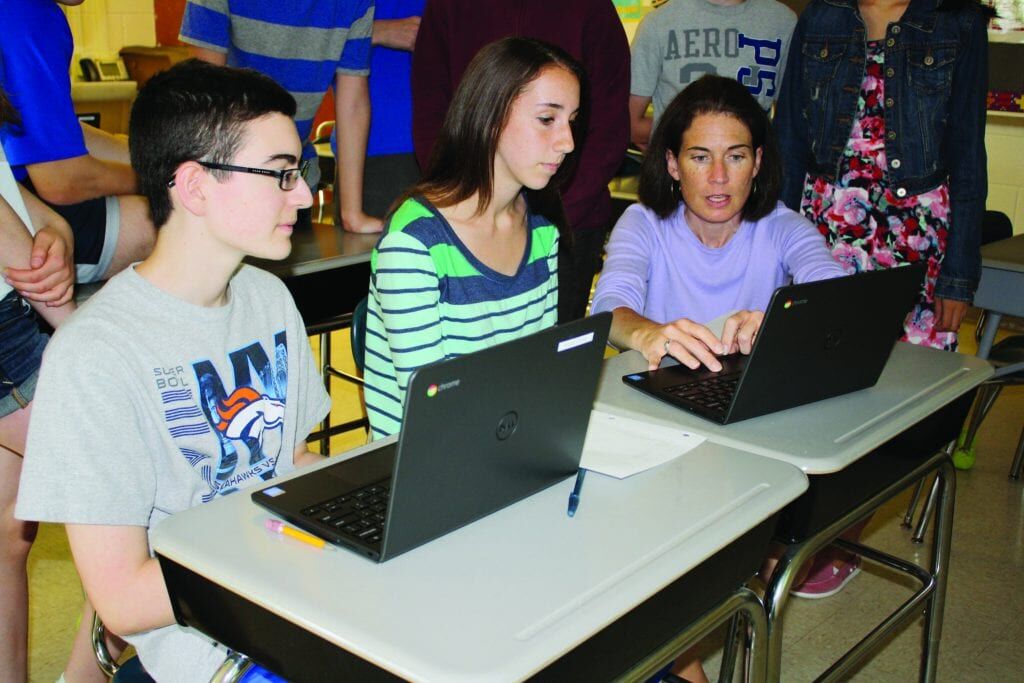
Geometry teacher Sonnie Cane goes over an online activity with eighth graders Justin Passer and Ali Schragger while other students look on. Mrs. Cane’s class piloted the 1:1 program this spring.,

