Nancy Kieling retiring after 20 years as head of PACF
Nancy Kieling sat in her Lawrence office, talking about the place she has lived and worked for most of her life. With a month and a half to go before she retired, she was reminiscing about growing up in Princeton in the 1950’s with her parents and two older sisters.
“Most of where all of us live and work nowadays didn’t exist. 15 Princess Road (where her office is) wasn’t here. Nassau Park was Reed’s Sod Farm,” she said. “There was Hightstown, there was Princeton, there was the Village of Lawrenceville. This area was basically a farming community. Then it got taken over by sprawl and strip malls.”
Times change — they always do. And communities change, though in many ways, their needs remain the same. As Kieling prepares to step down in January, having spent the last 20 years as chief executive of the Princeton Area Community Foundation, she can reflect on those formative years on Edgehill Street, knowing now better than ever that the sense of community they gave her became the bedrock of her professional career.
In a small town, Kieling said, people know one another. The house on Edgehill Street was in her family for 50 years. Neighbors have common interests and take care of one another. A community foundation has the mission of enabling members of the community who have resources to help those in need of them, which in a sense means it embodies those small-town values she grew up with.
“Once I got here, I realize now, I understood why I was drawn to this work,” she said. “Because I’ve seen some of the best of community.”
Kieling graduated from the University of Wisconsin with a degree in history — she also has a master’s degree in education from Old Dominion University — before starting her professional career. She worked for a nonprofit organization in Rhode Island, in the admissions office at Princeton University, and as a corporate lending officer for a Manhattan bank before halting her career to be a stay-at-home mom to daughter Gretchen.
Eight years later, she was ready to re-enter the workforce, but not sure how.
“I’m a curious generalist. I’ve never been someone who said, ‘I want to be an X,’” she said. A friend called her and told her about a job opening she might be interested in, with the PACF.
“All of a sudden, that wacky resume made sense,” she said. “[The job] pulled on my roots in the area. They wanted someone who understood finance; most guidance and counseling people don’t understand finance. They wanted someone who had worked with volunteers, and I had been on the staff side with volunteers on the outside and had also been a volunteer. In a sense, they had written the job description for me.”
She had never worked at a foundation, never been a CEO, but the board saw what they were looking for, and hired her. She said years passed before she was comfortable in the role, but because the PACF was a small organization still getting itself together, there was time to learn.
Now, as she has been preparing to hand the reins over to successor Jeffrey Vega (see sidebar), she has found herself sharing as much as possible of what she has learned over two decades. Recently, she gave Vega a binder four inches thick, containing policies, guidelines, bylaws and “all the things that’ll put you to sleep, but that a nonprofit is built on,” she said.
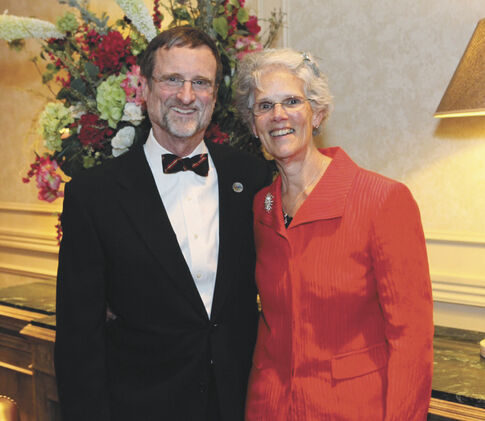
At a celebration held Nov. 7 at Greenacres Country Club in Lawrence, hundreds gathered to pay tribute to the work Kieling has done. When the PACF was founded in 1991, it managed less than $1 million in assets. Today, the nonprofit organization oversees some $105 million, including the new Nancy’s Fund, created in Kieling’s name and seeded with more than $400,000 from donors grateful for all she has done to help safeguard and grow the philanthropic interests that PACF oversees.
“I grew up with this, learned as I went,” said Kieling, 66. “It was all organizational development: building capacity for the organization, building a grantmaking program, working with the board. Learning from auditors, even learning how to install a server and eight workstations. That all really fed my thirst to know a little bit about a lot of things. In the end, speaking for me, it’s been a great match. I think I kind of lucked out.”
* * *
The Princeton Area Community Foundation is a charity that helps families, businesses and organizations create charitable funds. The foundation invests and administers the funds and awards grants and scholarships, and Kieling and her staff spend a lot of time networking to promote philanthropy and otherwise support nonprofits.
Kieling tends to deflect attempts to credit her leadership for the growth of the foundation, preferring to praise donors and board members for their generosity and imagination. If pushed, she talks about her staff and the skills they bring to bear on managing both money and relationships. But people who work with her are happy to recognize the role she has played in sustaining and augmenting the foundation.
“She has the ability to be both aspirational and … practical, get things done. Because I always thought aspirations stood in the way of really getting the day-to-day stuff done,” former board chair Tom Harvey said in a video shown that night. “And this is particularly true of the $100 million (in managed assets) … she took the steps that were necessary to get there.”
Kieling doesn’t hesitate to say that the job is substantially about building relationships.
“I think on one very simple level, we’re willing to spend time with people, to get to know them,” she said. “We’ve been at this long enough to know that a relationship you think you’re building on one side of the house is also connected on the other. I’ve often said my job is just a license to know anyone who’s interesting around here, because all our constituency are the good guys. They have the best for the community in mind.”
For Kieling, getting to know donors is about much more than money. Each fund, she said, is a story. Many, sadly, are tinged with sadness, out of which the Kieling and the PACF look to build hope.
“We have a number of memorial funds … philanthropy can be an enormously healing thing to do when someone’s lost someone important,” she said. “We’ve seen some of these funds have just done extraordinary things in the face of tragic losses. It’s a real privilege to sit at the table when someone’s in that very raw place and to help guide them through it.”
She said the foundation dealt for some time with the challenge of enumerating its mission. Dealing with so many constituencies, even they had to figure out exactly how it was that the system worked — how they helped flow financial resources from people determined to share them to people desperate to receive them. Management guru Peter Drucker turned out to have a crucial piece of advice.
“One of his basic tenets was, you have to decide who your primary customer is,” Kieling said. “Which was a challenging question for this organization. Was it our donors? Was it nonprofits? Was it the people our nonprofits serve? Was it the community, as diffuse as that is?
“In the end, [the board] said it’s our donors. Because that’s where it starts. But they also said it’s not about the money. There has to be a reason we go out for this money, and it’s because we want want to build this community,” she said.
* * *
Eighteen years into her tenure as the Princeton Area Community Foundation’s chief executive, Kieling began to think about retirement. A year later, the PACF announced that she would step down at the end of 2014.
“Twenty years is a good run, and it seemed like a good juncture at which the foundation could refresh,” she says. “[Vega] will bring new ideas, fresh ideas, different ways of doing things. That’s good for the organization. While change is always difficult, it wouldn’t have made that any easier if I’d stayed two, three, five more years.”
Kieling said planning for executive succession is critically important to small businesses, especially these days, with Baby Boomers retiring by the thousands.
“We’ve been trying to do the work really well, and model the work and talk about it with the world. Because a lot of our constituency are nonprofits or sit on the board of nonprofits,” she said.
On the foundation website, pacf.org, Kieling has been blogging about a number of management issues that face nonprofits today, including executive succession.
“It’s an issue people don’t talk about a whole lot. It’s my new favorite topic,” she said. “It’s a huge issue in private business, small business, family business. You know, dad is getting ready to retire, he thinks his two sons are just dying to take over but they have no intention to, and oops! Nobody has a plan at all.”
Kieling said in terms of the PACF transition, her staff knows how to run the day-to-day operations. So in helping Vega transition to his new role, she has focused instead on how to help him build up the hundreds of new relationships he’ll be counting on. Vega has more than 20 years of experience as a nonprofit executive, most recently with New Brunswick Tomorrow, but no one, no matter how skilled, could pick up right where Kieling will be leaving off.
“It took me 20 years to go one by one meeting all those people,” she said. “It would be a little easier if he could do that more efficiently.”
At the celebration, Kieling thanked her husband Jared, the co-founder of Bloomberg Press, for all the help he gave her over the years editing her written communications. The couple met when they were both studying abroad in Freiberg, Germany, in college. Jared, as it happened, was an undergraduate at Princeton University at the time, and after getting her degree from the University of Wisconsin, Nancy moved back to the Princeton area to be close to him.
They married and after moving around a bit, to Norfolk, Virginia and Newport, Rhode Island — Jared, an ROTC student at Princeton, served in the U.S. Navy — settled in West Windsor for many years. Recently, they’ve moved to Plainsboro. Their daughter Gretchen lives in Minnesota.
Kieling said she doesn’t have specific plans for the future, but has no plans to shrink from public view.
“I think there’s more work left in me. I like being part of a community. I’m not someone who’s going to go home and sit in my Barcalounger and knit,” she said.
Even so, she is looking forward to this new phase of her life.
“Earlier this year, I realized I had been very consumed by what’s going on here, really for 20 years,” she said. “So I’ve given myself permission to take a couple months to decide what I want to do next. Maybe some consulting. I’m looking forward to having a little more flexibility in my time.”
,

