World class inventor Thomas Edison’s connection to New Jersey will shine brightly this month when Thomas Edison State College (TESC) begins displaying its 1,500-piece collection related to the “wizard of Menlo Park” in downtown Trenton.
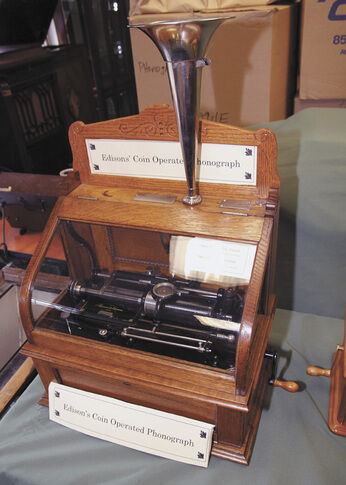
As befits the inventor of the usable electric light, the Thomas Edison College collection will include light bulbs as well other inventions that modernized the 20th century, including phonographs, mimeographs, electric fans, and an Ediphone (a type of dictophone). Edison Company promotional materials, patents, and artwork will also be displayed.
The Edison artifacts and memorabilia, a gift by New Jersey businessman John Martinson, are part of one of the largest collections of its kind in the country.
“I have enjoyed over 50 years of inspiration from learning about America’s greatest inventor. I am confident that the college will provide a long-term display of the collection both in Trenton and online. We think the collection is an excellent way to reinforce the College’s brand and innovation image,” says the 66-year-old investor in a statement printed by TESC.
Martinson is the founder of Edison Partners, a Lawrenceville-based investment company that embraced the inventor’s spirit of trial and error, taking the company from a start-up in 1986 to $850 million under management today. Edison Ventures generally invests in growth-stage companies located on the East Coast and focus mainly on four businesses: enterprise software, healthcare IT, financial technology, and interactive media.
Martinson’s financial success enabled him to build the collection that at one point included 85,000 Edison-related items. According to a business profile in U.S. 1 (a sister paper of the Trenton Downtowner), Martinson’s most prized possessions were Edison’s failures, like the 1875 electric pen. The pen, which consisted of a motor, a battery, and a reciprocating needle, punched tiny holes in a piece of paper as the user wrote or drew, creating a stencil that could be copied with a press. The electric pen was a commercial failure. “I enjoy that it failed for him, but he kept on trying,” he says. “Most of his inventions were not first-time overnight successes. He used the trial-and-error approach. I think he’s a good role model for any entrepreneur. While you may be thoughtful and multi-disciplined, never assume that you’re going to come right out and shoot perfect.”
The company also enabled the 2001 creation of the Martinson Family Foundation, a Lawrenceville-based nonprofit charitable corporation that reported assets of $3,543,800 in 2013. Recipients of foundation awards include the College of New Jersey, Rider University, and TESC Foundation, which received more than $700,000 to fund course development, technology, and new degree programs.
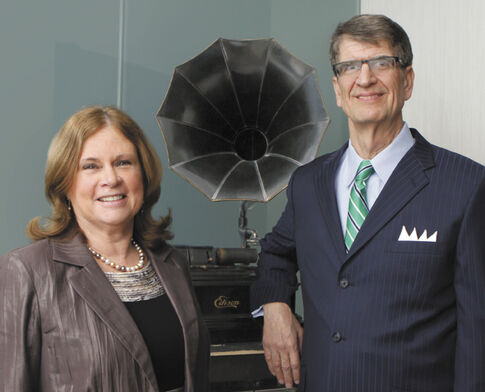
The “family foundation” name includes Eileen Martinson, who also serves on the board of the TESC Foundation. The Martinsons first became interested in Thomas Edison State College’s distance learning program to reach adult learners in 2002.
Unlike Thomas Edison (who was born in Ohio in 1847), John Martinson is from New Jersey, Franklin Lakes, where his father was a railroad industry executive. According to U.S. 1, Martinson majored in aeronautical engineering at the Air Force Academy, and then joined the Air Force as an officer. Martinson flew more than 500 combat missions over North Vietnam during the war, including reconnaissance, electronics countermeasures, and transport missions with a record that earned him the Distinguished Flying Cross. His cargo plane was the third-to-last to fly out of Saigon before the city fell.
Martinson made his first investment when he was in the Air Force Academy. It was a small real estate company that eventually became Re-Max.
When he returned from Vietnam he earned a master’s in astronautics from Purdue with the goal of becoming an astronaut, but he was disqualified for being too tall (he’s 6’). After a friend taught him about venture capital, Martinson joined a company called Innoven, based in Saddlebrook, which invested in high-tech companies. He later worked with Exxon Enterprises, flying to the West Coast and the Boston area, where most tech companies were located.
But he had a revelation. “I realized the New Jersey area, where I’d grown up, was largely untapped in the venture world, and ironically, it still is today,” he says.
Using research and partnering, rather than takeovers, Martinson’s Edison Ventures (now Edison Partners) positioned itself for the long growth. “We try to think ahead, and think about what market segments we would like to be in, understand the dynamics of that industry, see which companies fit our criteria and time frames. Then we reach out to those companies and try to understand the early leaders in that segment, and try to build relationships with them before investing.”
New Jersey native Eileen Martinson serves as president and CEO of Hamilton-based Sparta Systems, a global firm that provides enterprise quality management solutions. Sparta’s main product is TrackWise software, used to reduce risk, manage compliance, and improve safety.
Sparta Systems is a private company backed by venture firms Summit Partners and Altaris Capital Partners. In 2011 the firms brought Eileen Martinson aboard as CEO. Prior to that the daughter of an advertising executive and stay-at-home-mother was COO of Allscripts, a clinical software company.
The exhibition in the new Center for Learning Technology building is an additional attraction to West State Street and joins a concentration of sites that brings together segments of American history.
Other attractions include the 1757 Old Barracks (a building that figured in the Revolutionary War), the New Jersey State House (the second oldest in continuous use in the nation), the New Jersey State Museum (with historical and art collections that span the state’s history), and, most recently, Petty’s Run (the industrial archaeology site that includes the only example of Colonial-era steel industry in North America).
Additionally, the Trenton collection joins several other New Jersey locations that commemorate the inventor who came to New Jersey in 1868. That includes the National Park Service designations of his home and studio in West Orange and the Menlo Park tower that also houses a collection.
Alexander B. Magoun, author, outreach historian of the IEEE History Center at Stevens Institute, and former curator of the David Sarnoff Collection, says that “John and Eileen Martinson are to be commended for their generosity and public spirit, and we should all look forward to the presentation of their collection at Thomas Edison State College. Hopefully the exhibits will encourage visitors to compare the ingredients of successful innovation 100-plus years ago with what is required today.”
,