In the woods of Hopewell, industrial artist Sean Mannix works his magic
Metalworking. Plasticworking. Woodworking. Glassworking. Sean Mannix does it all. He designs everything from sneakers and bookcases to complex machinery used in hospitals to classified government projects.
“Everything that’s made is designed,” Mannix says. “Everything is. I like picking up something every now and again. You can look at it and say, ‘They made it this way, there’s telltale marks on it from this kind of tool.’”
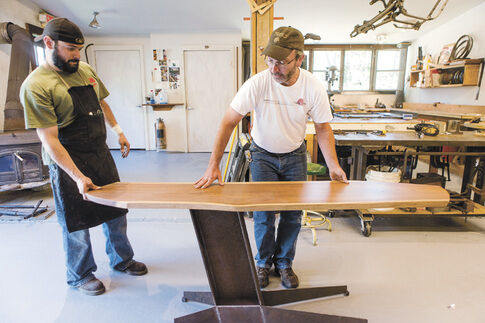
Mannix is the proprietor of Highland Design Farm, a contemporary design and fabrication studio tucked away in the woods of Hopewell Township, on the former property of Highland Poultry Farms. He is an industrial designer, custom furniture maker and all-around problem solver.
Mannix designs and builds things, or gets them built. If he doesn’t know how to do it, he probably knows who does. And if no one knows how to do it, he may be the best person to figure it out how it ought to be made. Lottery ball mixers. Insulin injectors. Baby incubators. He’s worked on them all.
In college, Mannix thought he was going to be an illustrator and a painter. That was until he met someone whose artistic skills knocked him out. “And that’s when I went into industrial design,” he said one day in the fall, in a phone interview.
His final portfolio presentation at the University of the Arts, in Philadelphia, was entirely hand illustrated. There was no computer rendering when he was in college.
“I had to mock up a newspaper ad—I had to be able to draw Times New Roman bold by hand, 8-point type, with a pen,” he said. “It was a different teaching back then. Naturally, it’s all been replaced by (Apple) Macs.”
Comfort and ergonomics are important considerations in his work. So is visual appeal. So is craftsmanship. In the course of a conversation with Mannix about his work, he might mention dozens of projects, all seemingly unrelated. Sometimes he’s working with new materials, or trying to discover new ways to use old materials.
Yet he’s not a mass manufacturer. He has his studio, but that’s mostly where he figures stuff out. Whatever he designs, if it is to be produced, will usually be produced elsewhere. Mannix’s specialty is the prototype: sketches becoming scale models. On a job he can spend weeks simply learning how materials behave in certain conditions. He determines if perhaps carbon fiber would be best for this project. Or perhaps goatskin.
In a world where companies prize efficiency as much as almost anything, Mannix resists standardization. He works with modern tools if he must — or at least, works with someone who will work with them. But he is someone who learned things the old way, and learned from people who learned things the old way. He is analog, not digital, if such terms can be applied to people.
For Mannix, it’s not a question of whether to use computers on a project, but when. Where some today render complex models on computers and then test them in theoretical environments, Mannix likes to work with physical objects: test different patterns on the soles of tennis shoes, say, but on actual soles made of actual materials. He can do two-dimensional computer-aided design, but he still likes to sketch by hand. He figures he can figure out the engineering if he works a problem long enough.
“By trying to do early conceptual work on a computer, you can’t think. File names, file size — you’re not thinking about what you’re designing, you’re thinking about the machine,” he said.
3-D printing is a hot technology, so he’s got guys who have got 3-D printers. But those are useful deeper into a project, once the challenges and problems have been largely identified. Before there is a prototype, for Mannix, there is research. If he’s working on a device that would be used in hospitals, he tries to figure every angle before he gets too deep into the process.
“We interview the doctors and nurses. We find out what they want to accomplish. We find out if there’s anything new coming out that we can create a game-changing design for,” he said. “It’s broad, but that’s industrial design.”
For someone who works on million-dollar projects on a regular basis, Mannix is down to earth. He has one full-time staff member, a 1,200-square-foot office and a 3,500-square-foot studio. The former chicken coops on his property have been converted into studios, which he leases to local artists.
In 1986, just out of college, he took a job in a model-making shop in Pennsylvania. Clients would go in with a toy design — say a vehicle with plastic wheels — and Mannix would model it. The first model might be made from a block of foam. Then they’d make castings. Then the first working toy.
He left that job and started working on Broad Street in Hopewell with Tom Johnson, a man who did work for Head racket sports. Johnson, it would turn out, was a kindred spirit. “Really, if I have a mentor, he’s one of them,” Mannix said.
They did the racket graphics for Head — developed the corporate identity, designed brochures and posters. But they also designed sports bags and tennis footwear.
And Johnson did other work as well. He was designing everything from computer housings to gas pump nozzles. Mannix saw the way working on one project could help a designer think differently on another.
“There’s things I get from (designing) footwear that I can use making furniture,” he said. “There’s things I learn making medical devices where I can use those (techniques) somewhere else. I was a good student of DaVinci and Michelangelo, and those guys could do everything. They weren’t just artists or sculptors. They did weapon design, vehicle design. That always seemed more intriguing. I like being involved with the whole thing.”
After Head closed down, Mannix worked on a free-lance bases for Prince sports, out of Lawrence, for about 5 years. From there he went on to building architectural models for other designers. “I was running my own show, bouncing around,” is how he summarizes that time. He went back to school to get a master’s degree, then changed his mind and did a full-time stint with Prince, from 1991 to 1996.
Prince was one of several points in Mannix’s career when he had a chance to settle into the corporate world. But it never took. He never wanted a job where he did the same thing over and over.
“I saw too many people becoming specialists,” he said. “I have friends, or other designers that I’ve met, that they’ve only ever done bicycles for 26 years. If they have to design a kitchen cabinet, they’re lost.”
At one point, Nike asked him to become their global brand manager for soft goods. He talked about it with wife Kelley, to whom he’s now been married for 17 years: he’d be away two or three weeks every month. The job would have been lucrative, but was it worth it?
He didn’t take the job.
“If you sell your soul to the brand, that’s how you make lots of money,” he said. “I’m having fun, but I’m not making that kind of money.”
He settled down locally, with Team Edge Product Development, just over the river. He was in the midst of a six-year stint, with an onsite studio, when his father, Bill, passed away. The next year, he and Kelley sold their Titusville house and moved onto the Highland Design Farm property with their daughter, Jillian, and his mother, Jean. He got the property zoned commercial, left Edge, and set up shop in the Sourlands.
It was a return home of sorts for Mannix, who graduated from Hopewell Valley Central High School in 1982. He was born in Princeton, but grew up until the age of 14 in Lower Makefield, Pennsylvania.
When he was 14, his grandmother died, and his family moved back to the house they inherited on Moores Mill-Mount Rose Road. His grandparents from both sides are from here.
In recent years, Mannix has become involved in Hopewell’s Tour des Arts, an annual self-guided art tours. The studios on his property are one of the stops on the tour.
The buildings on the property have been standing since 1940’s, but a previous owner converted the chicken coops to 15 studios in 1975. Some of the artists have been working on the property for 20 years or more. Mannix joked that he is in some ways the new kid on the block. He said his daughter and her friends have fun hanging out with all the painters and the wood turners.
Looking back, he sees the way his time spent with Tom Johnson shaped the serpentine path that is his career.
“Tom Johnson always adapted his career to his life. He never adapted his life to his career,” Mannix said. “That really stuck with me. When I was at Prince, I saw a lot of resumes. They all said the same thing. Head, Wilson, Prince, Adidas, Ektelon. All worked the same places, just in a different order. All these guys did was uproot their families every 3–5 years, became corporate vagabonds.”
Mannix calls his work “dynamic,” by which he means the work is always changing, always challenging. Once upon a time, it meant that he frequently changed jobs, going from contract to contract. Today it means that one factor determining whether he’ll take a job is whether the job presents technical challenges worth overcoming.
“It’s always a challenge. I don’t want to do the same thing twice. It’s not the growth I want.”
On the Web: highlanddesignfarm.com.
,

