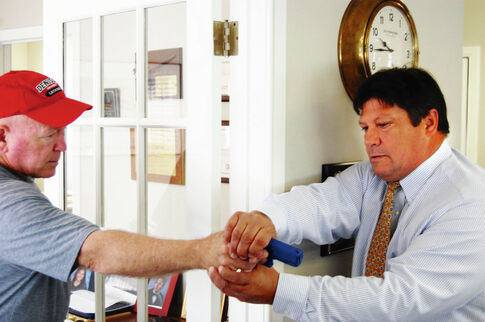
Hamilton resident Glenn Stanton, a retired FBI agent, acts as an armed intruder, as his partner, Hamilton resident Mike Taylor disarms him.
Retired agents use history to prepare school employees for the worst-case scenario
Retired law enforcement agents Glenn Stanton and Mike Taylor sat in the kitchen of Stanton’s Hamilton Square home, and knew they had to do something.
In the wake of the Sandy Hook school shooting, the pair set out to find a way they could use their experience to prevent tragedies—such as the December 2012 shooting that left 20 students and six teachers dead in Newtown, Conn.—from recurring on such a large scale.
The two Hamilton residents, who met more than 30 years ago on the Princeton police force, have extensive law enforcements backgrounds—Stanton served with the FBI for 27 years, including a stint as the Principal Firearms Instructor and the Head Sniper of the New York SWAT team, and Taylor served as a Naval Intelligence Agent with the NCIS and as a protective servant for military and government dignitaries, including President George H. W. Bush.
After some brainstorming and nearly three months of planning, the duo unveiled Point:Safety Education, an education and training program that prepares teachers and other school personnel to effectively react to and manage firearm threats within a school environment. The program is intended to work as a supplement to a school’s emergency plan, but the former officers’ training system goes beyond the gray lines of “fight or flight.”
“Nobody gives [teachers] the worst-case scenario,” Stanton said. “What if the gunman comes into the room? What do you do now?”
These are the exact questions that Stanton and Taylor aim to tackle in their six-hour seminar sessions that include firearm education, emergency situation management and an intimate look at the patterns of behavior in three of the most chilling school shootings in the country’s history.
“We looked at the big three shootings—Columbine, Sandy Hook and Virginia Tech—and some of the things that happened there were kind of scary and really a shame because people were uneducated and made uneducated decisions,” Taylor said.
The Virigina Tech shooter killed 31 people with two handguns in 2007. Stanton said the victims did not know how to respond to the shooter, and allowed him to walk right up to them. Instead, one strategy for people in that situtation would be to try to distract the shooter and make it difficult to get an accurate shot off.
“It’s impossible for me to aim accurately at you if everybody’s throwing stuff at me,” Stanton said. “We have to react to it, we would not make a good shot.”
Through decades of experience in law enforcement and high-risk situations, the program co-founders stressed that adequate training is key in making educated decisions in urgent situations.
“If you didn’t know what to do, and somebody came at you with a gun, you would just kind of freeze,” Stanton said. “If you don’t know what to do in a situation and you’ve never been confronted with that situation, there’s confusion and panic, and that’s what gives [gunmen] the time to act.”
With this in mind, Stanton and Taylor developed the ARM system, a three-part reaction plan for teachers and school personnel to follow in firearms-related emergencies. The system—which stands for assess, react and manage—is taught in each Point:Safety six-hour seminar through literature, practice and an exam, and culminates in a certification upon completion of the program.
At the end of each seminar, participants take home a booklet with an overview of the program, including a weapon disablement guide and Stanton and Taylor’s own self-tested ballistic data for standard classroom equipment like desks and books.
To keep training realistic, Stanton and Taylor created drills for teachers using airsoft and plastic guns as replicas of potential weapons an assailant could bring into a classroom.
“We go out of our way to point out, ‘there are no guns in this room,’” Taylor said, “because we’re not teaching a shooting class. We’re teaching how to defend yourself.”
Peter McClellan, who is the dean of students and a history teacher at the Peddie School in Hightstown, participated in a three-hour Point:Safety training session last spring along with about eight other members of the school’s security force.
“They taught us how to disarm guns, they taught us the capacity of different guns, they spoke about what people who are handling those guns would be thinking about when they came into a school, and they talked about the best ways to react to those people,” McClellan said.
Though the group has not completed the six-hour certification process, McClellan said he hopes that the force will be Point:Safety certified by the end of this year.
“With their expertise from the past and their very good presentation skills, they were able to convince us, teach us and perhaps even inspire us to be better custodians of people’s children,” McClellan said.
Stanton and Taylor have expanded the program to include a corporation-specific training program for office workers. To date, Point:Safety has delivered presentations and held seminars throughout New Jersey and New York, and the co-founders hope to eventually expand nationwide to school officials at all levels. In fact, they believe that aspiring teachers should undergo emergency training as a required college course.
Like any new business concept, Stanton said, Point:Safety’s biggest challenge is gaining traction, but Stanton and Taylor hope that schools understand the need for proactive emergency training in the light of recent school tragedies.
“If we were a lawn service, if your grass got high, you’d call us because you need the grass cut. Here, it isn’t an immediate necessity, so you’re trying to sell a concept that 95 percent of the people will never have to use,” Stanton said.
But like CPR, Taylor said, this training can make all the difference in a life-or-death situation.
On the Web: pointsafetyeducation.org.
,

