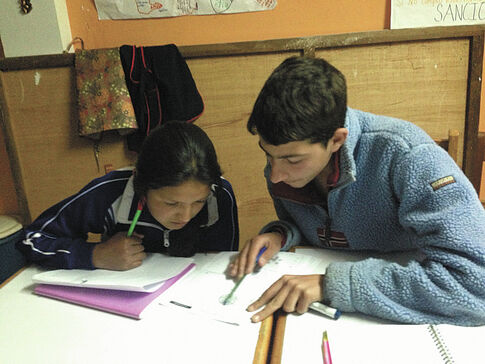
Menelaos Mazarakis, founder of the Princeton Peru Partnership, tutors Peruvian student Nohem Orihuela in math on his trip to Peru this summer.
Princeton High School student Menelaos Mazarkais founds the Princeton Peru Partnership Club to raise money for causes in Peru
By Cara Latham
To say that Princeton High School senior Menelaos Mazarakis is dedicated to making life better for many Peruvians living in poverty in the Andes Mountains would be an understatement.
Mazarakis has been to Peru every summer since his freshman year at Princeton High School when he, along with 19 other students, accompanied Spanish teacher Martha Hayden on a five-week trip to learn the culture and help the rebuilding efforts of a local school. The trip inspired Mazarakis so much that that he founded and has served as president of the Princeton Peru Partnership Club, a student-run organization that raises money for a number of causes in Peru.
“I was really impacted psychologically by the fact that in this area, most of the communities don’t have hot water; they don’t have electricity,” he said. “Here in the U.S., we take so much for granted. To see international communities have very little made me want to do something about it.”
Since then, Mazarakis has not stopped. To date, his efforts, along with those of the others in the group, have helped to raise tens of thousands of dollars — enough to be recognized with a series of accolades, most notably by President Barack Obama. The president awarded the group with a Gold Medal of Service, which honors students who are making a difference in their communities.
The idea for the fundraising efforts began after Mazarakis had a conversation with the town leader in his first trip to Taray, a town destroyed by a mudslide in 2009.
The leader, named Alonso del Rio, balanced his roles as a shaman, school director and father himself with the responsibilities of helping to lead the community. Del Rio took it upon himself to try to rebuild the local school.
While Mazarakis and his classmates participated in the efforts, he learned from del Rio that the government was not providing much support, and Mazarakis told him he would get a few friends together to raise some money to help.
Through a number of organized silent auctions, several dinners — consisting of a PowerPoint presentation, dinner, and entertainment provided by a student a cappella group — they ended up raising $15,000 in the first year. They decided not to stop there.
The next step on Mazarakis’s agenda was to expand the efforts to the local elementary schools beyond Princeton High School. He reached out to the principals at Johnson Park Elementary School and the Princeton Charter School to ask permission to give an assembly at the schools. Following approval and an assembly, Princeton Peru Partnership started a coin drive competition among the homerooms in each of the schools.
The following summer, Mazarakis returned to Peru to provide del Rio with about $10,000 of the $15,000 raised, as only $10,000 was needed to rebuild the school and stock the library.
Dan Black, a PHS graduate and current Davidson College student in North Carolina, who along with Mazarakis, founded the group, had also been inspired by Hayden’s class trip the year before Mazarakis. He said that watching Princeton unite for the cause to raise money in the following years was heart-warming.
“Most donors hadn’t been to Peru, or even South America, but were eager to open their wallets and express interest for a well-communicated cause in a part of the world that I love so much,” said Black. “This coming December, I will have the opportunity to visit the school that Princetonians built. Three years ago, when I was last in Taray, it was just a pile of rubble.”
Then Mazarakis and the group turned its attention to another cause two hours from Taray known as the Sacred Valley Project. The main goal of that group was to empower indigenous girls in the Sacred Valley through education so that they can serve their communities.
In that area, the girls would have to walk four to five hours a day to and from school, located in Ollantaytambo.
“All the communities in this area have access to elementary schools, but to have access to high school, you have to travel very far,” Mazarakis said.
To ease the burden for the girls, the project provides a dormitory where the girls can stay overnight five days a week.
Eventually, up to 30 female students will be able to forego traveling each day during the week to attend high school, and they can also obtain supplementary tutoring during their stay.
“You can only get to these communities by walking,” Mazarakis said. “Cars and motorcycles cannot even drive there. They are very narrow paths that have been there for thousands of years. I actually got to experience what these girls sacrificed on a daily basis … Just experiencing what they had to deal with their entire lives was really life changing.”
This year, Princeton Peru Partnership added car washes and bake sales to the fundraising efforts and sought other support from several local nonprofit groups and organizations. Among them were Princeton Tiger Tech, Amnesty International and Kids4Kids Music for a Cause, a local nonprofit that hosts benefit concerts every year performed by a piano teacher and about 25 students. The proceeds go to the selected charity.
This past year, Kids4Kids chose the Princeton Peru Partnership, and the performance featured a special guest — Priscilla Novarro, a renowned Peruvian pianist. She had won a competition to travel to Carnegie Hall to play, and she stopped to perform at the Princeton Peru Partnership concert before moving on to her big performance. Her participation alone raised $6,000 for the group.
With the extra money, the group gave about $15,000 to the Sacred Valley Project. The money will fund about 75 percent of the construction of the dormitory for the girls.
Because the levels of coursework are far more advanced than those that they completed in elementary school, it has been hard for the Peruvian students to keep up with the lessons.
“When they get to the dormitory, a lot of them are behind in most of their subjects,” said Mazarakis. “This year was the first year in which none of the girls failed their classes completely.”
The money will also partially fund a local panaderia (bakery) in the town.
“These girls will be able to bake bread, be able to manage their own small business, and sell their bread to the community,” Mazarakis said. “It will mutualize some of the costs that they have and help them learn the values of time management and business. It’s a practical tool for the future.”
Mazarakis traveled to Peru again this summer to participate in the project by managing international volunteer groups and overseeing construction as well as managing the Facebook page, blog, and other online activity.
Now with the remaining $5,000 they raised this year, the group is looking to start a new project, perhaps involving solar energy, as many are without power in the area.
“Our next step is to look at more efficient ways of fundraising, specifically online fundraising and crowdsourcing,” says Mazarakis.
He envisions the Princeton Peru Partnership to eventually grow into more than just a group that raises money to support other organizations. “I want to be one of those organizations that’s on the ground doing something.”
Despite being a dedicated student himself, Mazarakis continues looking for new ways he can expand the group’s work.
“It’s definitely really hard to balance doing Princeton Peru Partnership and doing schoolwork, but I’m just really motivated to take Princeton Peru Partnership to the next level,” Mazarakis said. “One thing I’ve been thinking about is taking a gap year before college so I can pursue developing PPP to the next level.”
A native of Greece, Mazarakis had experienced culture and customs in a variety places due to his parents jobs (his father works in private equity, and his mother is an architect).
He grew up in Mexico, lived in numerous cities before moving to Princeton in 2002, and is in the process of learning his fifth language, Arabic. In addition to English, he already speaks French, Spanish, and Greek.
“I would think that this multiculturalism and my experience with international relations gives me this different global perspective that allows me to be able to see these crises and projects in a different light because I don’t have a fixed mindset,” he said.”
Similar to Mazarakis, Black spent a few years of his life in Latin America (in Puerto Rico) and has been fascinated with the region ever since. His involvement with Princeton Peru Partnership has only strengthened his interests.
Also like Mazarakis, he wants to continue focusing on South America in his future, and is already taking the steps to do so. In addition to taking Spanish classes at PHS and his coursework in Peru and the Andean region in college, he is currently studying abroad in Peru through December.
“I’m considering law school but could end up heading in a completely different direction,” Black said. “Whatever I do choose as my career, however, I want to be able to do it in Spanish, or if given the opportunity, in Latin America.”
For more information on the Princeton Peru Partnership, visit www.princetonperupartnership.org.
,

