By Helen Kull
This month, I again leave our “namesakes” series to highlight an upcoming event of historical area interest. I promise to return to the series in future columns!
At 2 p.m. on Sunday afternoon, Nov. 10, in conjunction with Veterans Day, the Ewing Township Historic Preservation Society is featuring a talk by Ewing resident, historian and author Larry Kidder on the lives and service of the local militiamen who served in the Revolutionary war and are buried in the Ewing Church cemetery.
The illustrated talk will take place in Fellowship Hall, and then attendees will cross Scotch Road to enter the cemetery, and visit the graves of several of the veterans themselves. Please read the full details on this event in the article on page 3.
I thought it might be helpful to provide some background for those who plan to attend what promises to be a fascinating talk.
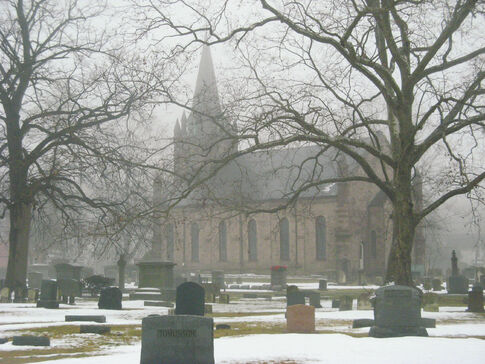
Ewing Presbyterian Church and its Cemetery, at the bend on Scotch Road, is undoubtedly the oldest continuously-existing entity in the township. Next March will mark its 305th anniversary — tracing its beginning to the signing of a deed in 1709 for just over an acre of land.
The land was purchased for five shillings from Alexander Lockhart by twenty men — local landowners — who purchased it for “their heirs and assigns forever.”
While the deed does not specifically state that its use was to be for burial ground, that was in fact the high ground’s immediate use: as a place to bury loved ones, and to gather for worship under the shade of two large oak trees.
It wasn’t until three years later, in 1712, that the first structure, a log cabin, was constructed to shield the itinerant preachers of the time and their local followers from inclement weather. Three structures would successively replace that log cabin, culminating with the stone structure built in 1867 which currently stands on roughly the same location.
Those early worshippers were many of the first settlers in what we now know as Ewing and its surroundings. Many of the deed signers had names which are still familiar in the area today: Scudder, Howell, Anderson, Hart, Sackett, Reeder and Reed, among others.
Other families would soon arrive as well, with the names Lanning, Green, Hendrickson, Hunt, Rose, Moore, Hough, Clark and more. Many of these people arrived from Presbyterian enclaves in Elizabethtown (Elizabeth), N.J., and other locations in East Jersey (near New York), or from similar enclaves on Long Island or Connecticut.
Others came directly from Scotland and England. Oftentimes it would be a second, third or fourth son arriving, having not received land by birthright, and setting out on their own to find unclaimed land to the west. While the area was not exclusively Presbyterian, a good number of early settlers in this area were of that denomination.
They lived and thrived in the area, making homes and settlements in the wilderness, and farming the fertile land. They started or contributed to commerce along and across the Delaware River, and the inland routes to and from Philadelphia, New York and points beyond. They founded churches and educational institutions (for example, the College of New Jersey, or what we know as Princeton University). They became active in government, industry and business. And they fought strongly for their beliefs and lives.
In England, Presbyterians were known as “dissenters,” or essentially “anti-monarchical” trouble-makers, disagreeing with the prevailing Anglican Church and its theology. So too in the American Colonies, as the 18th century progressed, mounting frustration and anger with the King was inflamed by the Presbyterians pressing for liberty and freedom, so much so that the war was sometimes referred to as the “Presbyterian Rebellion” by King George III.
So it should not be surprising that here in heavily-Presbyterian central Jersey, many local residents became active in the rebellion against the king. Men of all ages joined the cause, fought the good fight, and thirty-nine of them (or more) were laid to rest in the Presbyterian cemetery at the bend in the Scotch road.
Come listen to Larry Kidder speak about their lives and sacrifice on Nov. 10 at 2 p.m. at Ewing Presbyterian Church. I’ll see you there!
Do you have a Ewing story to share? Email Helen at ewingthenandnow@gmail.com
,

